Accra, Ghana’s capital, lies on the country’s southern coast, on the Gulf of Guinea. In 1877, it became the capital of the British Gold Coast, which won independence as Ghana in 1957. Its stories here are Nkrumah declaring Ghana free, Louis Armstrong and a woman with his mother’s face, W. E. B. Du Bois’s last home, an aeroplane coffin, and a cook who seized a castle.
1 Kwame Nkrumah declares Ghana free on the old polo ground
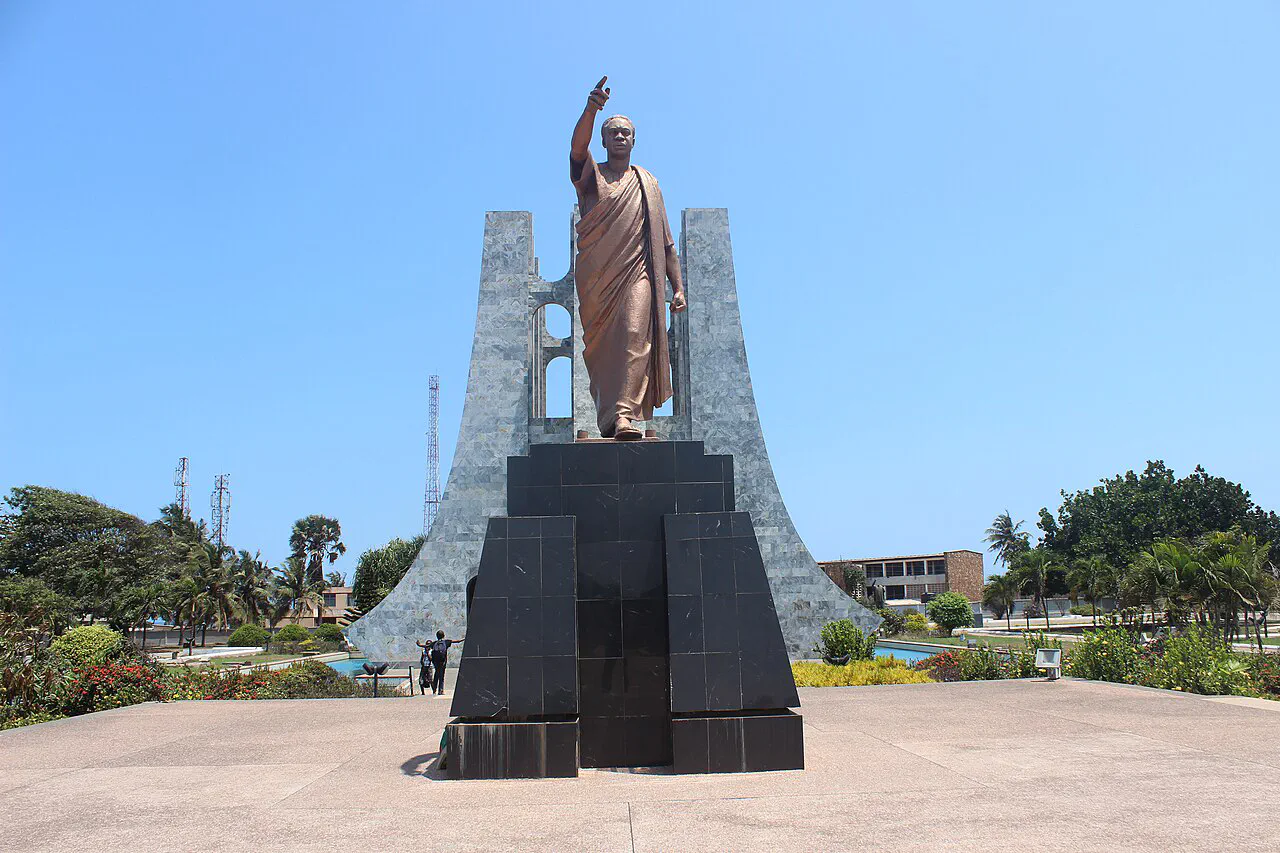
Stand here. The Kwame Nkrumah Memorial Park, downtown Accra, on the old colonial polo ground. His marble mausoleum, topped with a black star, holds his remains.
Kwame Nkrumah wanted the Gold Coast free of Britain. In January 1950, he called for “positive action”, and the unions began a general strike. Within weeks he was jailed with common criminals. But his party won the 1951 election in a landslide while he was still inside, and he came out to a rapturous welcome. Six years later, as 5 March turned to 6 March 1957, he stood on this ground before tens of thousands and told them, “At long last, the battle has ended! And thus Ghana, your beloved country is free forever.”
2 Louis Armstrong and his mother’s face in Accra
Stand here. The Kwame Nkrumah Memorial Park once more. Before the mausoleum, this was the old polo ground, where Louis Armstrong played in May 1956.
For two days in May 1956, Louis Armstrong was in Accra, and on this ground he played to more than 100,000 people. The crowd at the back had to be stopped from crushing the front. At the Opera Cinema, with the prime minister, Kwame Nkrumah, in the audience, Armstrong dedicated “Black and Blue” to him. But in Accra, Armstrong saw a woman who looked just like his mother, dead twenty years. “I came from here, way back,” he said. “At least my people did.”
Stand here. No. 22 First Circular Road, Cantonments. His former home is now the Du Bois Memorial Centre, with his grave in a shrine beside it.
W. E. B. Du Bois, the American civil rights activist and a founder of the NAACP, was 93 when he moved to Ghana. Ghana had invited him to manage the Encyclopedia Africana, and he worked on it in this house. But in early 1963, the United States refused to renew his passport, so he became a Ghanaian citizen. He died in Accra on 27 August 1963. The next day, at the March on Washington, a speaker asked hundreds of thousands of marchers to honour him with a moment of silence.
4 Kane Kwei’s aeroplane coffin in Teshie
Stand here. The Kane Kwei Carpentry Workshop, in Teshie, a coastal suburb near the airport. His grandson began running it with his own father in 2005.
Kane Kwei was a carpenter here, and his family says he made the first fantasy coffin. His grandmother grew up in Teshie, mystified by the planes overhead, and had always wished to travel abroad, but she never did. By the family’s account, when she died, he buried her in a coffin shaped like an aeroplane, so she could fly into the afterlife. Others trace the coffins to the shaped palanquins, or litters, that carried chiefs. But it was Kane Kwei’s coffins that went to Paris.
5 Asameni, the cook who seized Christiansborg Castle
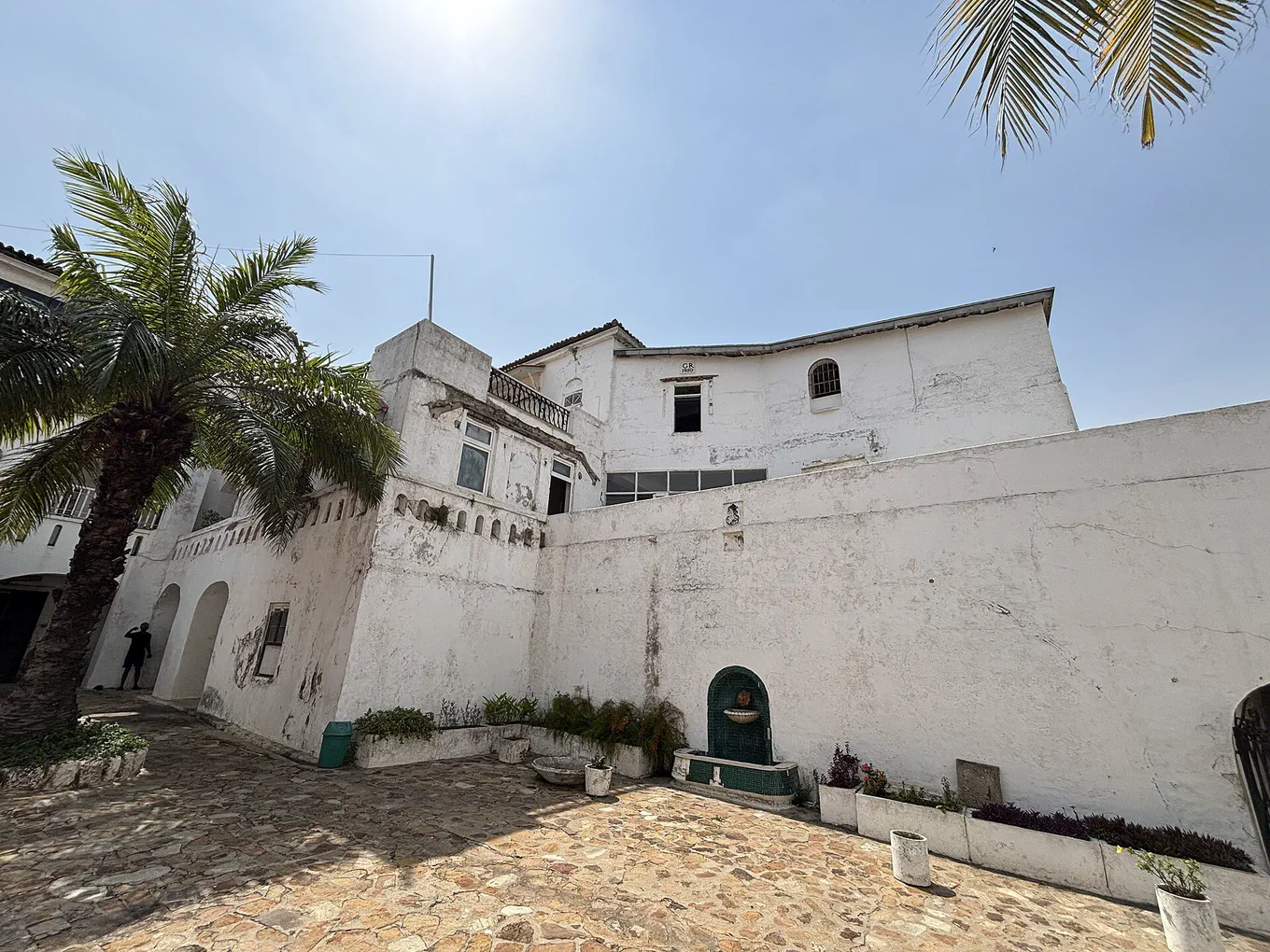
Stand here. Osu Castle, or Christiansborg, on the seafront. From 1902 it was the seat of government, until that moved to Jubilee House.
The Danes held this castle, but Asameni, a trader and warrior of the Akwamu people, wanted his people to dictate trade terms. Disguised as a cook and interpreter, he studied the traders who came. In June 1693, he told the Danes he was bringing Akwamu traders to buy ammunition. It was the custom to test goods first, so his men were handed ammunition, and they took the castle. Asameni put on a Danish governor’s uniform, and a year later he sold the castle back. He kept all 26 silver keys.
Pack nothing. Leave Friday.
Every Friday, I write a free letter, Journey, that takes us on a trip through places, stories, and ideas.
All God’s Children Need Traveling Shoes(Maya Angelou, 1986). A memoir, the fifth volume of Angelou’s autobiography, recounting the years she lived in Accra, where she found a job at the University of Ghana.
Children of the Street(Kwei Quartey, 2011). A murder mystery, the second featuring D.I. Dawson, about the serial murders of Accra’s homeless children. It concentrates on Old Accra, with one crime scene in the Agbogbloshie slum.
Changes: A Love Story(Ama Ata Aidoo, 1991). A novel set in modern-day Accra. Esi, a data analyst for the Department of Urban Statistics, divorces her first husband and marries into a polygamist union.
Films to watch before you visit Accra
An African City(Nicole Amarteifio, 2014). A TV and web series set in Accra, created as a Ghanaian equivalent of Sex and the City, following five single young women who have recently resettled there.
Azali(Kwabena Gyansah, 2018). A drama film set in Accra. Unable to have a baby in the compound, Amina goes to live on the city’s streets while a few weeks pregnant.
Soul to Soul(Denis Sanders, 1971). A documentary film. It is about the Independence Day concert held in Accra on 6 March 1971, in Black Star Square, now Independence Square.
Questions
Where is Kwame Nkrumah buried?
In the Kwame Nkrumah Memorial Park, in downtown Accra, on the old colonial polo ground where he declared Ghana’s independence. His mausoleum is clad in Italian marble, with a black star at its top for unity, and is shaped to recall an upside-down sword, an Akan symbol of peace. The park was dedicated in 1992.
What happened at Christiansborg Crossroads in 1948?
On 28 February 1948, Gold Coast war veterans marched peacefully to petition the Governor, because the pensions they had been promised weren’t paid. Police stopped them, and a British superintendent grabbed a rifle and fired at the leaders, killing Sergeant Adjetey, Corporal Attipoe, and Private Odartey Lamptey. It became a turning point on the road to independence.
Where is Accra, and when did it become the capital?
Accra is on Ghana’s southern coast, on the Gulf of Guinea, part of the Atlantic Ocean. In 1877, at the end of the second Anglo-Asante War, it replaced Cape Coast as capital of the British Gold Coast. It is now the capital and largest city of Ghana, which won its independence in 1957.