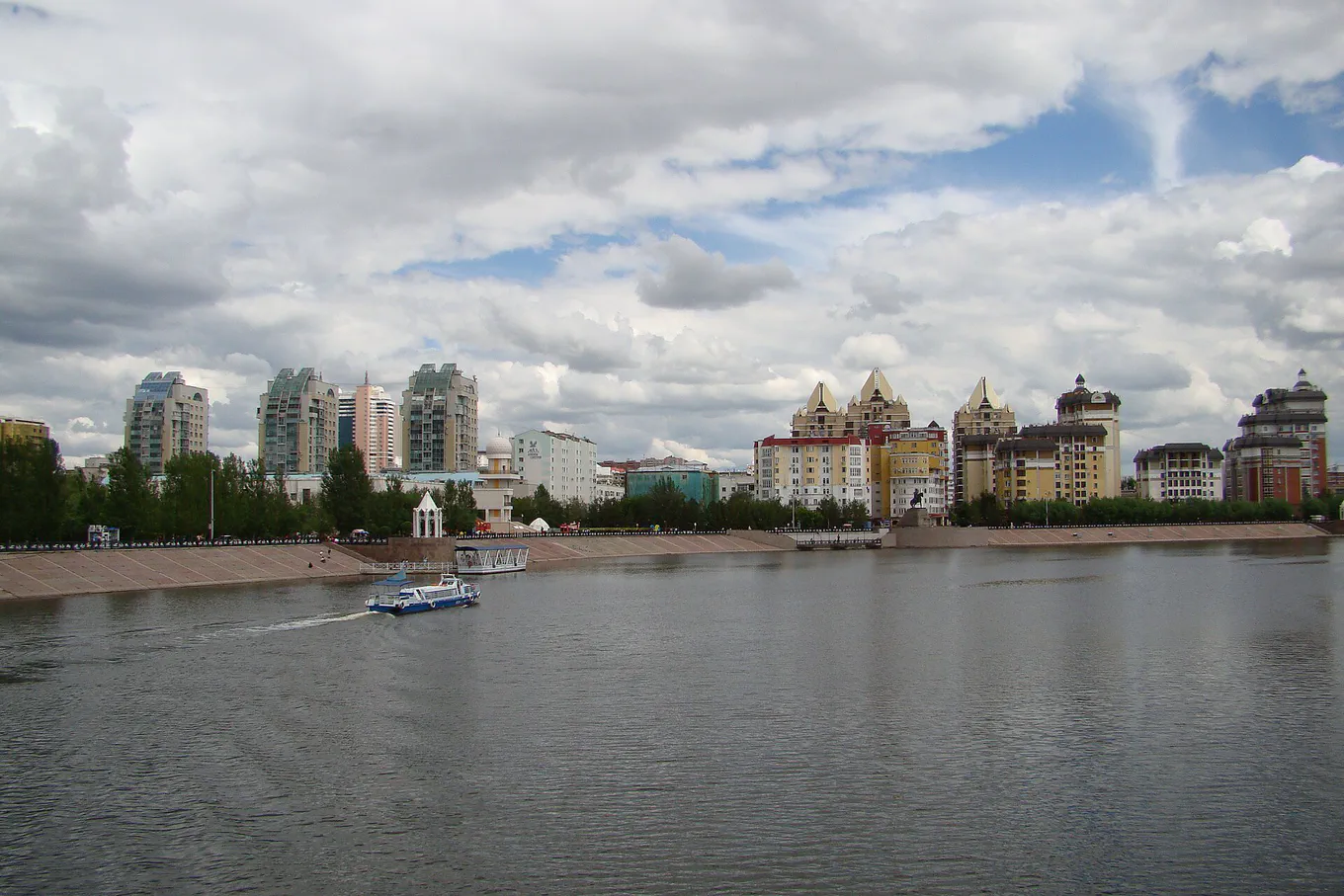
Astana stands on the Ishim river in the north of Kazakhstan. Founded in 1830 as Akmoly, it replaced Almaty as Kazakhstan’s capital on 10 December 1997, and the next May it took the name Astana, Kazakh for “capital city”. Its stories here are a khan whose men took its fort, a ballerina’s mother in a camp, Khrushchev’s palace, a pope after 9/11, and a golden handprint.
1 Kenesary Khan, whose men took the fort that became Astana
Stand here. The Kenesary Khan Monument, on a high bank of the Ishim. The 11-metre monument has been restored and re-erected.
Kenesary Kasymov, grandson of Ablai Khan, wanted Kazakh independence back, with an end to taxes and to the Russian forts. In May 1838, his men captured Akmolinsk, the fort on the Ishim, and it was burned. Kenesary, the last khan of the Kazakh Khanate, later died in battle against Kyrgyz chieftains, and sources suggest his severed head was sent to the Russians. Today his statue gazes out over the city that grew from the fort his men took.
2 Maya Plisetskaya’s mother in the ALZhIR camp outside Astana
Stand here. Near Aqmol, about 40 km west of Astana. The ALZhIR camp was demolished, and a museum stands behind the 18-metre Arch of Sorrow.
In March 1938, the secret police arrested Rachel Messerer, a film actress and the mother of the dancer Maya Plisetskaya. Her husband, a diplomat, had already been executed. The agents demanded she confirm he had been a spy and a traitor. She refused, and got eight years. She was sent to ALZhIR, the camp outside Akmolinsk for the wives of “traitors”, and Maya, facing an orphanage, was taken in by her aunt, a ballerina, and grew up to become prima ballerina assoluta of the Bolshoi. Rachel was released in 1941, three years into her eight.
3 Khrushchev’s palace for the Virgin Lands in Tselinograd
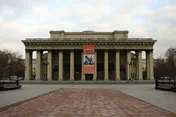
Stand here. The Palace of the Tselinniks, at 32 Kenesary Street. Built with 2,500 seats, it now has 1,600.
The Virgin Lands campaign was Nikita Khrushchev’s plan to boost Soviet farm output, and the city was its capital, renamed Tselinograd, “Virgin Land City”. After a visit, Khrushchev said Tselinograd needed a good palace for meetings. He got the Palace of the Tselinniks, built for events honouring the pioneers of the Virgin Lands, and it opened in 1963. The next year, he came back, and this time the meeting was held inside it. But the harvests had been falling for years. Within a year of the palace’s opening, his rivals had ousted him.
4 Pope John Paul II’s Mass in Astana, days after 9/11
Stand here. The Square of the Motherland, where John Paul II said an open-air Mass on 23 September 2001.
Days before John Paul II was due in Kazakhstan, the attacks of 11 September 2001 struck the United States, and his safety became a worry. The pope was 81. But the Vatican said cancelling had never been in question, and President Nazarbayev thanked him for coming anyway. At the open-air Mass, on an altar built in the shape of a yurt, about 50,000 people listened, many of them Muslims. He asked Muslims to join Christians in building a “civilization of love” that rejects violence and hatred.
5 Nazarbayev’s golden handprint and the city named after him
Stand here. The Baiterek tower on Nurjol Boulevard, with its observation level 97 metres up.
At the top of the Baiterek tower, visitors put a hand into a gilded print of Nursultan Nazarbayev’s right hand and make a wish. Nazarbayev, Kazakhstan’s first president, had moved the capital here and sketched the tower’s outline himself. In 2019, his successor had the city renamed Nur-Sultan in his honour. But after deadly unrest in January 2022, the same successor removed him from his remaining posts, and that September the name went back to Astana. Many of the deputies who called for the old name had voted for Nur-Sultan.
Pack nothing. Leave Friday.
Every Friday, I write a free letter, Journey, that takes us on a trip through places, stories, and ideas.
The Geopolitics of Spectacle: Space, Synecdoche, and the New Capitals of Asia(Natalie Koch, 2018). A study. Natalie Koch asks why autocrats build spectacular new capital cities, through an in-depth case study of Astana and reactions from the poverty-stricken Aral Sea region.
City of the Future: Built Space, Modernity and Urban Change in Astana(Mateusz Laszczkowski, 2016). An anthropological study of Astana’s development, through everyday practices, official ideologies, and the memories and dreams of longstanding residents and recent migrants.
Astana: Architecture, Myth & Destiny(Frank Albo, 2017). A non-fiction book offering a detailed analysis of Astana’s unique architectural style and the overlap between ancient Kazakh mythology and the city’s architecture.
Films to watch before you visit Astana
Altered(Timo Vuorensola, 2024). A science-fiction film. It was shot in Astana in autumn 2023, at sites including the Palace of Peace and Reconciliation, the First President’s Library, and the Nur Alem sphere.
Capital(Maxim Pozdorovkin, 2010). A documentary about the tenth anniversary of Astana, the utopian capital Kazakhstan’s first president built on the steppe, observed between dream and disenchantment.
Astana – My Love(Yermek Shinarbayev, 2010). A drama and melodrama from Kazakhstan and Turkey, in which young people meet in Astana, where the business interests of Kazakh and Turkish builders intersect.
Questions
What was Astana called before?
It began in 1830 as Akmoly, on the Ishim, and was later known as Akmolinsk. In 1961, under Khrushchev, it became Tselinograd, “Virgin Land City”. After independence in 1991, it was Akmola, then Astana from 1998, Nur-Sultan from 2019, and Astana again from September 2022.
Where is the ALZhIR memorial?
Near the village of Aqmol, about 40 km west of Astana. The camp itself was demolished in Soviet times, but the mass grave of women who died there remains, and a museum-memorial to the victims of political repression opened in 2007. The 18-metre Arch of Sorrow, a woman mourning her husband and lost children, stands at its entrance.
What does the Baiterek tower stand for?
It embodies a folktale in which the bird Samruk laid her egg in the crevice between two branches of a tree. The observation level is 97 metres up to mark 1997, the year Astana was proclaimed capital, and the tower follows an outline Nazarbayev sketched himself.