I played Byron in a college production of Tennessee Williams’ Camino Real. A small part, but you really get to hold the stage. And that last line as he leaves. Loved it. “This way…”
— Nick
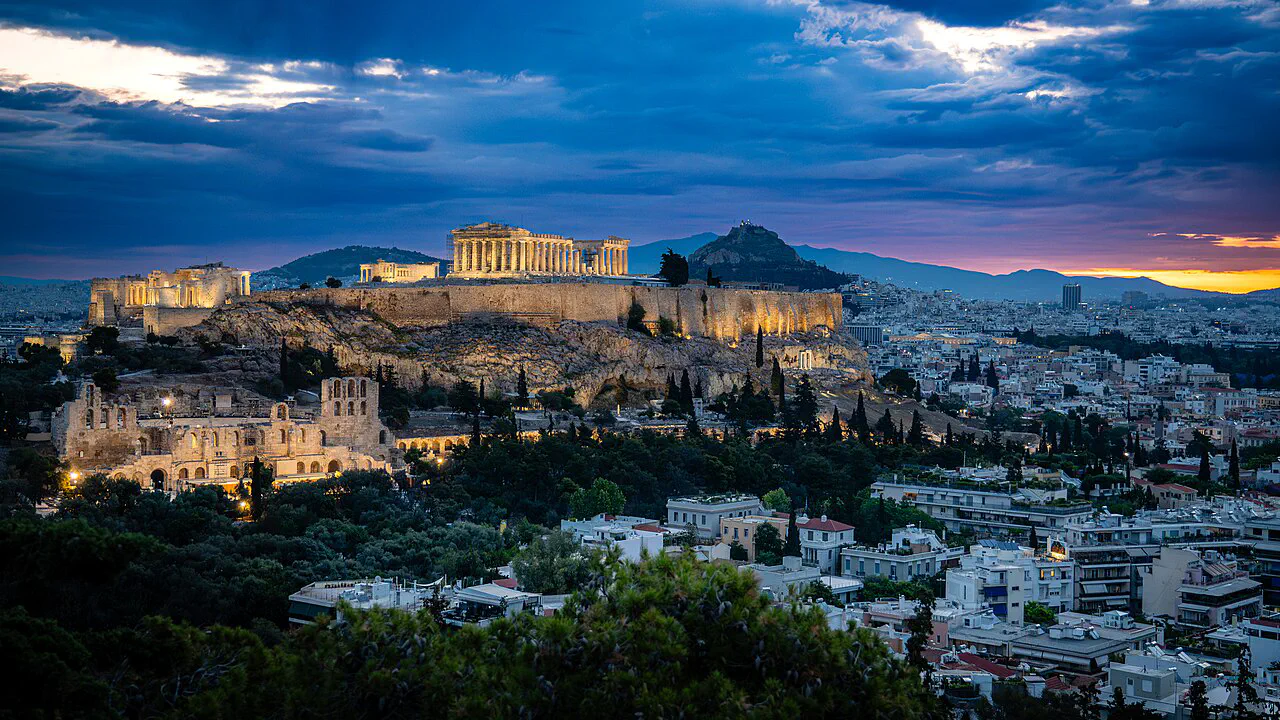
Recorded history in Athens runs back more than 3,400 years, but it became the capital of independent Greece only in 1834. It is now the country’s largest city, spread across the central plain of Attica. The five stories take in a philosopher who refused to escape, the evening the Parthenon blew up, a poet’s curse, a water carrier’s marathon, and two young men who tore down a flag.
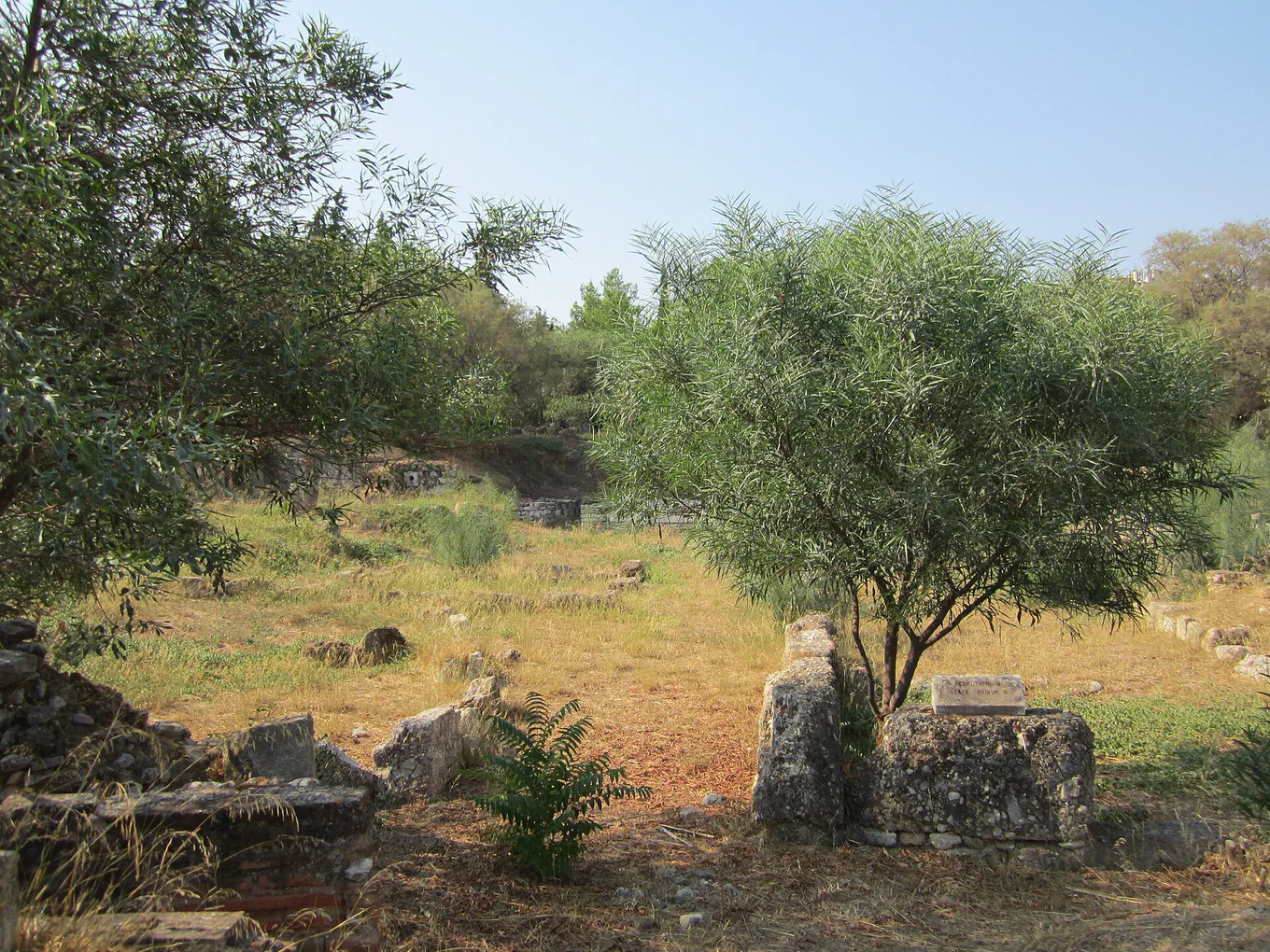
In 399 BC, Socrates was tried in a single day for impiety and corrupting the young, and a jury of hundreds of Athenians condemned him to death. A sacred voyage to Delos, when Athens executed no one, bought him time, and his friend Crito planned to bribe the guards and pay for his escape. In Plato’s telling, Socrates refused. To wrong the state, even in answer to an injustice, would be an injustice. He spent his last day in prison and drank the hemlock the next morning.
2 Morosini’s mortar and the evening the Parthenon blew up
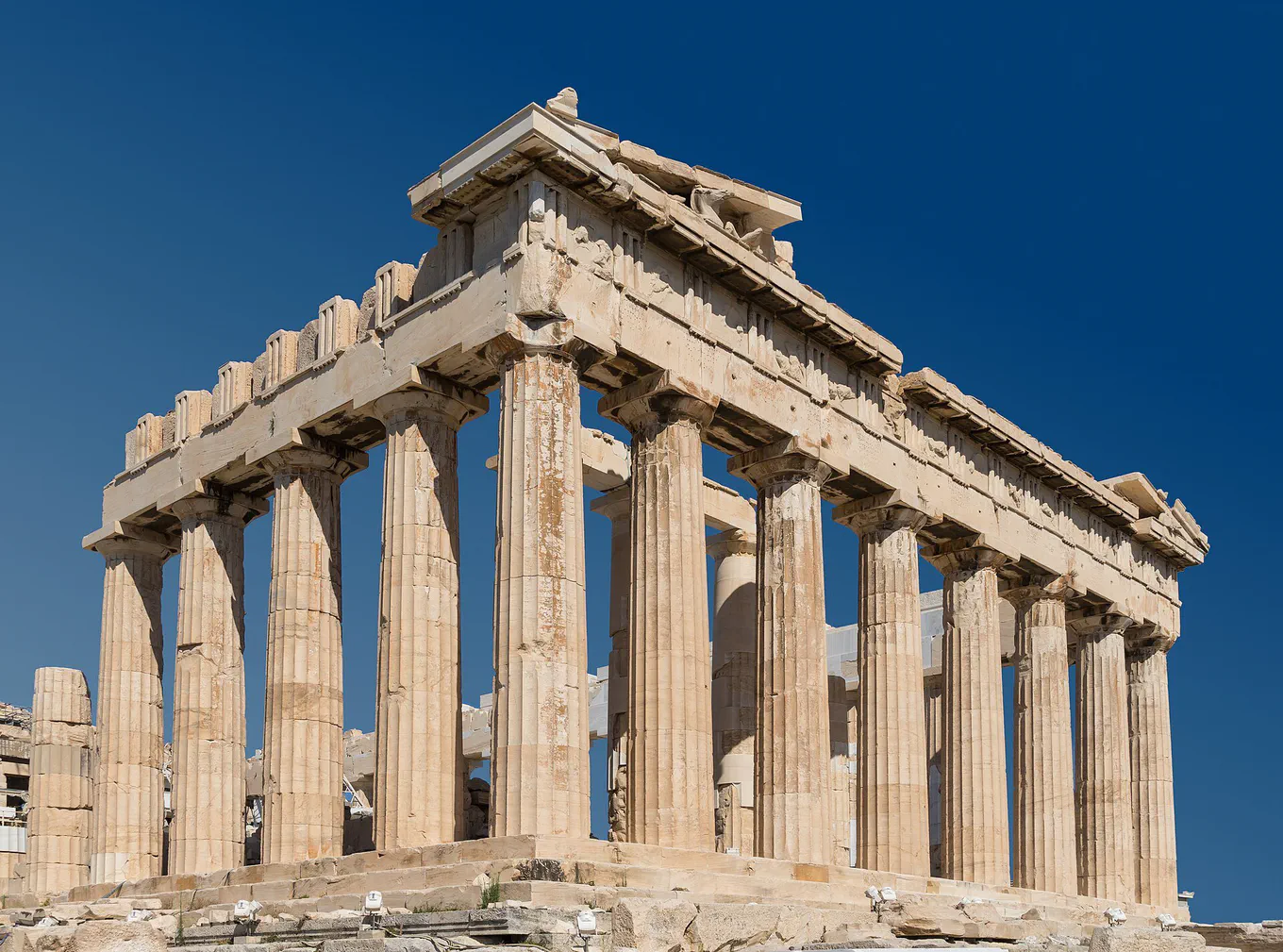
Stand here. The Parthenon, on the Acropolis.
The Parthenon on the Acropolis of Athens, seen close up from the south-east.Jebulon / CC0.
In 1687, the Parthenon still had its roof, and the Ottomans holding the Acropolis kept their gunpowder inside the temple. Francesco Morosini, a Venetian commander, laid siege. On 26 September, a mortar round fired from the Hill of Philopappos blew up the gunpowder, killing about 300 people and bringing down the roof. Morosini called it the “miraculous shot”. His men tried to take statues from the pediment as spoils, and the statues fell and smashed. The next spring, the Venetians abandoned Athens. In June 2026, that pediment was unveiled, restored.
3 Lord Byron curses Lord Elgin beside the Monument of Lysicrates
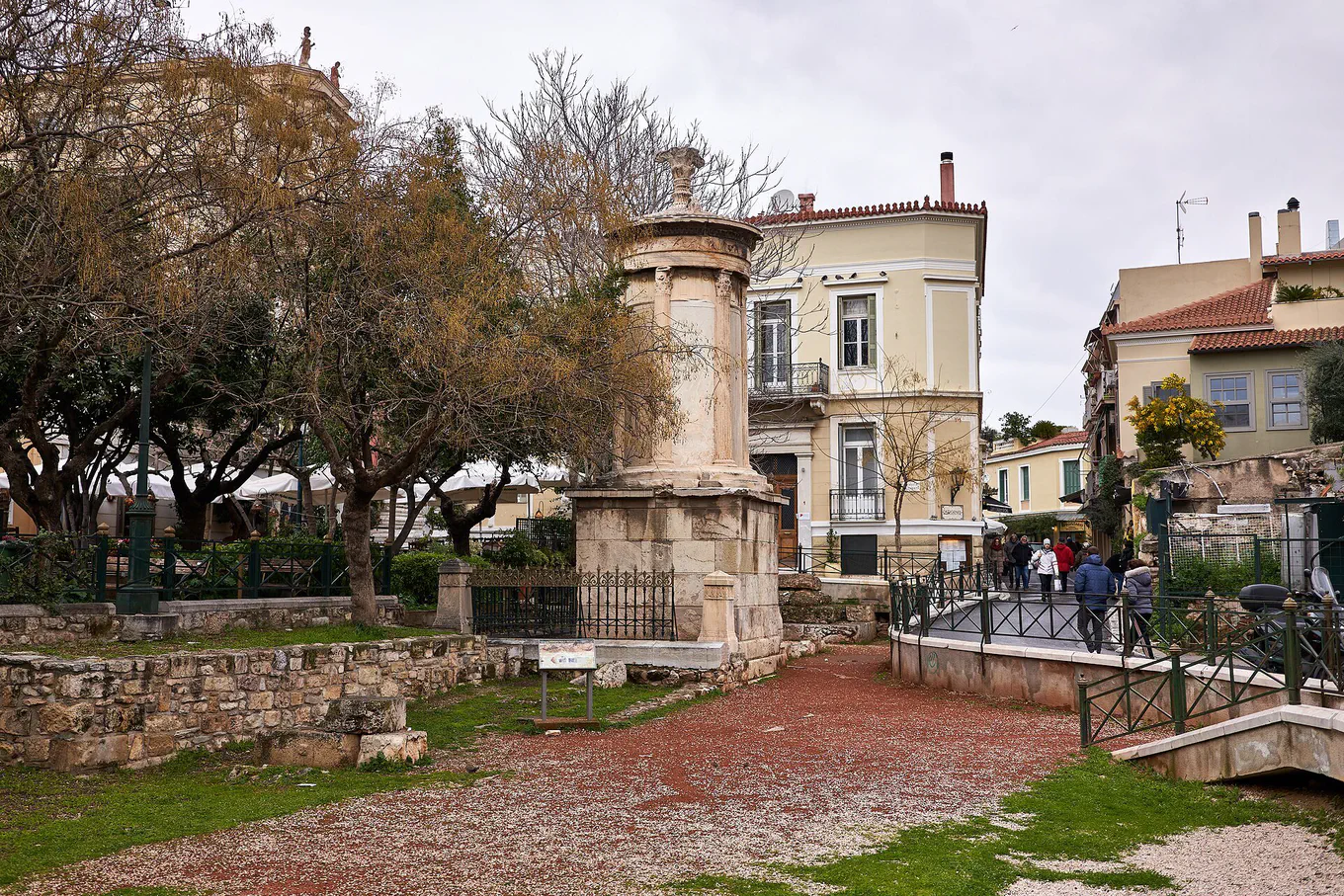
Stand here. The Monument of Lysicrates, built to mark a prize in 335/334 BC, in its little garden on Tripodon Street. The monastery beside it is gone.
Lord Byron, the Romantic poet, came to Athens on his Grand Tour. He lodged at a Capuchin monastery that owned this monument and used it as its library. There, on 17 March 1811, Byron wrote The Curse of Minerva, a scathing satire calling Lord Elgin’s removal of the Parthenon sculptures, now called the Elgin Marbles, plunder. Ten years later, in the Greek War of Independence, the Ottomans burned the monastery, but the monument survived. Byron joined that war and died of a fever, aged 36.
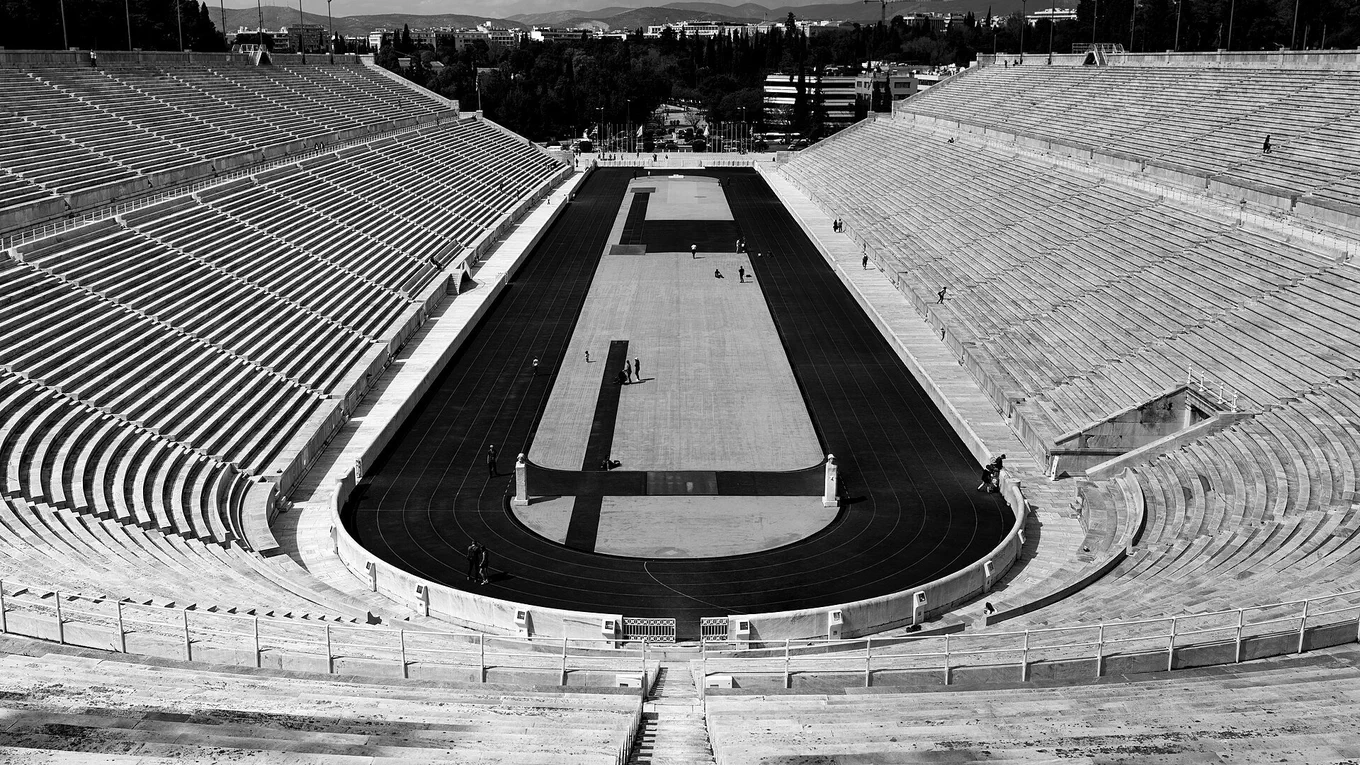
At the first modern Olympic Games, in 1896, no Greek had yet won a track and field event, and the public longed for a Greek to win the marathon, the race closest to their history. Out on the course, the Frenchman in the lead dropped out, and then the Australian who took over collapsed. Spyridon Louis, a water carrier from a poor family in Marousi, entered this stadium to cheers, and two princes ran the last lap beside him. He took home the carriage he had asked the king for.
5 Two teenagers tear the Nazi flag off the Acropolis
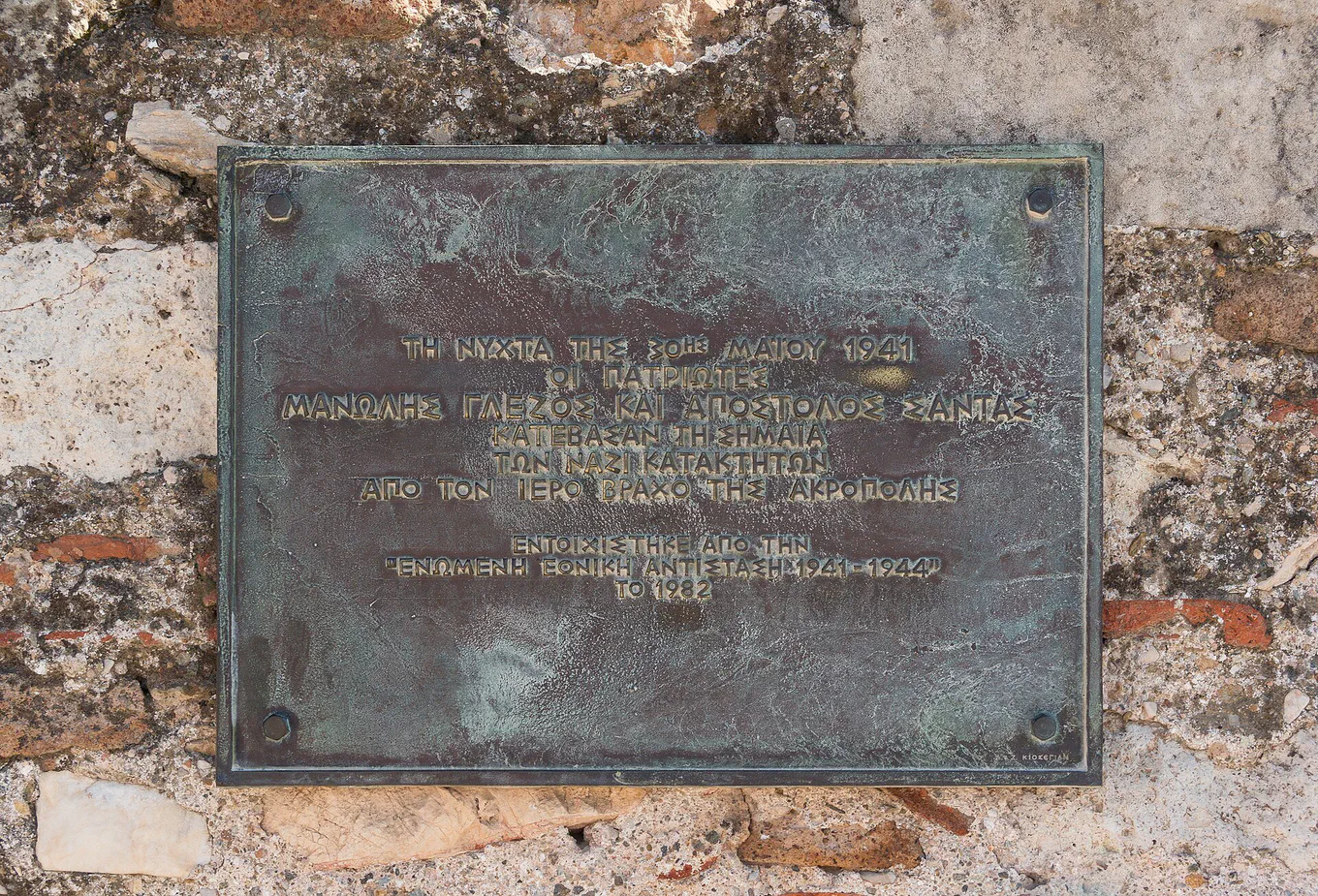
Stand here. The Acropolis, above the city. A plaque marks the spot where two young men climbed its walls one night in 1941.
The bronze plaque on the Acropolis of Athens honouring Manolis Glezos and Apostolos Santas.Jebulon / CC0.
Weeks after Nazi forces entered Athens in April 1941, the German flag still flew over the Acropolis. On the night of 30 May, Manolis Glezos, 18, and his friend Lakis Santas, 19, crawled up through a cave to avoid the guards, reached the flagpole, and tore the flag down. Each cut a piece from its black cross to keep, and they hid the rest in a ditch. Within hours, the Germans sentenced the culprits to death, without knowing who they were. Both lived into old age, Glezos to 97.
Pack nothing. Leave Friday.
Every Friday, I write a free letter, Journey, that takes us on a trip through places, stories, and ideas.
The Republic(Plato, c. 375 BC). A philosophical dialogue. It opens in Piraeus, Athens’ port, where Socrates meets Cephalus at the house of his son, Polemarchus.
The Last of the Wine(Mary Renault, 1956). A novel in which Lysis is killed in battle between the Long Walls that ran from Athens to Piraeus.
The Athenian Murders(José Carlos Somoza, 2000). A novel. A young man, Tramachus, is found on the slopes of Mount Lycabettus, apparently attacked by wolves.
Deadline in Athens(Petros Markaris, 1995). A novel. It takes in Omonoia Square and an immigrant vendor’s stall on Athinas Street.
Films to watch before you visit Athens
Never on Sunday(Jules Dassin, 1960). A film. Ilya, a free-spirited, self-employed prostitute, lives in the port of Piraeus.
My Life in Ruins(Donald Petrie, 2009). A film, the first from an American studio allowed to shoot on location at the Acropolis.
Questions
Can you see where Socrates was imprisoned?
Not for certain. His exact cell is unknown, but the ancient state prison lay about 100 metres southwest of the Heliaia court, just outside the Ancient Agora, where a building is tentatively identified as the prison. The “Prison of Socrates” on Filopappou Hill is only a traditional name for a building whose purpose is unknown.
Where are the Parthenon sculptures known as the Elgin Marbles?
About half the surviving sculptures were removed by Lord Elgin’s agents in the early 1800s and are in the British Museum in London. Greece formally asked for their return in 1983. The Acropolis Museum, opened in 2009 on the southeastern slope of the Acropolis, shows the Parthenon marbles on its top floor.
Where did the Athenian democracy meet?
On the Pnyx, a hill less than a kilometre west of the Acropolis, where Athenians gathered for their assemblies from as early as 507 BC. Speakers stood on the bema, a flat stone platform, and the hill’s fenced parkland can be visited free of charge at any time.