Winchester’s stories
Henry’s Round Table, Austen’s grave, Swithun’s rain, Lady Lisle’s window, and a diver in the dark.
Winchester has more stories than one page can hold. Start with Winchester’s stories, watch the films and TV set there, or settle in with the books below.
Winchester’s literature is mostly short and mostly true to a spot. Keats walked the water meadows and wrote an ode. Austen wrote, or more probably dictated, her last poem in College Street, three days before she died. Trollope seems to have drawn on real inquiries into the Hospital of St Cross, and Hardy brings his Tess to the city late in the novel.
Novel · Thomas Hardy · 1891
Romsey Road, from the Westgate up to the first milestone
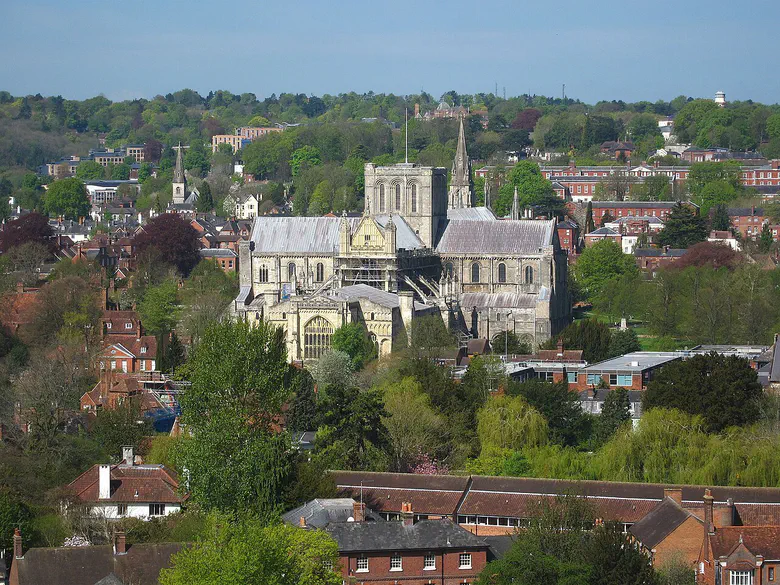
Hardy’s Wessex calls Winchester “Wintoncester”, and the city appears late in the novel. On a July morning, as the town clocks strike eight, two of its characters climb out of the city to the first milestone and look back over the broad cathedral tower and the pinnacled tower of the College. Walk from the Westgate up Romsey Road, then called West Hill, to the milestone inscribed “1 WESTGATE WINTON”, and you retrace their climb.
Novel · Anthony Trollope · 1855
Hospital of St Cross
The first Barchester novel turns on a quiet scandal. Is the meek Septimus Harding paid too much as warden of Hiram’s Hospital, an old almshouse for twelve men? It seems to draw on the Reverend Henry Holloway’s 1849 inquiries into the Hospital of St Cross, whose Master, the Earl of Guilford, was thought to draw more than £2,000 a year. Read it, then ask at the Porter’s Lodge for the Wayfarer’s Dole, still a small horn cup of ale and a piece of bread.
Poem · John Keats · 1820
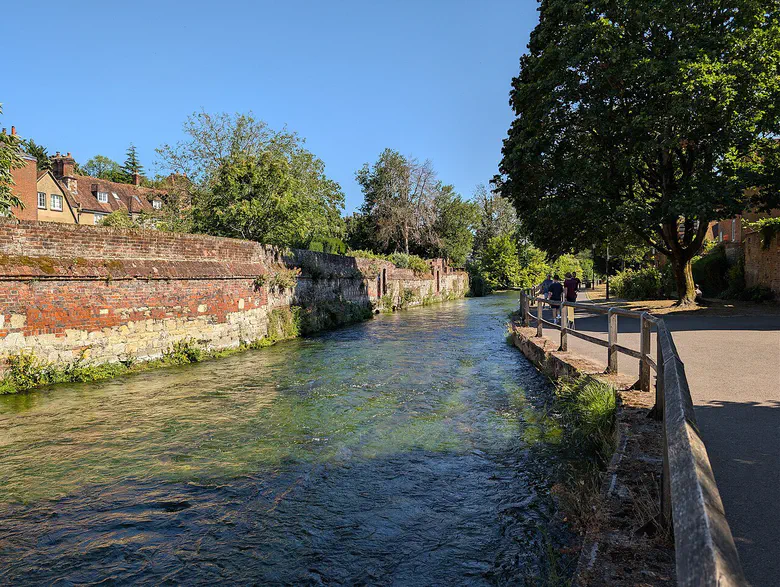
College Walk and the water meadows to St Cross
Keats wrote it on 19 September 1819, after a Sunday walk out of Winchester, and two days later told a friend, “I never lik’d stubble fields so much as now.” The usual route runs from the Close down College Walk and through the water meadows to St Cross, along what is now called Keats Walk. In 2012 three scholars argued that St Giles’s Hill, on the city’s eastern edge, shaped the poem more than the meadows did. Read it, walk the two-mile round trip, and judge.
Poem · Jane Austen · 1817
College Street, where she lodged
Three days before her death, while lodging in College Street, Jane Austen wrote, or more probably dictated to Cassandra, a comic poem headed “Written at Winchester on Tuesday the 15th July 1817”. That was St Swithun’s Day. It teases the townspeople for going to the races on Worthy Down instead of honouring the saint, and plays on his forty days of rain. Read it before visiting the cathedral, which holds her grave and the site of his shrine.
Henry’s Round Table, Austen’s grave, Swithun’s rain, Lady Lisle’s window, and a diver in the dark.
Winchester’s cathedral and almshouse stand in for the Vatican, Westminster Abbey and Hampton Court.
Every Friday, I write a free letter, Journey, that takes us on a trip through places, stories, and ideas.
Unsubscribe whenever you like. See my privacy policy.