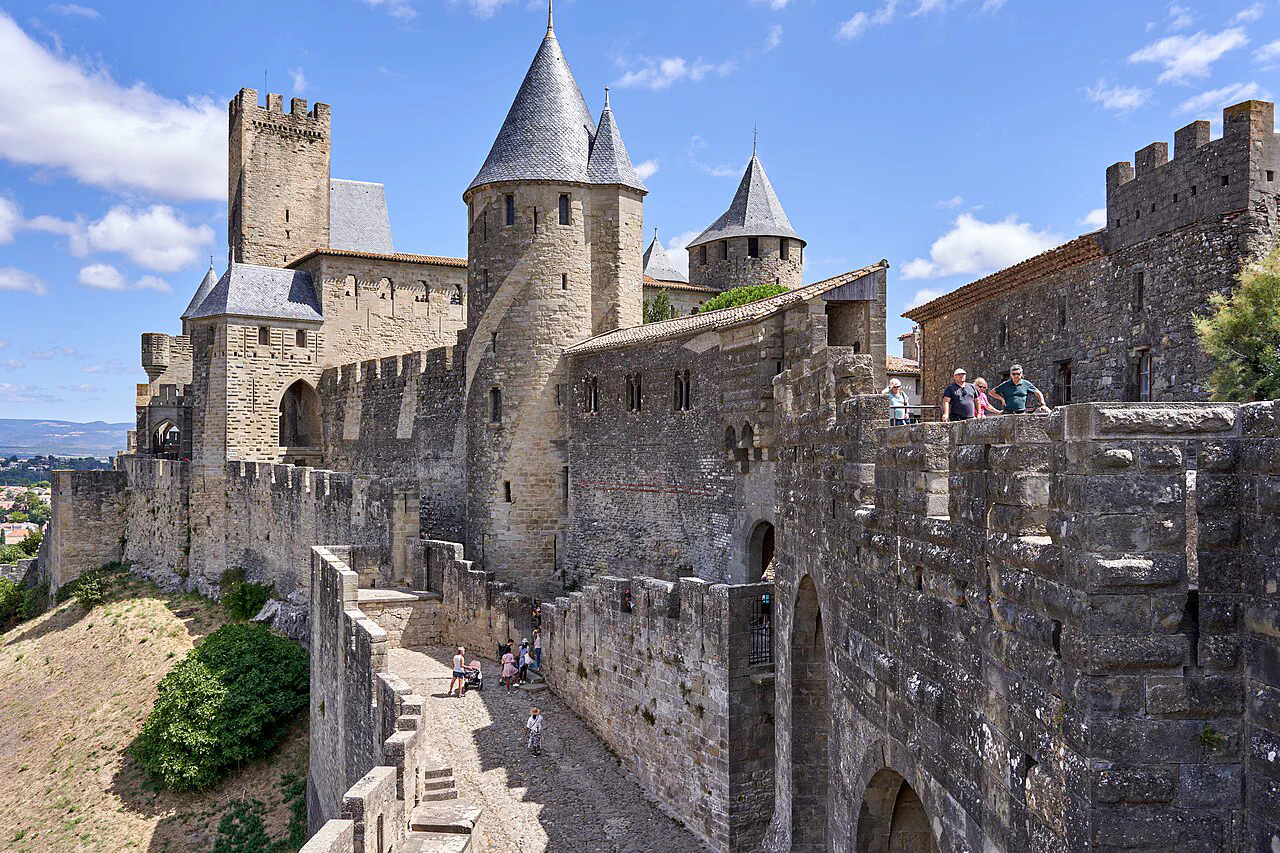
Robin Hood: Prince of Thieves famously gets from the white cliffs to Nottingham by way of Hadrian’s Wall in an afternoon. It turns out Nottingham Castle was in the south of France as well, played by the walls of Carcassonne. I loved that movie, but its geography was really screwed up.
— Nick
Carcassonne is the prefecture of the Aude department, in Occitania, southern France. Its medieval Cité, ringed by double walls with 52 towers, stands on a hill above the river Aude, and Louis IX founded a new town across the river. The stories here are a princess and a pig, a viscount who gave himself up, the man who saved the walls, a poet’s shuttered room, and a novelist’s tiny house.
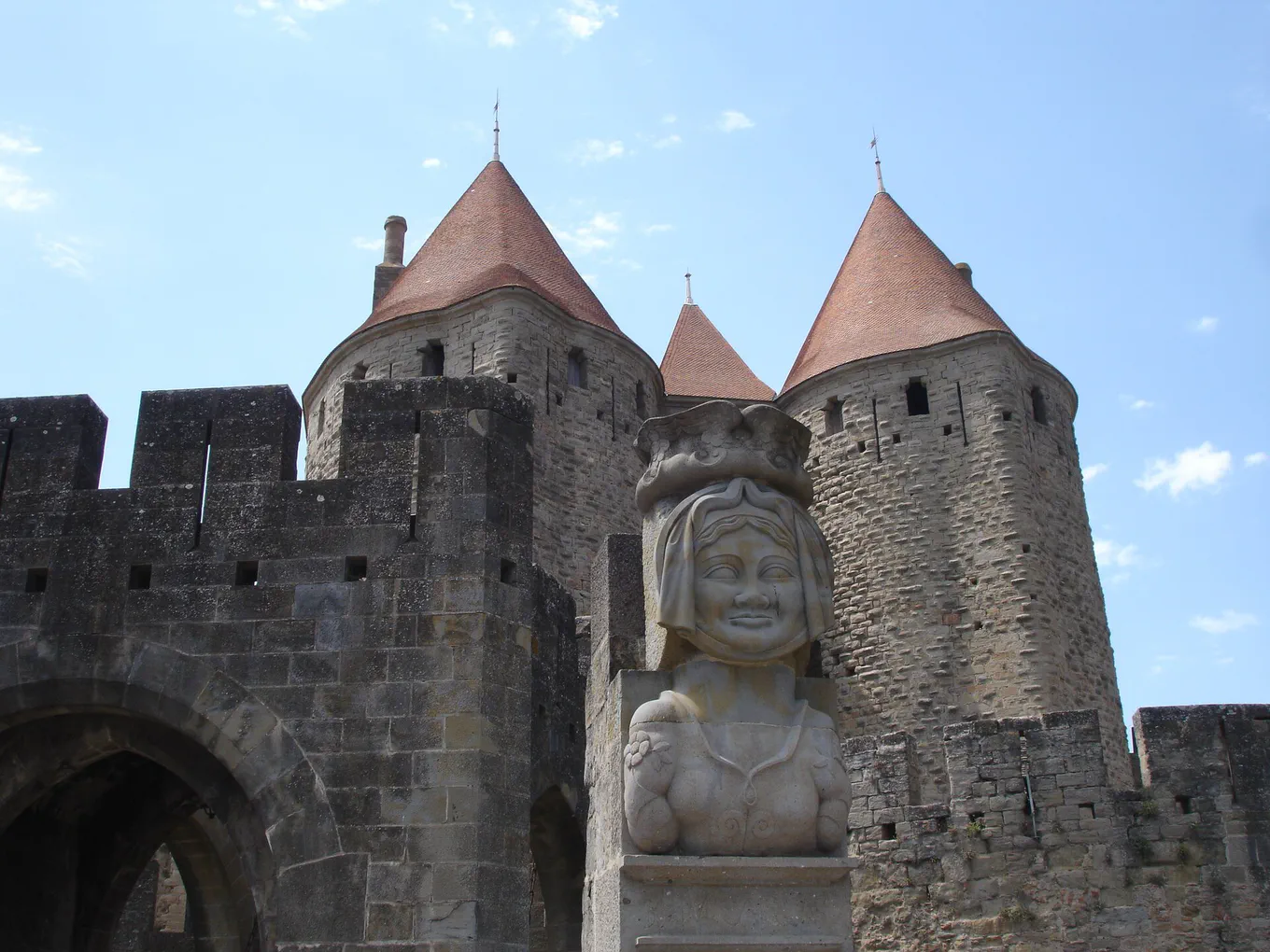
The story goes that Charlemagne besieged Carcassonne for five years, while Carcas, a Saracen princess, ruled its knights. Villagers brought her a pig and a bag of wheat. She fed the wheat to the pig and threw it from the highest tower. Then the cry went up, “Carcas sonne!” But Charlemagne’s father had taken the city in 759. There was never a siege for her to break.
2 Raymond-Roger Trencavel gives himself up at Carcassonne
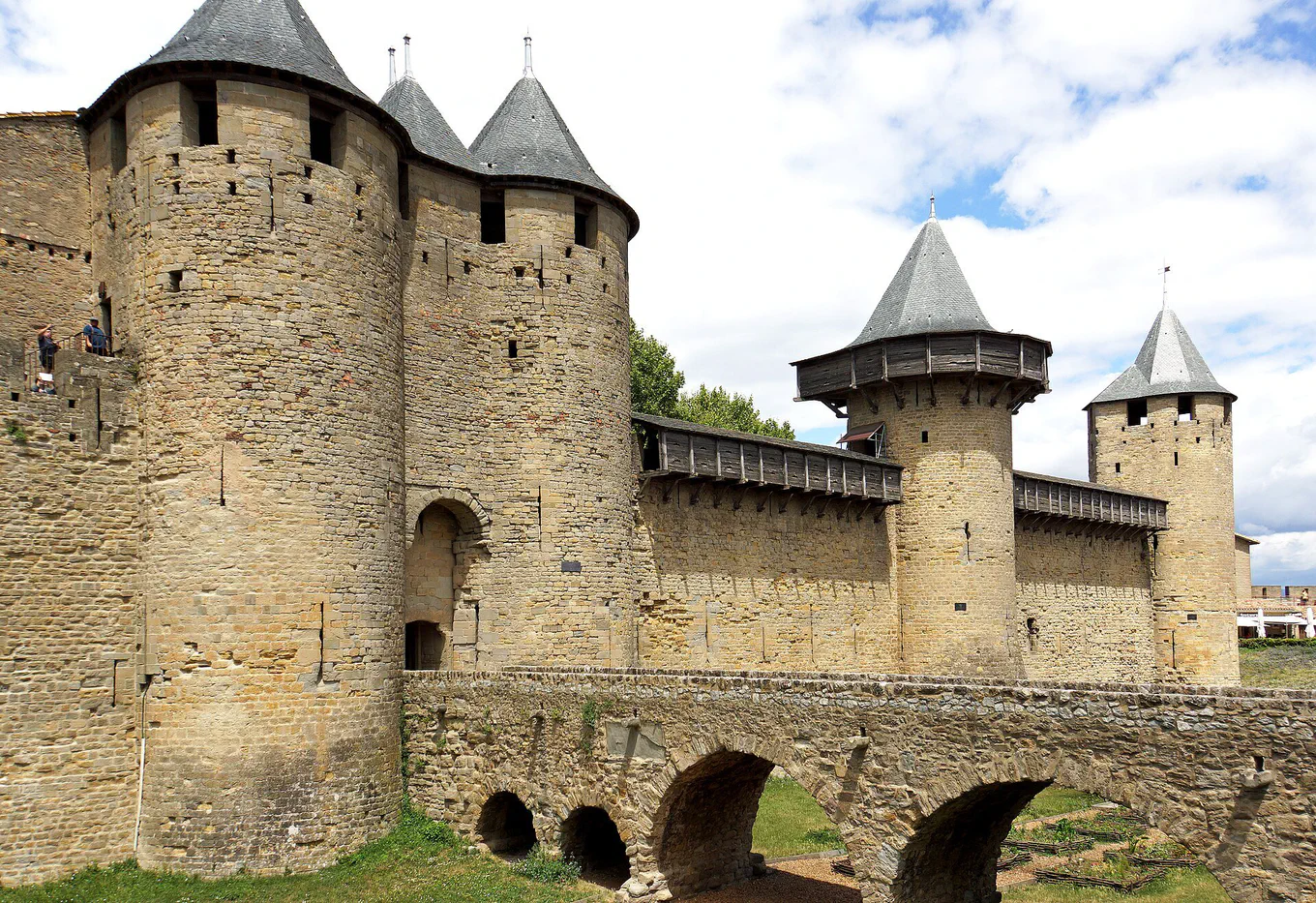
Stand here. His own castle, in the Cité. It and the ramparts are part of the UNESCO World Heritage site.
In August 1209, a crusading army under the Pope’s legate besieged Carcassonne and cut it off from water. Its viscount, Raymond-Roger Trencavel, went to the crusaders under a safe-conduct to talk terms and gave himself up, possibly to save his people. The city surrendered on 15 August. Its people were spared, but forced out with only the clothes they wore. Trencavel, kept prisoner by the French knight Simon de Montfort, died of dysentery in his own castle that November. Four years later, the man who held him was Viscount of Carcassonne.
3 Jean-Pierre Cros-Mayrevieille saves the walls of Carcassonne
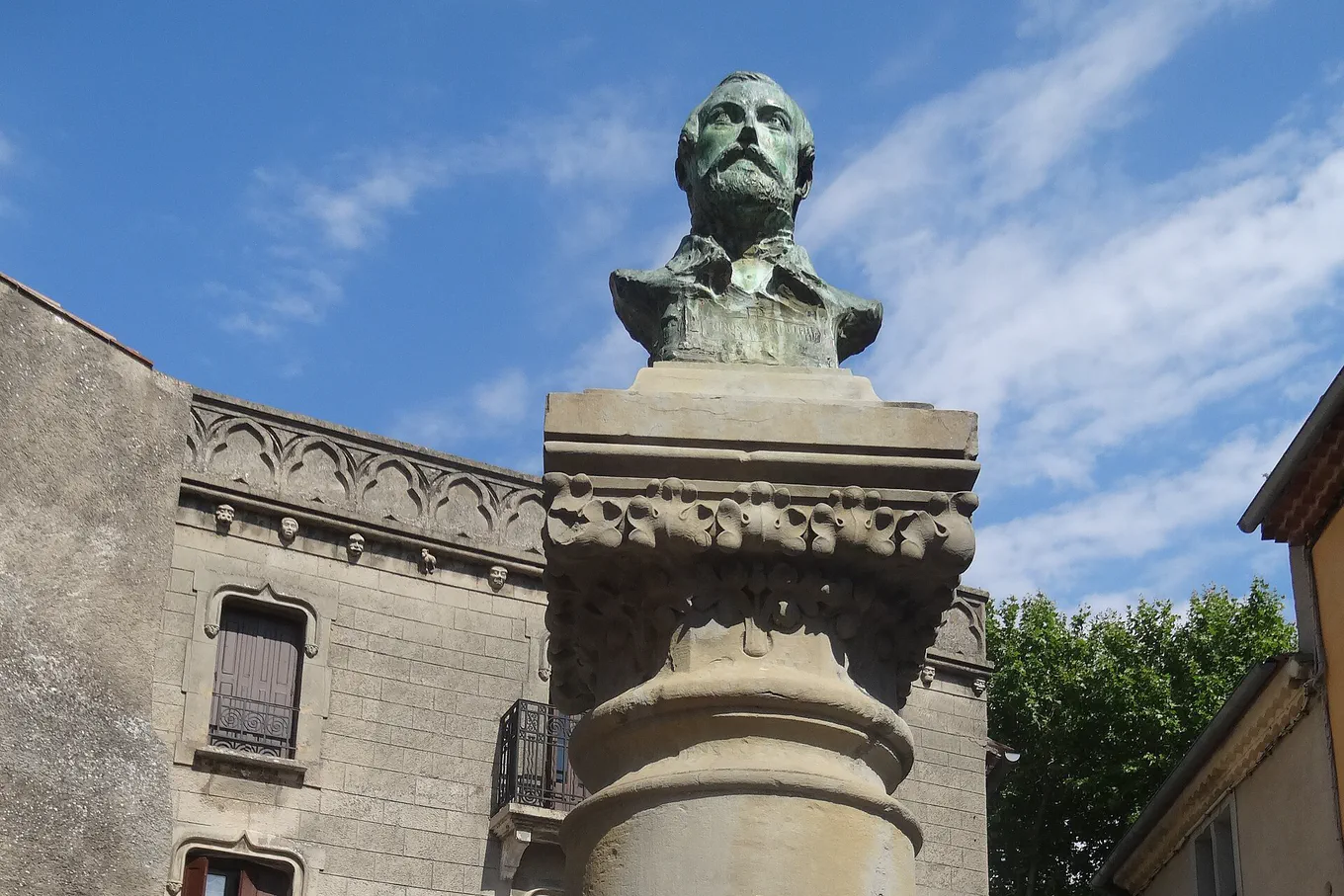
Stand here. Place du Château in the Cité, where Jean Rivière’s bust of him stands by the castle.
The Cité’s walls were being dismantled and sold piece by piece to local masons. In 1849, the French government decided the fortifications should be demolished. Jean-Pierre Cros-Mayrevieille, a historian born in Carcassonne, called it “state vandalism”. With Prosper Mérimée, France’s inspector general of historic monuments, he fought until the decree was annulled. Mérimée handed the restoration to the architect Eugène Viollet-le-Duc, who capped the towers with pointed slate roofs. Critics complained that slate belonged in northern France. At least there were towers left to complain about.
4 Joë Bousquet and the shuttered room on rue de Verdun
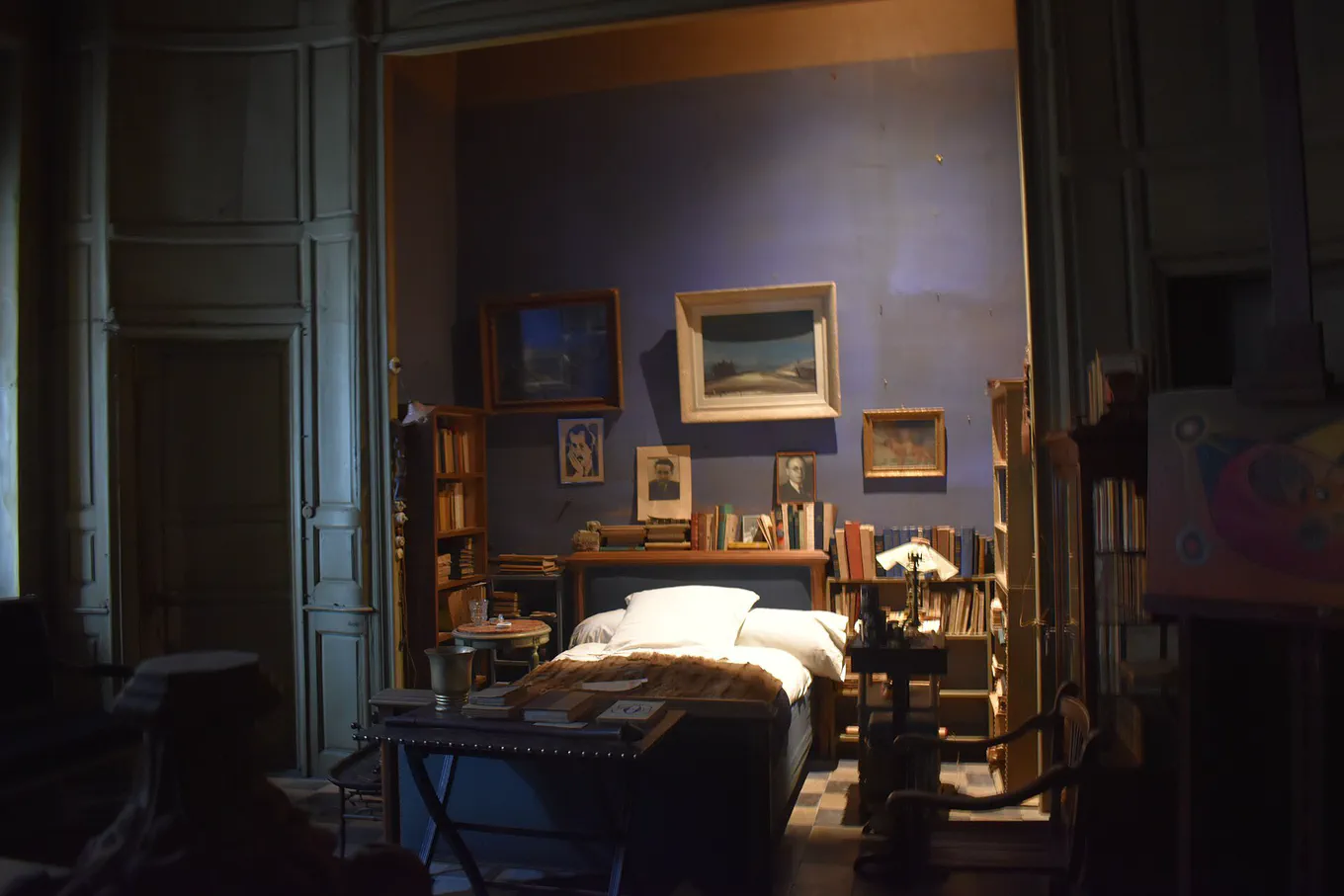
Stand here. 53 rue de Verdun, Carcassonne. His home is now the Maison des Mémoires, with his bedroom kept as it was.
Salvador Dalí, René Magritte, and the philosopher Simone Weil all came to one bedroom in Carcassonne, where the shutters stayed closed. It belonged to the poet Joë Bousquet. In May 1918, as a young lieutenant, he was hit in the spine by a German bullet and paralysed from the chest down. He was 21. After that he lay, most of the time, in this room on rue de Verdun. So the intellectuals of the century came to him.
Kate Mosse’s Labyrinth, the second best-selling book in the UK in 2006, began in Carcassonne. In November 1989, she and her husband bought a tiny house in the shadow of the city walls, while she was expecting their first child. She had already written four books, but she hadn’t found her voice. Carcassonne, she says, freed a kind of writing she didn’t know was in her. The novel came years later. “I am the novelist I am,” she has said, “because of Carcassonne.”
Pack nothing. Leave Friday.
Every Friday, I write a free letter, Journey, that takes us on a trip through places, stories, and ideas.
Labyrinth(Kate Mosse). A novel. Its heroine is the daughter of the steward of Carcassona.
The Friar of Carcassonne(Stephen O’Shea, 2011). A history. The life of Bernard Délicieux, a Franciscan friar who led a revolt against Carcassonne’s inquisitors.
The Burning Chambers(Kate Mosse, 2018). A historical epic set in Carcassonne in 1562, where nineteen-year-old Minou Joubert receives an anonymous letter at her father’s bookshop on the eve of war.
Films to watch before you visit Carcassonne
Robin Hood: Prince of Thieves. A film. The medieval walls and towers of the Cité stand in for Nottingham and its castle.
Les Visiteurs(Jean-Marie Poiré, 1993). A French fantasy comedy film, in which the Cité plays the medieval castle.
Le Corniaud(Gérard Oury, 1965). A comedy film. Its Carcassonne scenes were shot over three days in the medieval Cité, by the Porte Narbonnaise, the drawbridge, the Porte d’Aude, and the Basilica of Saint-Nazaire.
Questions
Was Dame Carcas a real person?
Almost certainly not. She appears to be a fictional character, and Charlemagne could not have besieged Carcassonne, because his father, Pepin, had already taken the city from the Saracens in 759. Her bust stands in front of the Porte Narbonnaise, and the 16th-century original is kept in the castle.
Was Robin Hood: Prince of Thieves filmed in Carcassonne?
Yes. The medieval walls and towers of the Cité stood in for Nottingham and its castle in the film. The Cité has been the set for other films too, among them Les Visiteurs, where it plays the medieval castle, and Le Corniaud.
Is the board game Carcassonne named after the city?
Yes. The game, designed by Klaus-Jürgen Wrede and published by Hans im Glück in 2000, is named after the medieval fortified town, famed for its walls. Wrede had the idea while touring the south of France on holiday in the late 1990s. It won the Spiel des Jahres in 2001.
Can you see Joë Bousquet’s room in Carcassonne?
Yes. He lived at 53 rue de Verdun, now the Maison des Mémoires, and his bedroom is kept exactly as it was.