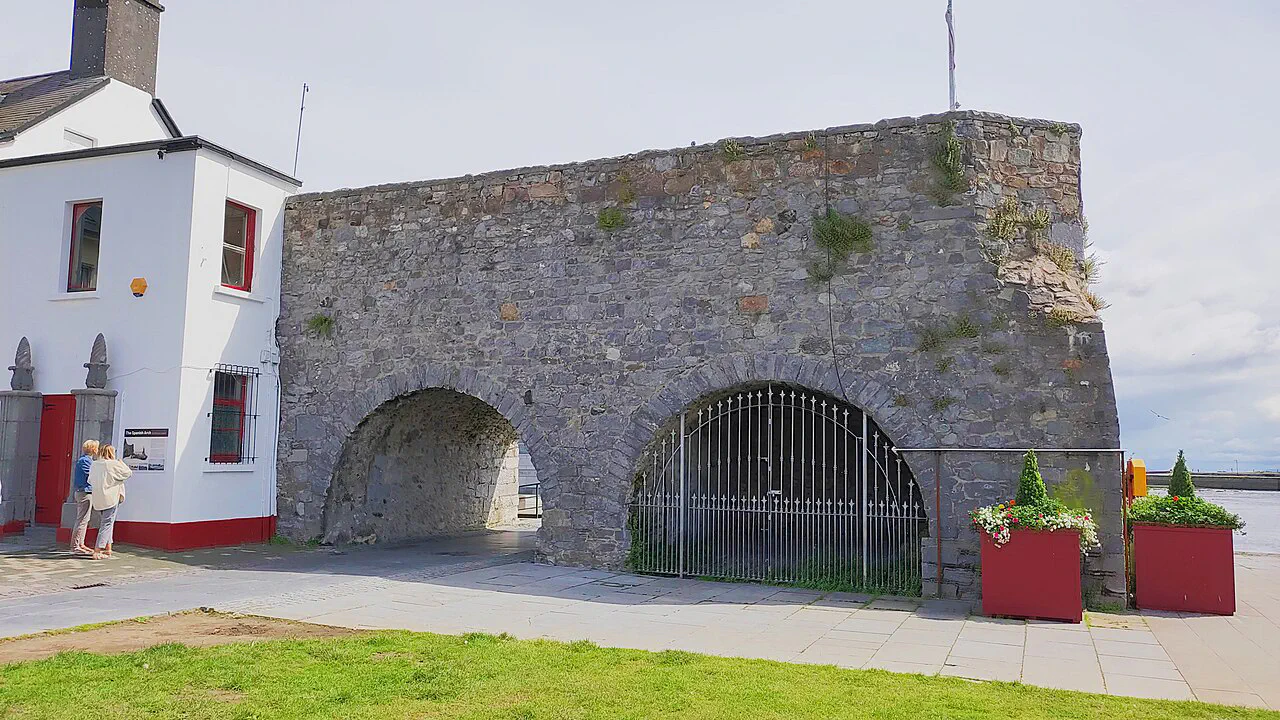
Galway likes to say that Christopher Columbus prayed in St Nicholas’ Church in 1477, fifteen years before he crossed the Atlantic. In 1992, I followed his route across on a yacht, and we had midnight mass in the same Spanish church that Columbus had been blessed in 500 years before. It’s good to take a moment before you start something huge.
— Nick
Galway is a city in Ireland, on the River Corrib between Lough Corrib and Galway Bay. In 1484, a charter let the walled town form a council and mayoralty, and merchant families, the Tribes of Galway, made it a trading port. Its stories are the Galway girl James Joyce married, Kennedy in Eyre Square, Lord Haw-Haw’s grave, the Claddagh ring, and a theatre company’s Tonys.
The Claddagh ring, with a heart for love, a crown for loyalty, and two clasped hands for friendship, almost certainly began in or near Claddagh, a small fishing village in Galway. Legend tells of a Galway man, Richard Joyce. Around 1675, it says, Algerian pirates captured him on his way to the West Indies and sold him to a goldsmith, who taught him the craft. Fourteen years later, he was freed and came home. But the oldest known Claddagh ring was made about 1700, by Richard Joyce of Galway.
2 Nora Barnacle, the Galway girl behind Joyce’s The Dead
Stand here. Bowling Green, where Nora’s childhood home, derelict until the 1980s, was restored as a museum. A 2018 report said it was closed.
In June 1904, James Joyce met a Galway girl, Nora Barnacle, and a day that June became Bloomsday. She had grown up here with her mother and her uncle, and left for a chambermaid’s job at Finn’s Hotel in Dublin. But Galway came with her. A boy she had loved here, Michael Bodkin, died in 1900. Years later, in The Dead, Joyce gave a wife named Gretta a Galway sweetheart who died at seventeen. His name was Michael too.
William Joyce, nicknamed Lord Haw-Haw, broadcast Nazi propaganda in the Second World War, and every broadcast began “Germany calling, Germany calling, Germany calling”. Born in Brooklyn, he grew up in Salthill, County Galway, the son of devoted unionists, and lied about his nationality to get a British passport. At his trial, the judge accepted that he couldn’t betray a country not his own. But that passport bound him to Britain, and in 1946 he was executed. In 1976, after his daughter’s campaign, he was reburied in Galway.
4 John F. Kennedy’s speech in Eyre Square
Stand here. Eyre Square, officially renamed John F. Kennedy Memorial Park. A bust of Kennedy stands in a flower bed, and a plaque marks the spot.
On 29 June 1963, President John F. Kennedy spoke to a packed Eyre Square, and more than a few in the crowd were his relatives. On a clear day, he said, if they looked west from the bay, they would see cousins of theirs working on the Boston docks. And if they came to America, they should “come to Washington and tell them, if they wonder who you are at the gate, that you come from Galway”. Five months later, he was assassinated in Dallas.
5 Druid’s The Beauty Queen of Leenane at the Town Hall Theatre
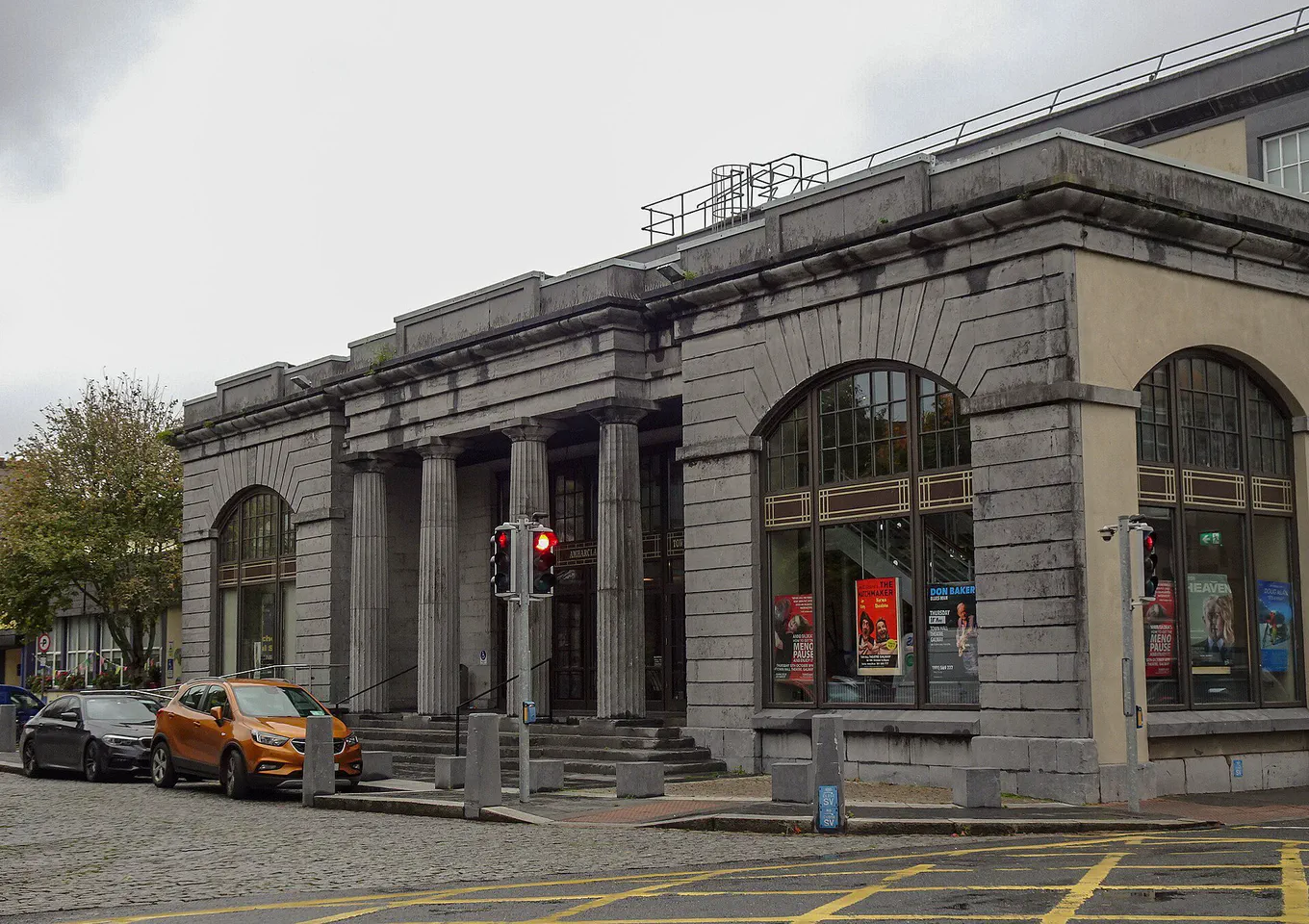
Stand here. The Town Hall Theatre on Courthouse Square, in the old Galway Town Courthouse, reopened as a theatre in 1995.
Before Martin McDonagh made the films In Bruges and The Banshees of Inisherin, his play The Beauty Queen of Leenane opened here, on 1 February 1996. It was staged by Druid, the company Garry Hynes had co-founded in 1975 as the first Irish professional theatre company outside Dublin. McDonagh was a young Londoner whose father came from Connemara. Two years later, the production went to Broadway and won four Tony Awards. One of them made Hynes the first woman to win a Tony for directing a play.
The Dead(James Joyce, 1914). A short story, the last in Dubliners. It is set in Dublin, but Gretta remembers her grandmother’s house on Nuns’ Island, in Galway.
Rain on the Wind(Walter Macken, 1950). A novel, set in the Claddagh, the old fishing quarter of Galway where the ring is thought to have begun.
Nora: A Biography of Nora Joyce(Brenda Maddox, 1988). A biography of Nora Barnacle, who grew up on Bowling Green before she met James Joyce.
The Guards(Ken Bruen, 2001). A novel in the Jack Taylor series, set in Galway.
Films to watch before you visit Galway
Jack Taylor(Ken Bruen, 2010–2016). A TV series. Set in Galway and based on Ken Bruen’s novels, with Iain Glen as Jack Taylor, a former officer with the Garda Síochána.
The Watchers(Ishana Night Shyamalan, 2024). A horror film. At a pet shop in Galway, Mina is asked to deliver a golden conure parrot to a zoo near Belfast. Shot partly in Galway.
North Sea Hijack(Andrew V. McLaglen, 1980). An action film starring Roger Moore and James Mason. The Galway City Docks were transformed into a Norwegian port, where the supply ship Esther is hijacked.
Questions
Where did John F. Kennedy speak in Galway?
In Eyre Square, on 29 June 1963. The square was later officially renamed John F. Kennedy Memorial Park. A plaque marks the place where he became a Freeman of Galway that day, and a bust of Kennedy stands in a flower bed.
Does the word ‘lynching’ come from Galway?
No. A Galway legend says that James Lynch FitzStephen, elected mayor in 1493, condemned and executed his own son Walter, and a memorial window on Market Street records it. The story was put forward as the origin of ‘to lynch’, but that is a false etymology. James Mitchell argues the story itself is a pure myth.
How old is the Spanish Arch?
Sources disagree. One dates it to the mayoralty of Wylliam Martin, in 1519–20. Another says the Eyre family made the arches in the eighteenth century, to give the town a way through to new quays. In 1755, the tsunami from the Lisbon earthquake partly destroyed them.