Tai-Pan is my favourite Clavell novel, and it opens in the wreckage of the First Opium War. That war began here, when Lin Zexu sealed the foreign merchants inside the Thirteen Factories and destroyed 20,283 chests of opium. Clavell’s heroes were the people he besieged.
— Nick
Guangzhou, or Canton, is the capital of Guangdong, in southern China, on the Pearl River about 120 kilometres north-west of Hong Kong. It was founded as Panyu in 214 BC and was long the only Chinese port open to Europeans. Its stories here are a king’s secret seal, a monk and a flag, an opium siege, a love letter written before an uprising, and two future enemies at one academy.
Stand here. The Nanyue King Museum, 867 Jiefang Road, in Yuexiu. Opened in 1988, it is built over the tomb itself.
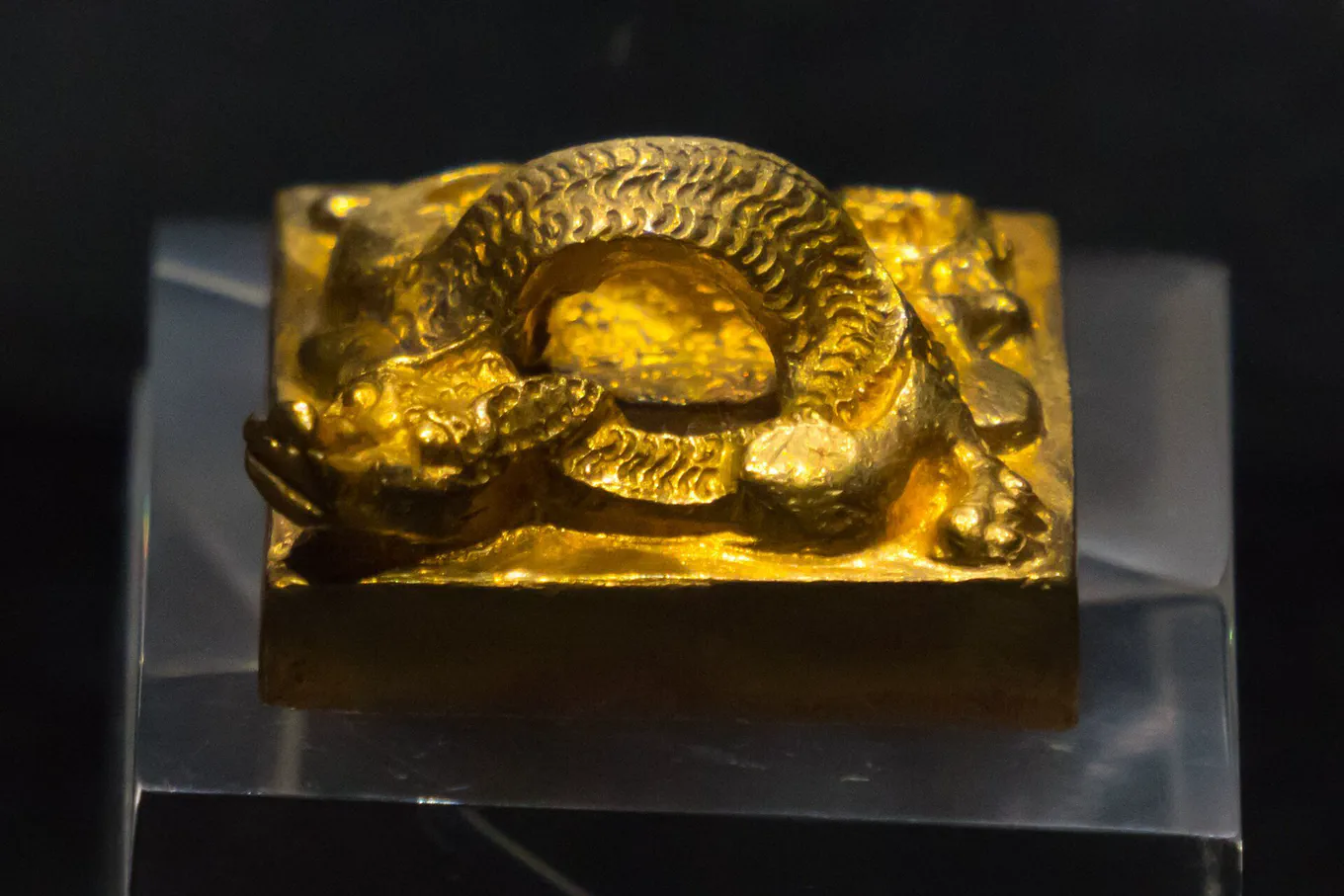
The gold “Imperial Seal of Emperor Wen”, with its dragon knob, from Zhao Mo’s tomb at the Nanyue King Museum, Guangzhou.Shujianyang / CC0.
Guangzhou was once Panyu, capital of the breakaway kingdom of Nanyue. In 137 BC, its founder’s grandson inherited the throne. To China’s Han court, the grandson was a king, but at home he called himself emperor, and in time even his name was lost. Then, in 1983, his tomb turned up 20 metres under Elephant Hill, on a construction site for a hotel, never touched by robbers. Seals inside gave back his name, Zhao Mo, and a gold one gave away his secret: “Imperial Seal of Emperor Wen”.
2 Huineng, the wind and the flag at Guangxiao Temple
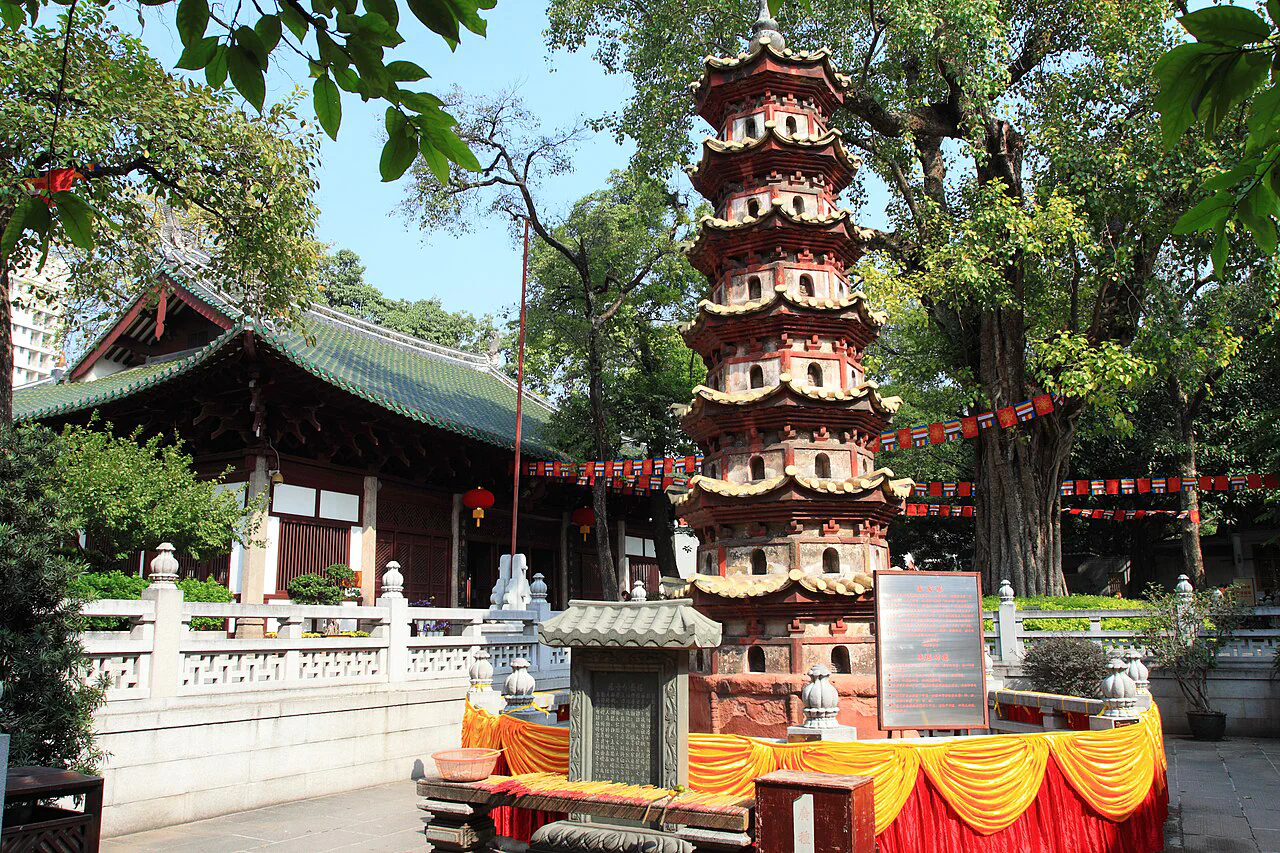
Stand here. Guangxiao Temple, near Ximenkou metro station. Behind the main hall, under a bodhi tree, stands the pagoda raised over Huineng’s hair.
Chan, or Zen, Buddhism tells this story of its Sixth Patriarch. Huineng was a poor firewood seller who, by tradition, couldn’t read, yet the Fifth Patriarch passed him his robe and bowl and told him to flee. He lived among hunters for fifteen years. Then, the story goes, he walked into this temple as two monks argued. One said the wind was moving, the other the flag. Neither, said Huineng. Their minds were moving. In 676, the abbot shaved the stranger’s head and asked to be his pupil.
3 Lin Zexu and the siege of the Thirteen Factories
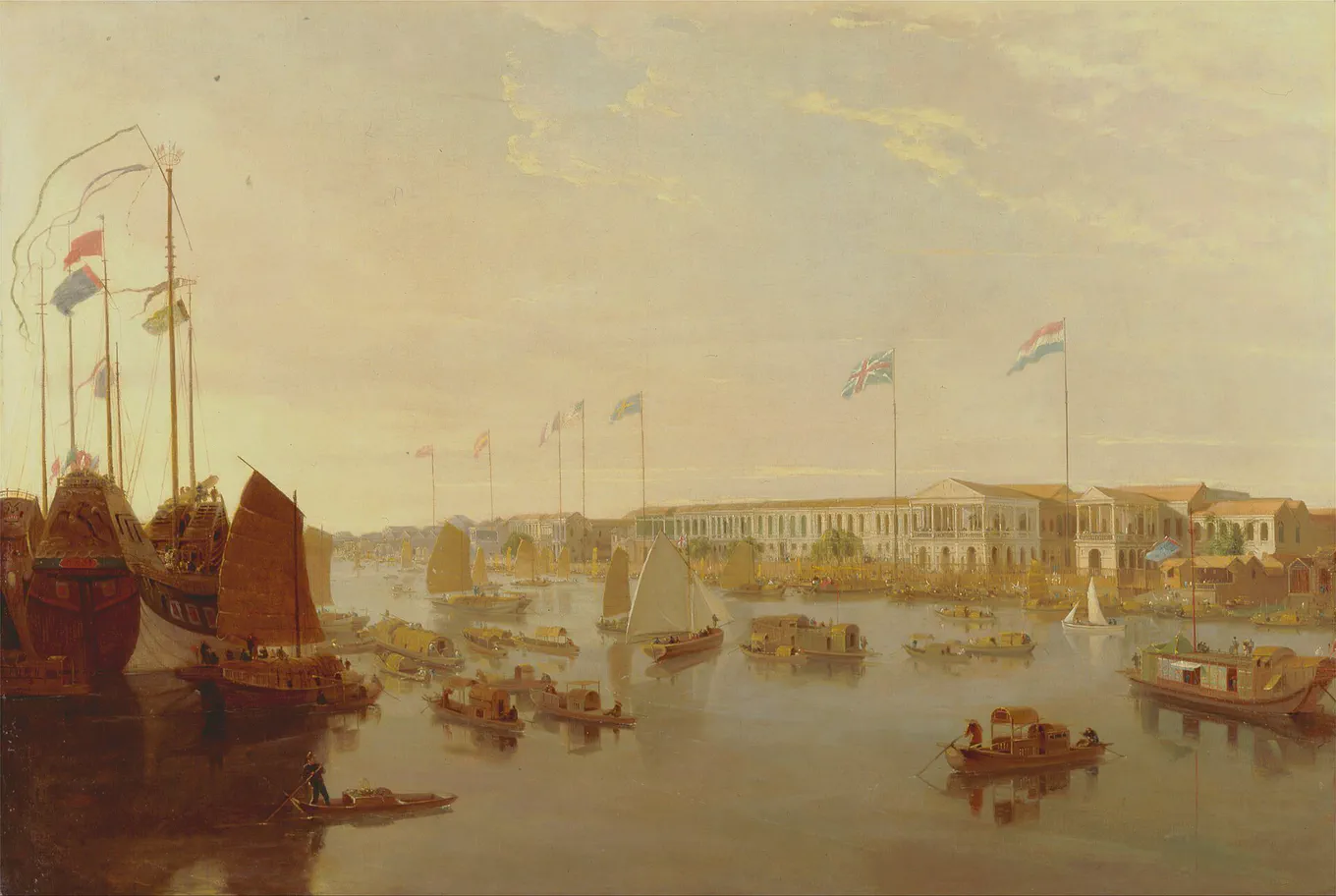
Stand here. Guangzhou Cultural Park, by the Pearl River in Liwan. The factories burned in 1856, and the Thirteen Hongs Museum stands on their site.
The Thirteen Factories on the Pearl River at Canton, flying their national flags, in a painting by William Daniell.William Daniell / Public domain.
Before the First Opium War, there was a siege on this riverbank. In March 1839, the emperor’s commissioner, Lin Zexu, had soldiers seal the foreign merchants inside the Thirteen Factories, the only place they were allowed to live and trade. The British superintendent, Charles Elliot, gave up 20,283 chests of opium, and Lin had every one destroyed. Lin also wrote to Queen Victoria, asking her to help end the trade. No reply came. Britain sent a force, and Lin, made the scapegoat for China’s losses, was exiled to remote Xinjiang.
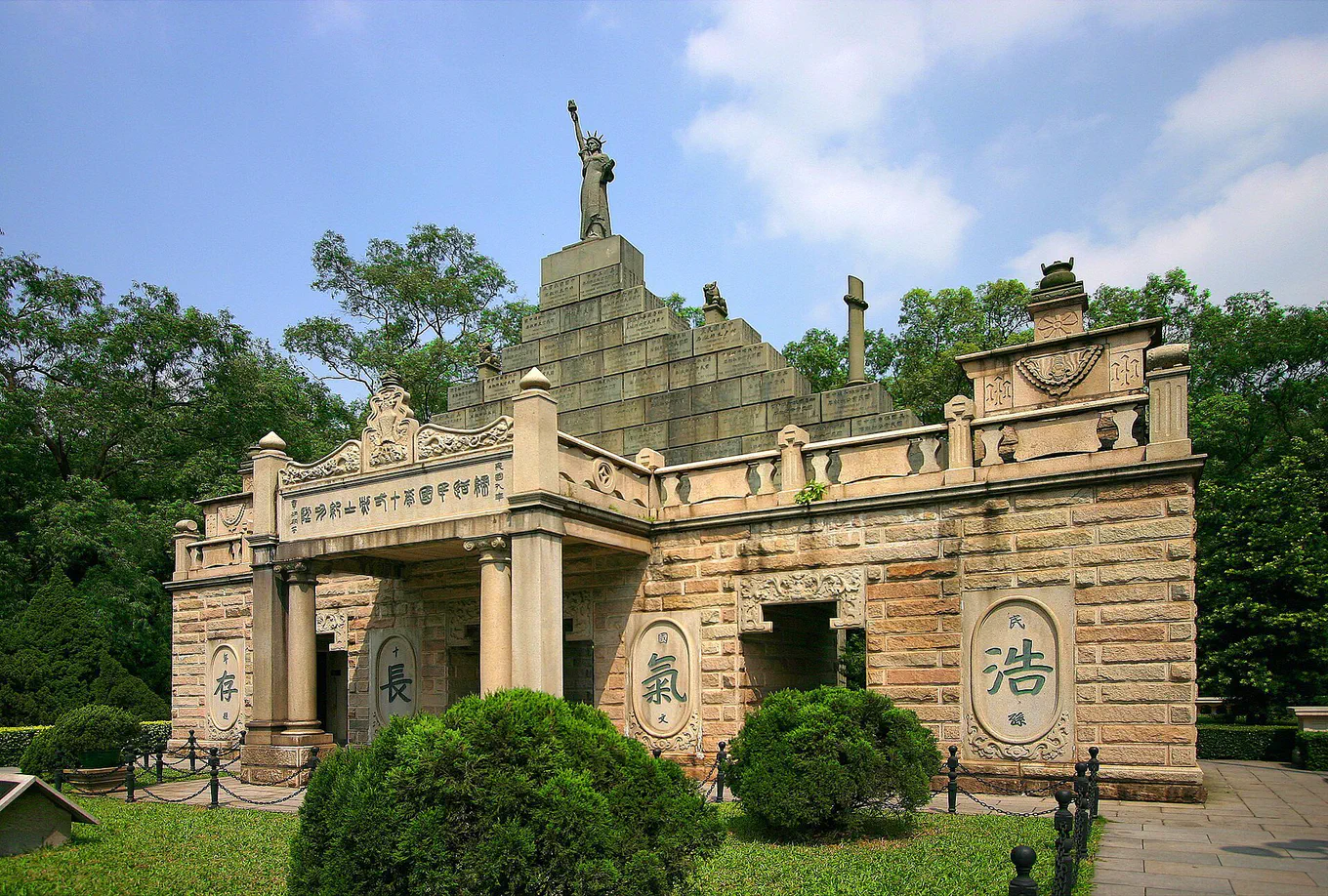
Lin Juemin was 23 when he wrote what has been called the most famous love letter in the modern Chinese-speaking world. In April 1911, days before joining an uprising against the Qing, he wrote to his pregnant wife, Chen Yiying, partly on a white handkerchief. It was because he loved her too much, he told her, that he was willing to give up his life. The uprising failed. Its dead were buried here, and Lin was executed. Two years later, Chen Yiying died, of deep sadness, it was said.
5 Chiang Kai-shek and Zhou Enlai at Whampoa Military Academy
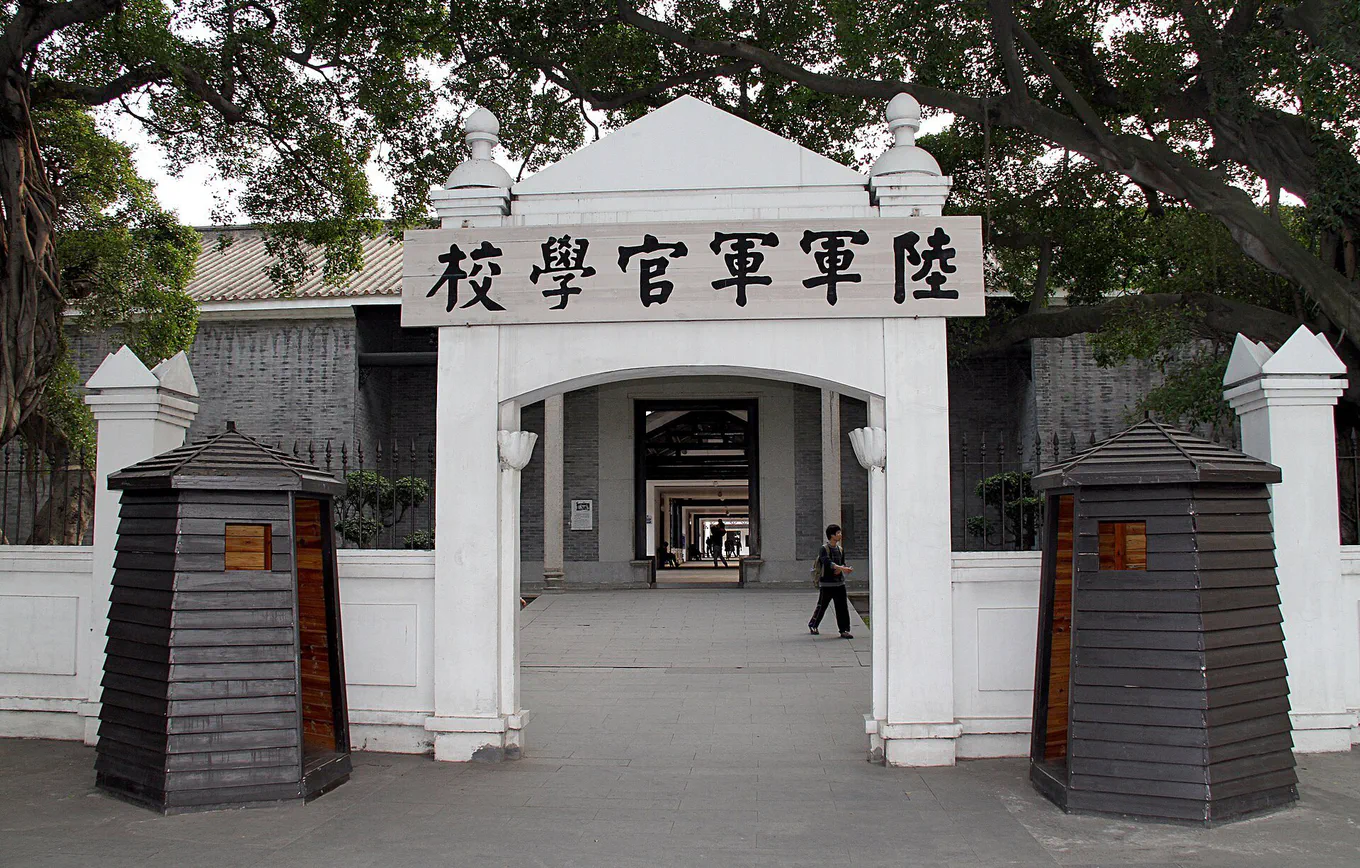
Stand here. The former Whampoa Military Academy, on Changzhou Island in Huangpu. Its headquarters, bombed by Japanese planes in 1938, was rebuilt in 1996.
Chiang Kai-shek and Zhou Enlai once addressed the same cadets here, one straight after the other. In 1924, Sun Yat-sen founded this academy for his Nationalists, with Soviet money and advisers, and Communists were admitted as teachers and cadets. Chiang was its superintendent. Zhou, a Communist, was its chief political officer. But by 1926, Chiang had shut the Communists out of the academy, and he then purged them in the Shanghai massacre, setting off a civil war. In 1949, Chiang retreated to Taiwan, and Zhou became the first Premier of the People’s Republic.
River of Smoke(Amitav Ghosh, 2011). A novel set in Fanqui town, the strip of land in Canton where foreigners traded.
The Joy Luck Club(Amy Tan, 1989). A novel. In its chapter “A Pair of Tickets”, June’s journey through China begins in Guangzhou, with a visit to family.
Canton Under Communism(Ezra F. Vogel, 1969). A history, and a detailed study of government and politics in Canton and the rest of Guangdong under Communist rule.
Films to watch before you visit Guangzhou
The Opium War(Xie Jin, 1997). A film. Lin Zexu bans opium in a 19th-century Guangzhou rebuilt as a set, with a climax at Humen Fort.
Once Upon a Time in China II(Tsui Hark, 1992). A film. Wong Fei-hung takes the train from Foshan to a chaotic Canton for a medical seminar.
The Shadow Play(Lou Ye, 2018). A film set among the skyscrapers and luxury facades of modern Guangzhou.
Black Tea(Abderrahmane Sissako, 2024). A film. Most of it takes place in what is meant to be Guangzhou’s “Chocolate City”.
Questions
Why is Guangzhou called Canton?
The English name Canton came from the Portuguese Cidade de Cantão, a blend of local pronunciations of “Guangdong”. Canton was later adopted as the city’s postal romanisation, and it stayed the official name until the change to Guangzhou.
Where can you see the Nanyue King’s tomb and jade suit?
At the Nanyue King Museum, 867 Jiefang Road in Yuexiu District, which opened in 1988 on the site of the tomb itself. Its centrepiece is Zhao Mo’s burial suit, made of 2,291 pieces of jade joined with silk, the only one of its kind known.
Why is Guangzhou called the City of Rams?
The nickname, City of Rams or City of the Five Rams, comes from five stones kept in a Taoist temple. They were said to be the animals ridden by the Taoist heroes who were credited with bringing rice growing to the area.