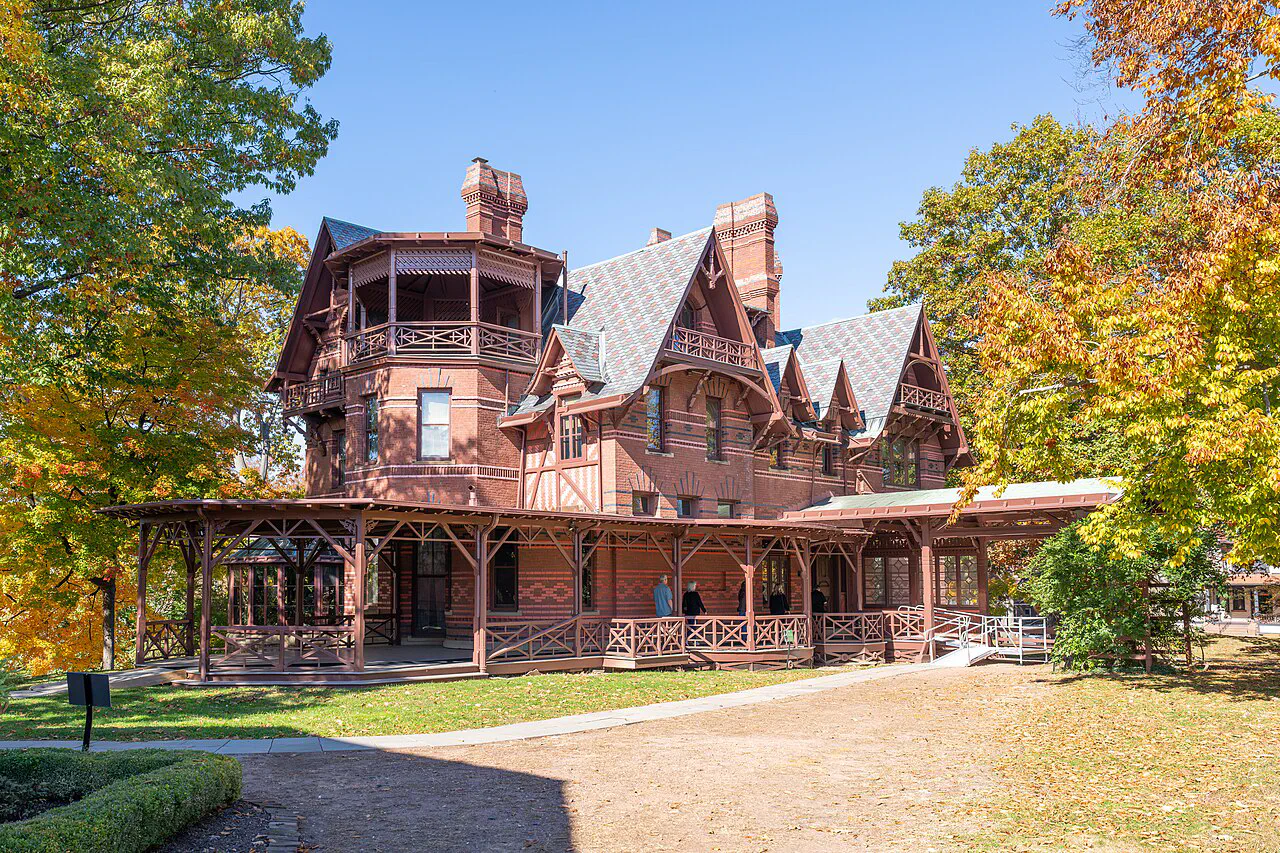
Mark Twain described a badly built sentence as a sea serpent with half its arches under the water. His biographer described Twain’s Hartford house as ‘part steamboat, part medieval fortress and part cuckoo clock’. I guess the gift for metaphor was catching.
— Nick
Hartford, on the Connecticut River, is the capital of Connecticut and was founded in 1635, among the oldest cities in the United States. So many insurers have their headquarters here that it is called the Insurance Capital of the World. Its stories are a charter said to have been hidden in an oak, a widow under a blue dome, Mark Twain’s house, a circus fire, and a poet who walked to work.
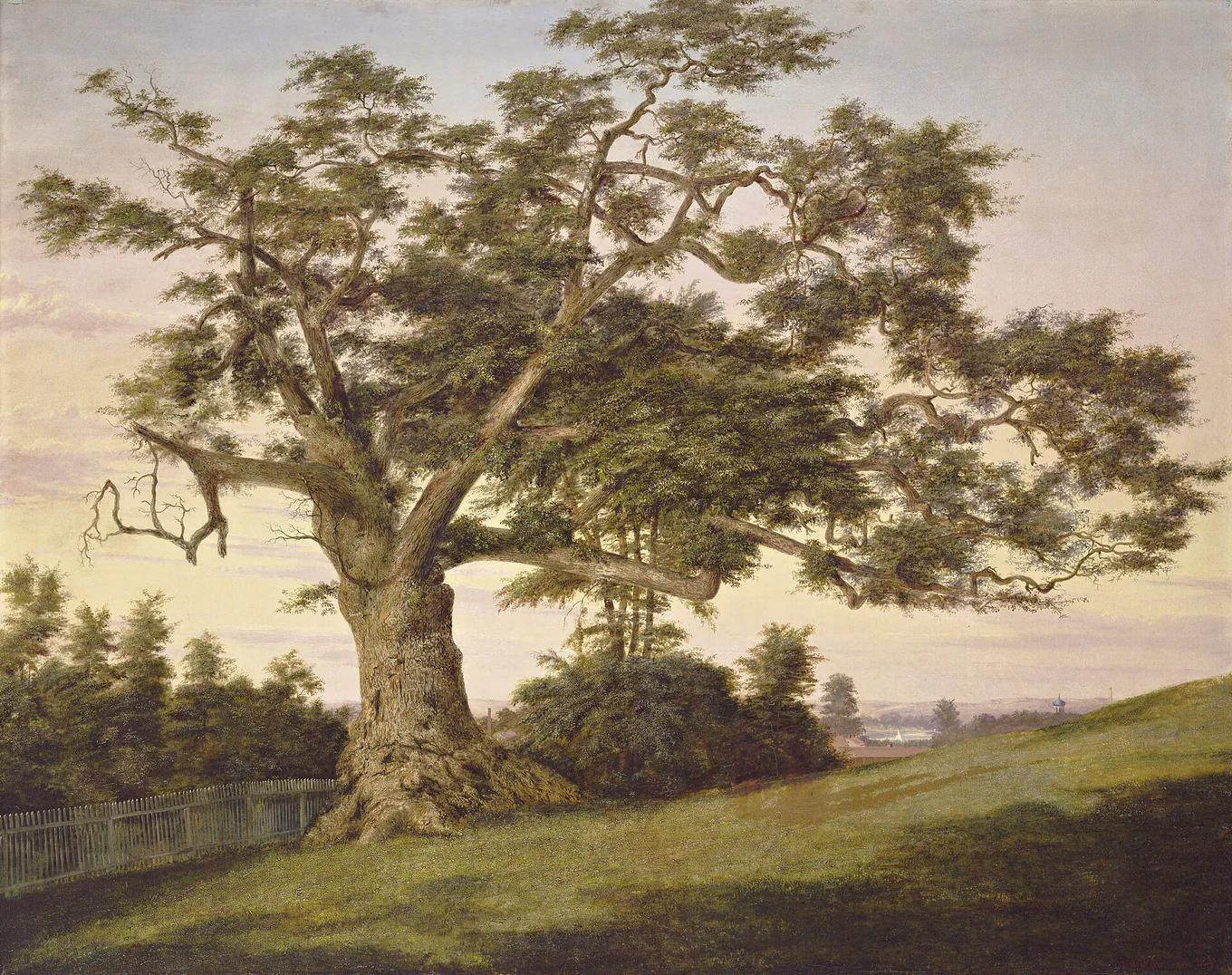
Connecticut’s 1999 state quarter shows the oak that hid the colony’s charter, or so the story goes. In October 1687, Edmund Andros, governor of the Dominion of New England, came to Hartford to take it. The two sides met, and mid-debate, the story says, the candles were blown out. When they were relit, the charter was gone, supposedly carried by Captain Joseph Wadsworth to a hollow oak. Andros was overthrown in Boston two years later. When the tree fell, Hartford gave it a funeral, with dirges and tolling bells.
2 Elizabeth Colt and the blue onion dome over Coltsville
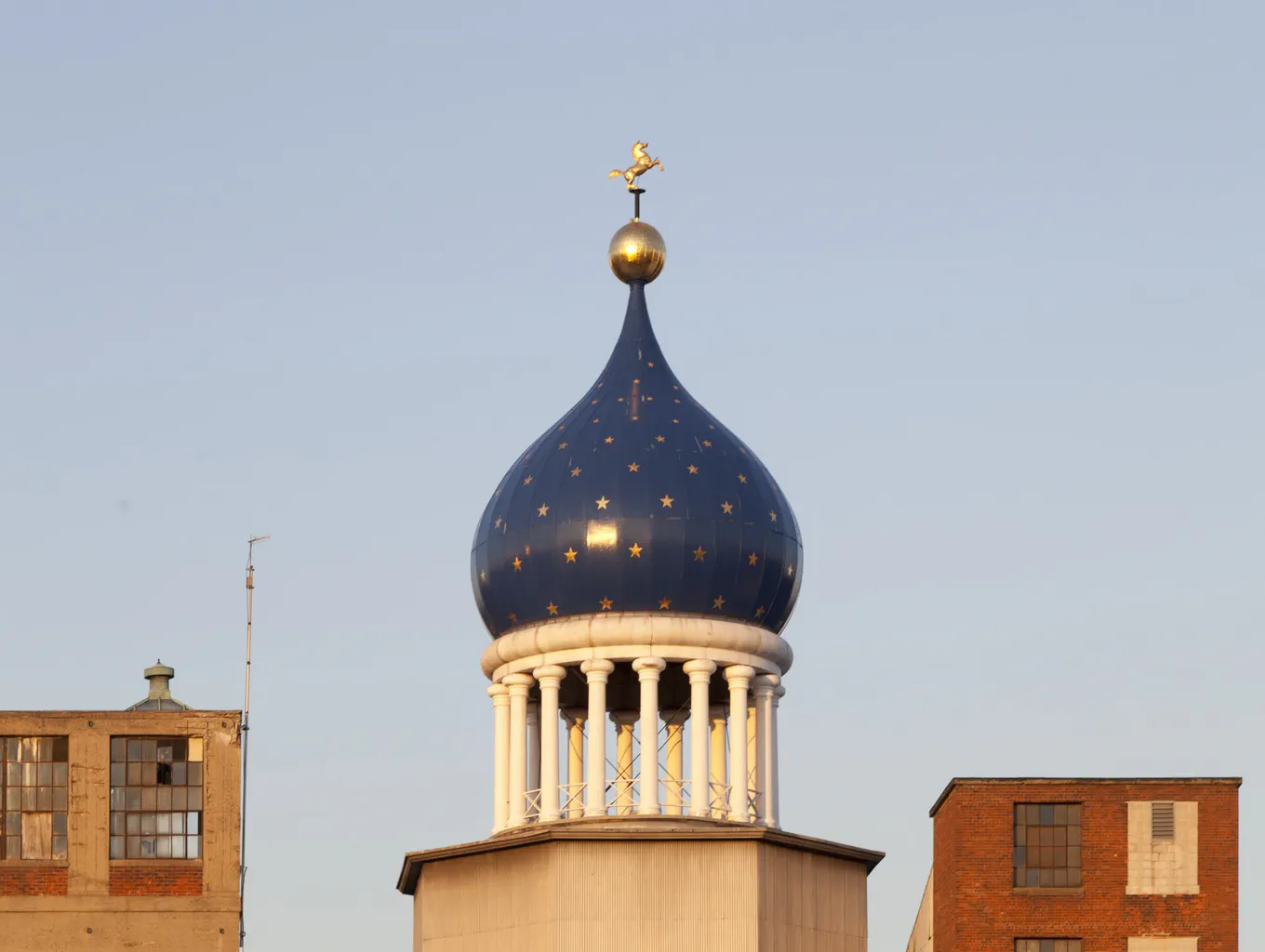
Stand here. The Colt Armory in Coltsville, beside Interstate 91, under its blue onion dome with gold stars and a rampant colt.
The blue onion dome, studded with gold stars and topped by a rampant colt, on the Colt Armory in Coltsville, Hartford.Carol M. Highsmith / Public domain.
Samuel Colt, the firearms maker, began building his armoury on the Connecticut River meadows in 1855, and within a year Coltsville was a city within a city. He died in 1862, at 47, leaving his wife Elizabeth pregnant, and seven months later the baby was stillborn. Two years on, fire almost destroyed the armoury. Under Elizabeth, who now controlled the company, it was rebuilt, blue onion dome and all. Then she built a church to Samuel and their lost children, its stone carved with bullet moulds, gunsights, and cylinders.
3 Mark Twain’s Hartford house and the daughter who died there
Stand here. The Mark Twain House, 351 Farmington Avenue. A house museum since 1974, it stands next door to the Harriet Beecher Stowe House.
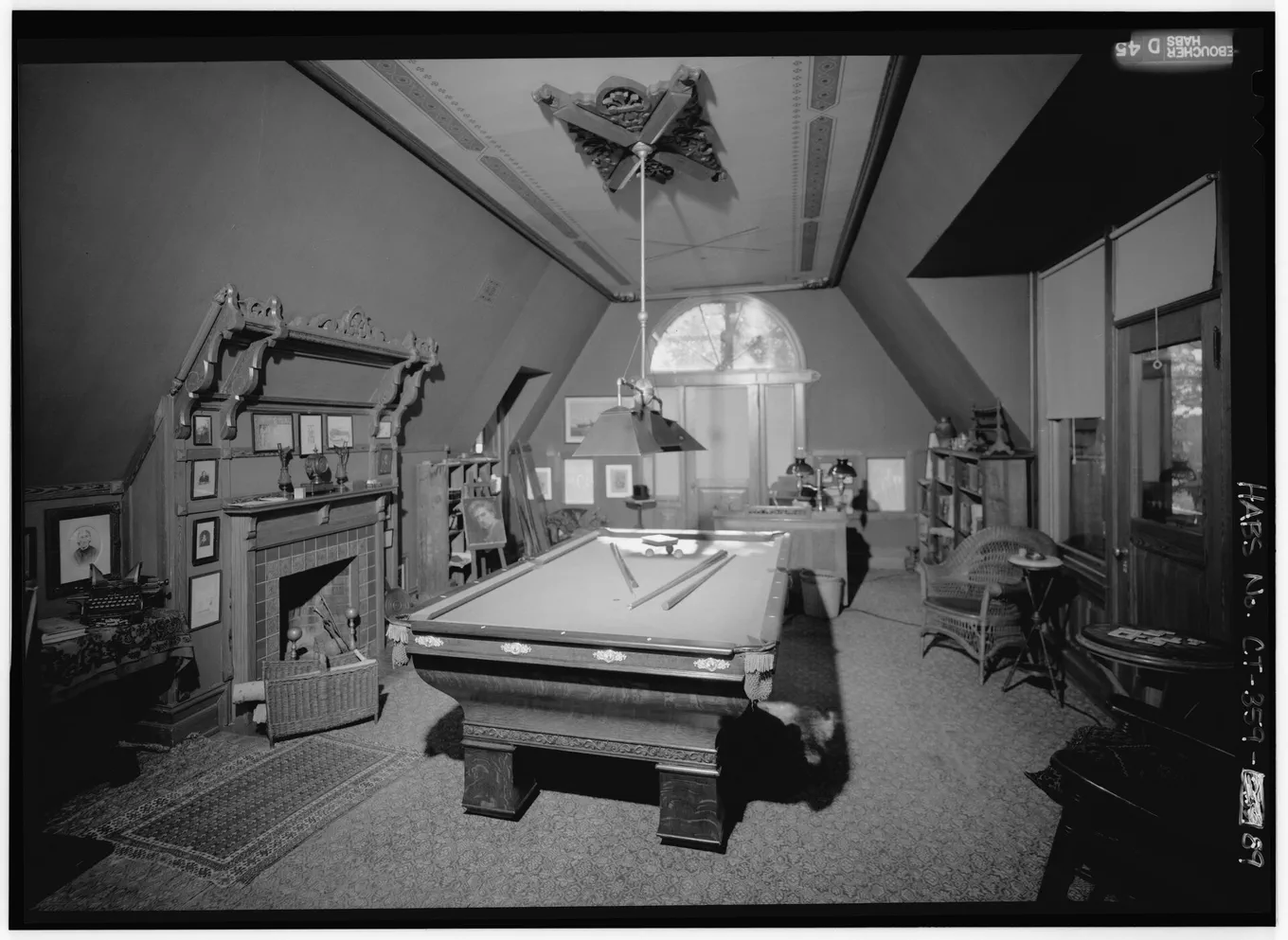
The third-floor billiard room of the Mark Twain House on Farmington Avenue, Hartford, where Twain did much of his writing.Unknown / Public domain.
Mark Twain wrote Tom Sawyer and Huckleberry Finn in this house, which he and his wife Livy had built for their family. He wrote that it “had a heart, and a soul, and eyes to see us with”. But he sank money into a typesetting machine that never worked properly, and in 1891 the losses drove the family to Europe. In 1896, their daughter Susy, 24, died here of meningitis while on a visit home. Livy could not bear to live in the house again.
Stand here. The Hartford Circus Fire Memorial, behind the Wish School at 350 Barbour Street. Its centre plaque sits where the centre ring stood.
A photograph of the clown Emmett Kelly holding a water bucket gave the circus fire of 6 July 1944 its name, “the day the clowns cried”. At least 167 people died when the Ringling Bros. and Barnum & Bailey tent burned. The best known was a blonde girl in a white dress, buried nameless as Little Miss 1565, her number at the morgue. In 1991, she was declared to be eight-year-old Eleanor Cook. Eleanor’s mother said it was not her daughter, and held to that until she died.
5 Wallace Stevens, the insurance man who turned down Harvard
Stand here. The Wallace Stevens Walk, from his old office in Asylum Hill to 118 Westerly Terrace, marked by thirteen granite stones.
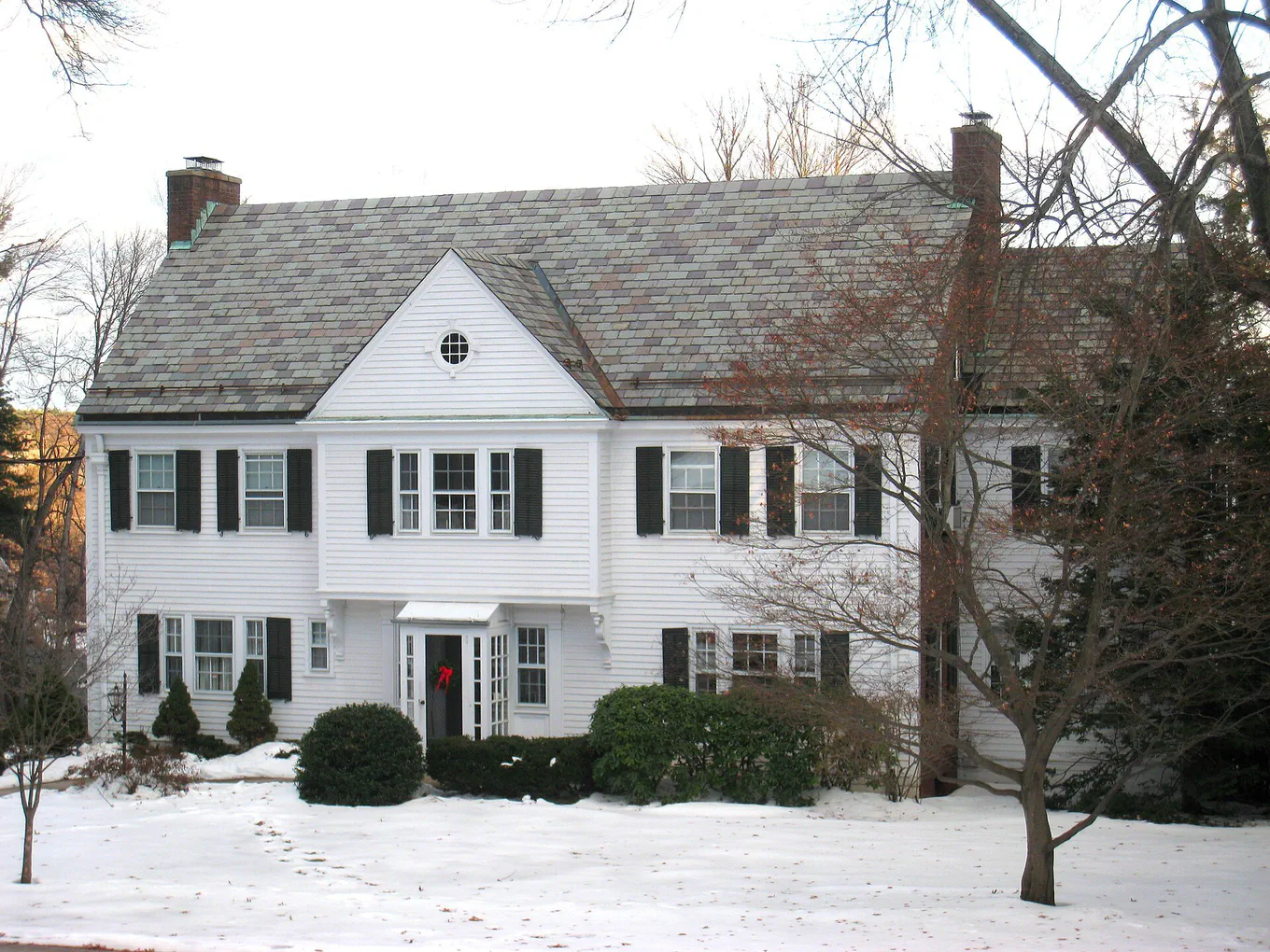
Wallace Stevens’s former home at 118 Westerly Terrace, Hartford, the end point of the Wallace Stevens Walk.Daderot / Public domain.
Wallace Stevens, who wrote “Thirteen Ways of Looking at a Blackbird”, worked in insurance. He joined the Hartford Accident and Indemnity Company and rose to vice-president. He never learned to drive, so every day he walked two miles to the office, composing poems in his head to the rhythm of his steps. In 1955, his Collected Poems won the Pulitzer Prize, and Harvard offered him a post. He turned it down, because he would have had to give up his job. That August, he died in Hartford.
Pack nothing. Leave Friday.
Every Friday, I write a free letter, Journey, that takes us on a trip through places, stories, and ideas.
Mr. Clemens and Mark Twain(Justin Kaplan, 1966). A biography. Kaplan called the Farmington Avenue house “part steamboat, part medieval fortress and part cuckoo clock”.
A Connecticut Yankee in King Arthur’s Court(Mark Twain, 1889). A novel written at the Mark Twain House. Its hero, Hank Morgan, is from East Hartford, across the river.
The Circus Fire(Stewart O’Nan, 2000). A history of the 1944 fire on the Barbour Street circus lot, where the memorial now stands behind the Wish School.
“Thirteen Ways of Looking at a Blackbird”(Wallace Stevens, 1917). A poem whose stanzas are carved on thirteen granite stones along the Wallace Stevens Walk, through Asylum Hill.
Films to watch before you visit Hartford
Far from Heaven(Todd Haynes, 2002). A film set in Hartford in the autumn of 1957, where a husband has been exploring the city’s hidden gay bars.
Call Jane(Phyllis Nagy, 2022). A film. It depicts the Jane Collective, an underground abortion movement in 1960s Chicago, and was filmed in Hartford’s Charter Oak neighbourhood, chosen for its historic architecture.
Must Read After My Death(Morgan Dews, 2009). A documentary set in 1960s Hartford. Allis and her husband Charley turn to psychiatry for help with their marriage, and things quickly spiral out of control.
Questions
Where did the Charter Oak stand?
On Wyllys Hill in Hartford. A monument put up in 1905 stands at the corner of Charter Oak Avenue and Charter Oak Place, inscribed “Near this spot stood the Charter Oak”. After the tree fell in 1856, its wood made the governor’s desk and two chairs in the state capitol.
Where is the Hartford circus fire memorial?
On the site of the fire, behind the Wish School at 350 Barbour Street. It was dedicated on 6 July 2005. Its centre plaque sits exactly where the centre ring of the big top stood, and it carries the name of every victim of the fire.
Why is Hartford called the Insurance Capital of the World?
Because so many insurance companies have their headquarters there, and insurance is the region’s main industry. The poet Wallace Stevens worked for decades at one of them, the Hartford Accident and Indemnity Company, and became its vice-president.