Until 1596, Kraków was the capital of Poland; today it is the second-largest city in the country and one of its oldest. It stands on the Vistula river, and in 1978 its Old Town became one of the first World Heritage Sites. A Leonardo on a Nazi’s wall, an archbishop who became pope and a sculptor sentenced to branding keep company with a dragon that drank until it burst.
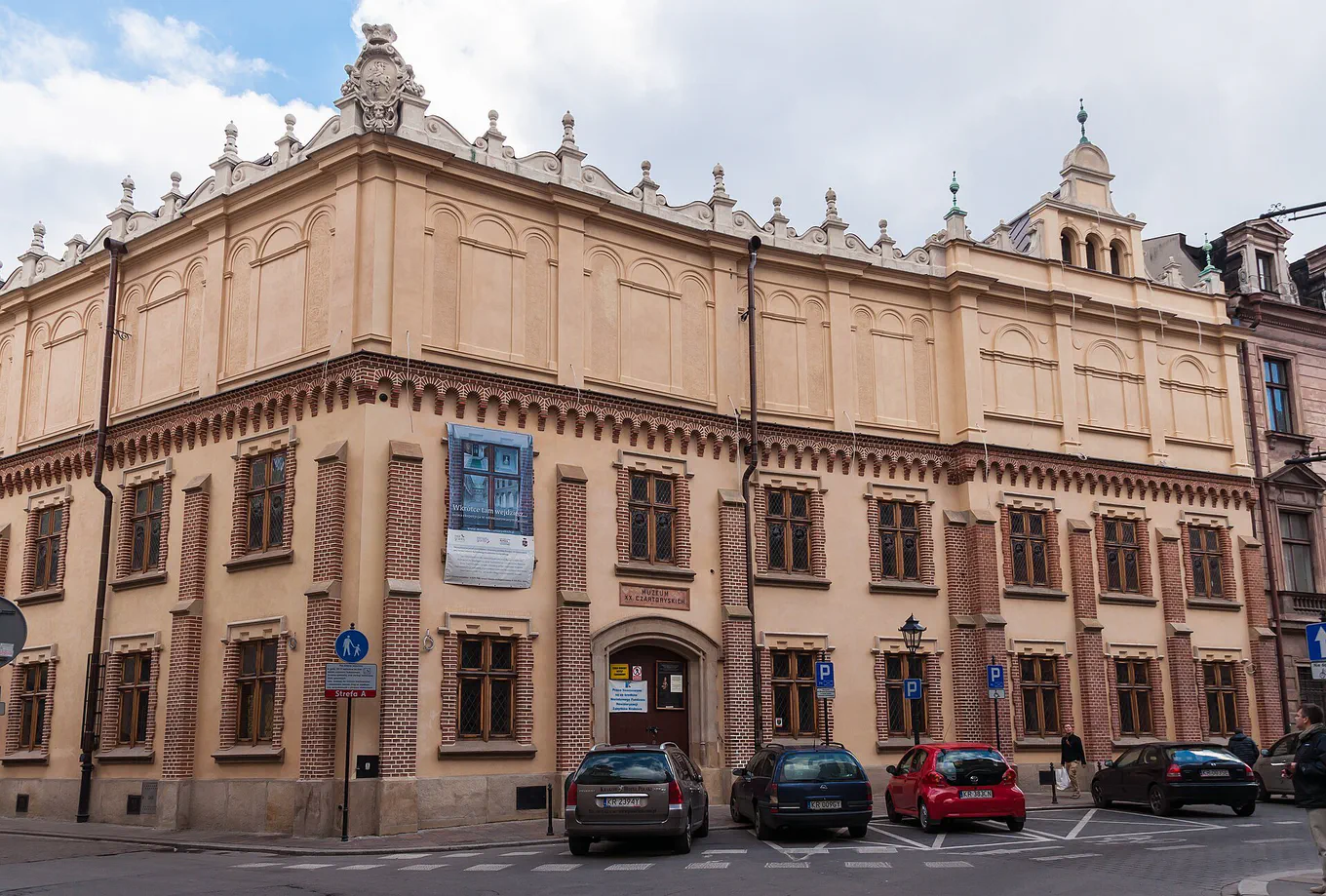
Only four portraits of women by Leonardo da Vinci survive. One is the Mona Lisa. Another, Lady with an Ermine, entered the Czartoryski collection, and in 1830 the 84-year-old Princess Czartoryska hid it from the Russian army. The Nazis seized it and sent it to Berlin, where in 1940 Hans Frank, governor-general of occupied Poland, saw it and had it brought back to Kraków to hang in his offices in Wawel Castle. Allied troops found it in his Bavarian home. It came home in 1946, the year Frank was hanged.
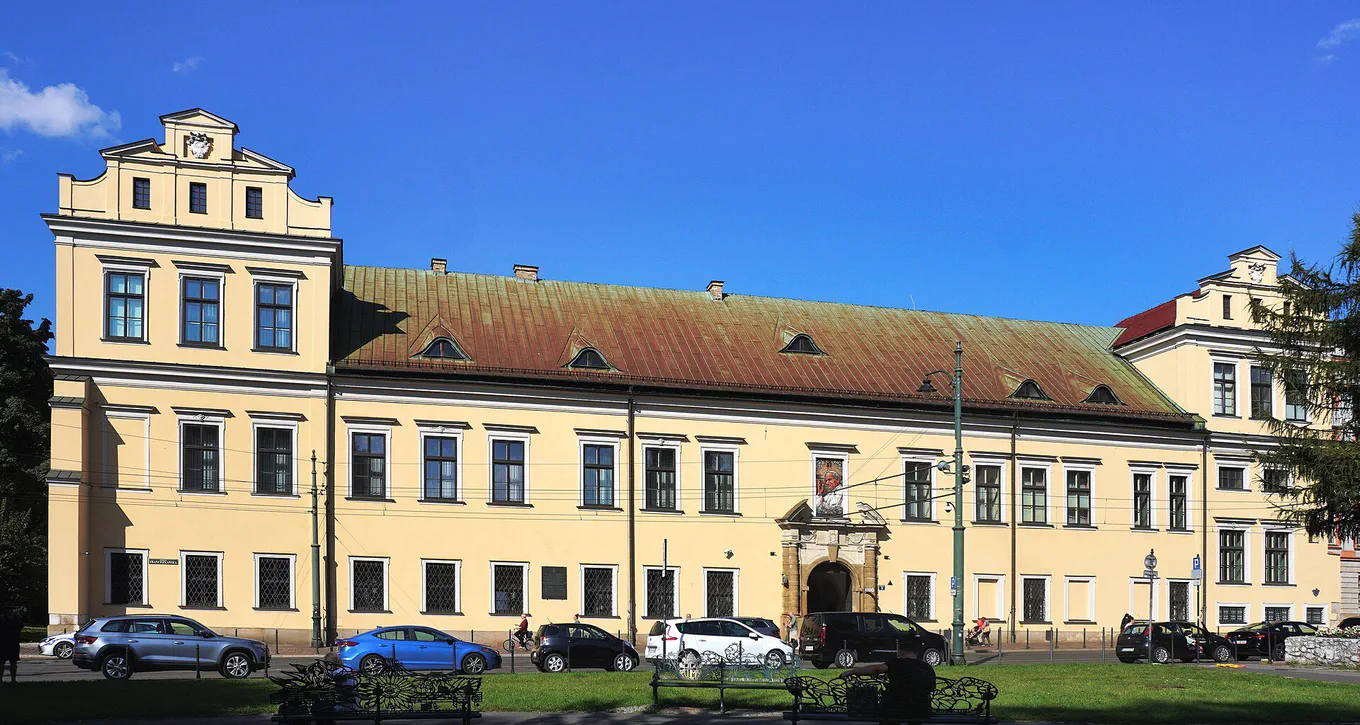
Before he was Pope John Paul II, Karol Wojtyła was a student in wartime Kraków who wanted to be a priest. He worked in a limestone quarry to avoid deportation to Germany, and studied at the archbishop’s secret seminary. He became Archbishop of Kraków himself, and lived in this palace. In October 1978, he was elected pope. On his visits home he stayed here, and at night he spoke to the crowds from the window above the door. It is still called the papal window.
3 Veit Stoss, the St Mary’s altarpiece, and a forger’s sentence
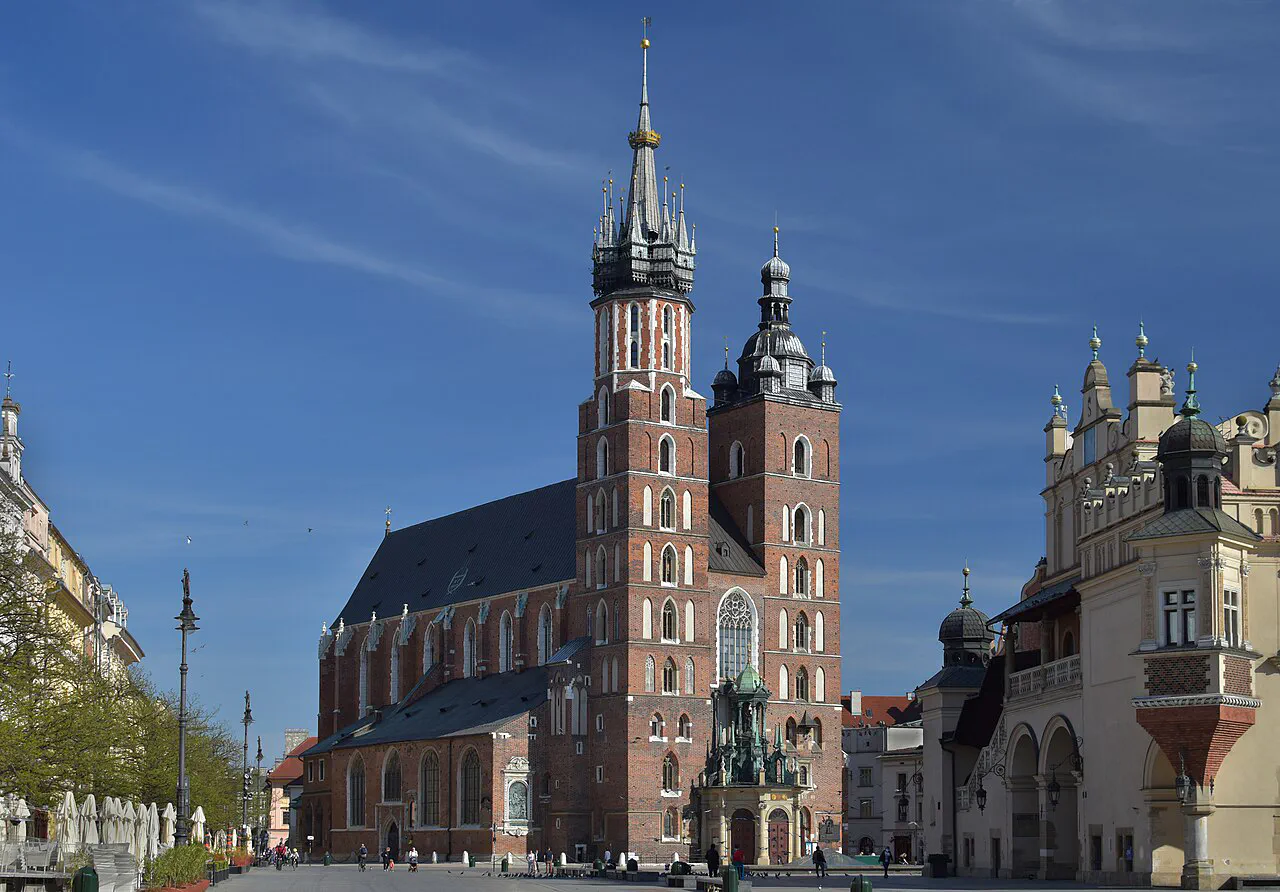
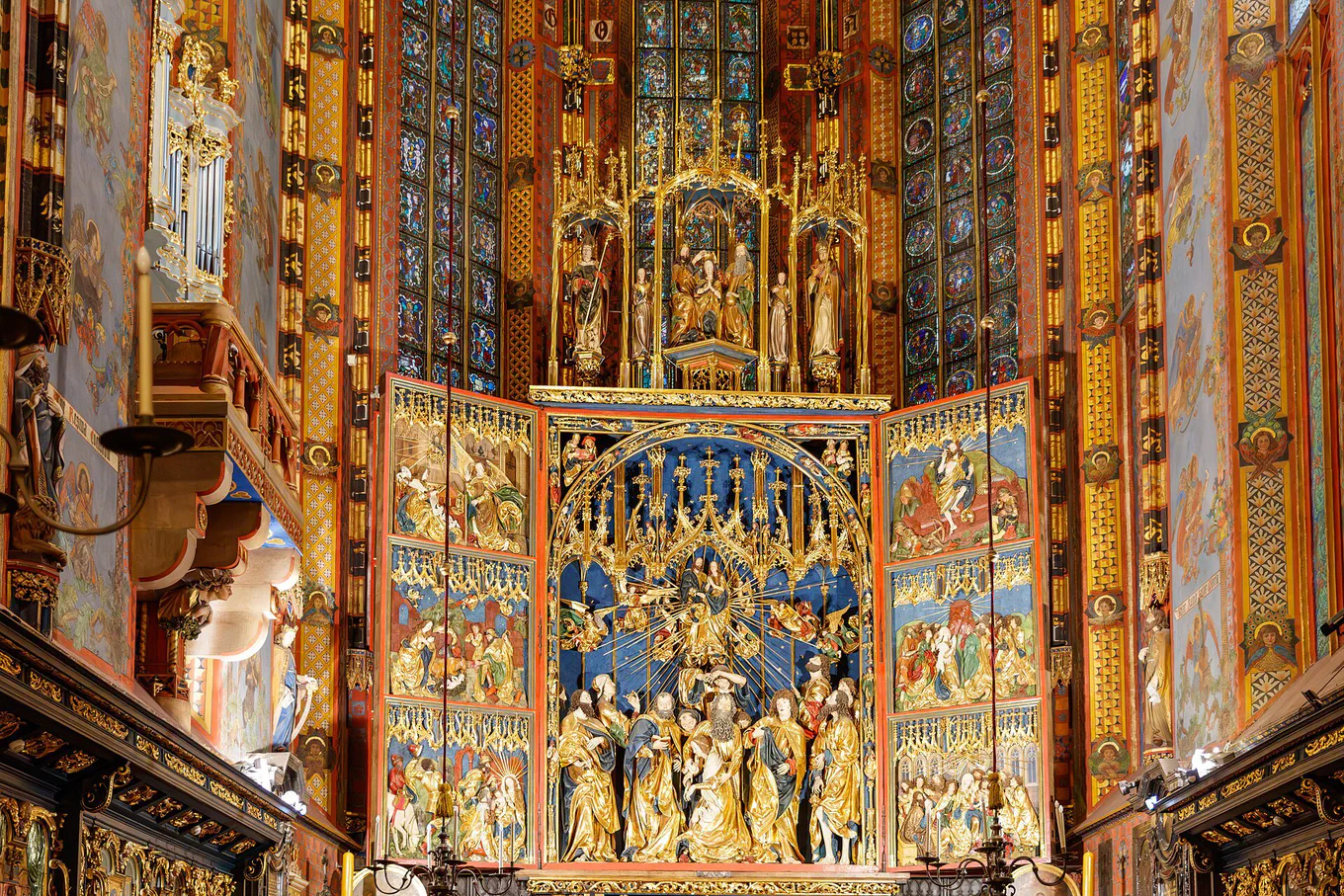
Stand here. St Mary’s Basilica, on the Main Market Square. The altarpiece stands behind the high altar, about 13 metres high and 11 wide when open.
Veit Stoss, a sculptor from Nuremberg, spent almost twenty years in Kraków, then Poland’s royal capital. His altarpiece for St Mary’s is a triptych, in three panels, with figures 2.7 metres tall, each carved from the trunk of a lime tree. When he finished it in 1489, it was the largest triptych of its time. Then he went home. In Nuremberg, he was arrested for forging a seal and a signature, and sentenced to be branded on both cheeks. Three years later, the emperor pardoned him.
4 Skuba the cobbler and the Wawel Dragon
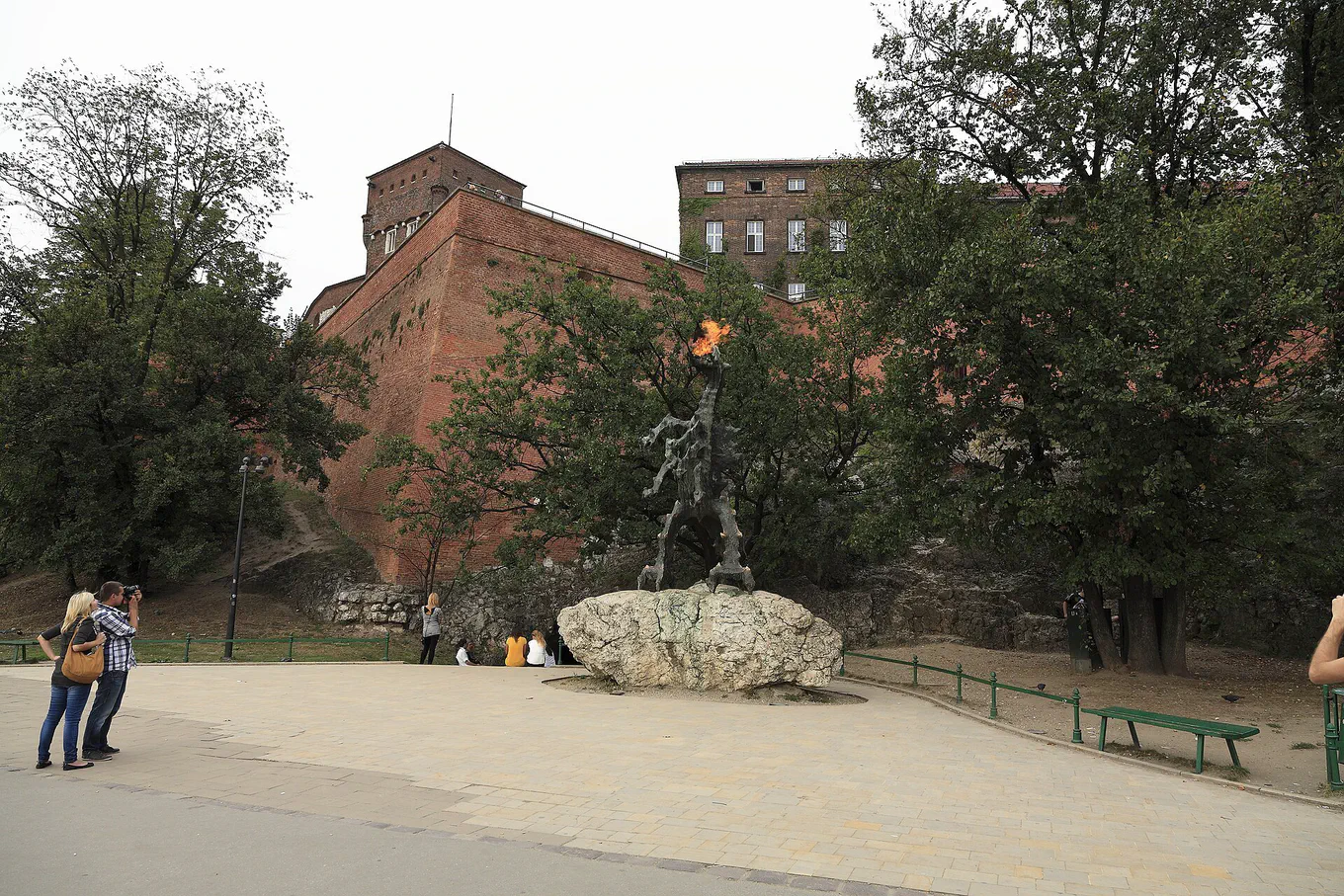
Stand here. The Dragon’s Den, a cave below Wawel Castle, on the edge of the Vistula. Outside it, a seven-headed metal dragon breathes fire every few minutes.
Legend says Kraków was built above a dragon’s cave, and the king promised his daughter to whoever killed the dragon. In the popular telling, a cobbler’s apprentice named Skuba took up the challenge. He didn’t fight. He stuffed a lamb with sulphur and left it outside the cave. The dragon ate it, grew so thirsty it drank from the Vistula, and kept drinking until it burst. Skuba married the princess. In the oldest telling, two princes kill the dragon. Then the younger kills the elder and blames the dragon.
Pack nothing. Leave Friday.
Every Friday, I write a free letter, Journey, that takes us on a trip through places, stories, and ideas.
The Trumpeter of Krakow(Eric P. Kelly, 1928). A novel. Its hero, Andrew, becomes night trumpeter at St Mary’s, around the fire that burned much of the city in 1462.
The Wedding(Stanisław Wyspiański, 1901). A play, inspired by a poet’s real wedding at St Mary’s Basilica and the reception in Bronowice, a village now part of Kraków.
The Cracow Ghetto Pharmacy(Tadeusz Pankiewicz, 1947). A memoir by the man who kept the ghetto’s only pharmacy, Under the Eagle, in Podgórze. It is now a museum.
Films to watch before you visit Kraków
Schindler’s List(Steven Spielberg, 1993). A film, shot in Kraków in black and white. Its exterior and stair scenes were filmed at Schindler’s real enamel factory, on Lipowa Street.
The Double Life of Véronique(Krzysztof Kieślowski, 1991). A film. Walking through the Main Market Square, Weronika sees a French tourist who looks identical to her, taking photographs.
Man of Marble(Andrzej Wajda, 1977). A film about a worker held up as a model of over-achievement in Nowa Huta, a new socialist city near Kraków.
Vinci(Juliusz Machulski, 2004). A film. An art thief is hired to steal Leonardo’s Lady with an Ermine from the Czartoryski Museum.
Questions
Where can you see Leonardo’s Lady with an Ermine?
At the Czartoryski Museum, at Pijarska Street 15, a branch of the National Museum in Kraków. The painting is on permanent display there, and it returned to the museum for its reopening on 19 December 2019.
Does the Wawel dragon statue really breathe fire?
Yes. Bronisław Chromy’s metal dragon has stood in front of the Dragon’s Den, below Wawel Castle, since 1972. It breathes fire every few minutes, from a natural gas nozzle in its mouth. It has seven heads, though people often take it for one head and six forelegs. The cave itself can be visited.
Was Kraków the capital of Poland?
Yes. It became the seat of Polish monarchs in 1038, and they were crowned and buried in Wawel Cathedral. In 1596, Sigismund III Vasa moved the capital to Warsaw, but Kraków is still officially the Royal Capital City of Kraków.