My one A at school was Classical Studies, so I’ve always had a soft spot for Claudius. His own mother called him a monster. He became emperor anyway. In Lyon, his birthplace, a draper dug up his Senate speech for the Gauls in a vineyard 1,480 years later.
— Nick
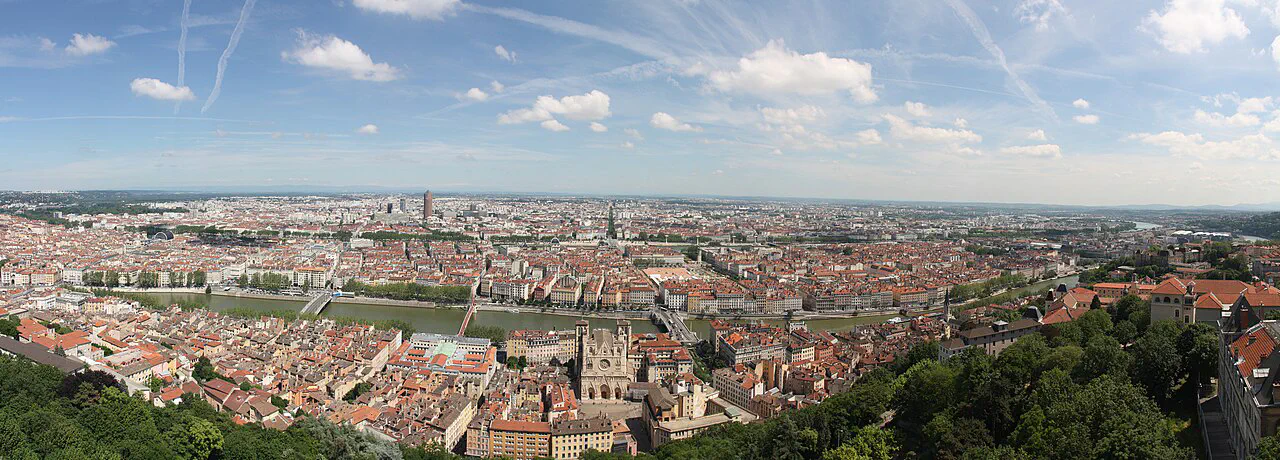
Lyon stands where the Rhône and the Saône meet, 391 km southeast of Paris, and it is France’s third-largest city. The Romans founded it in 43 BC, and it became an important centre of silk weaving. Its stories here are an emperor’s speech found in a vineyard, a tooth-puller’s puppet, a night of candles, a factory gate on film, and an airman who never came back.
1 Claudius’s bronze speech, found on the Croix-Rousse
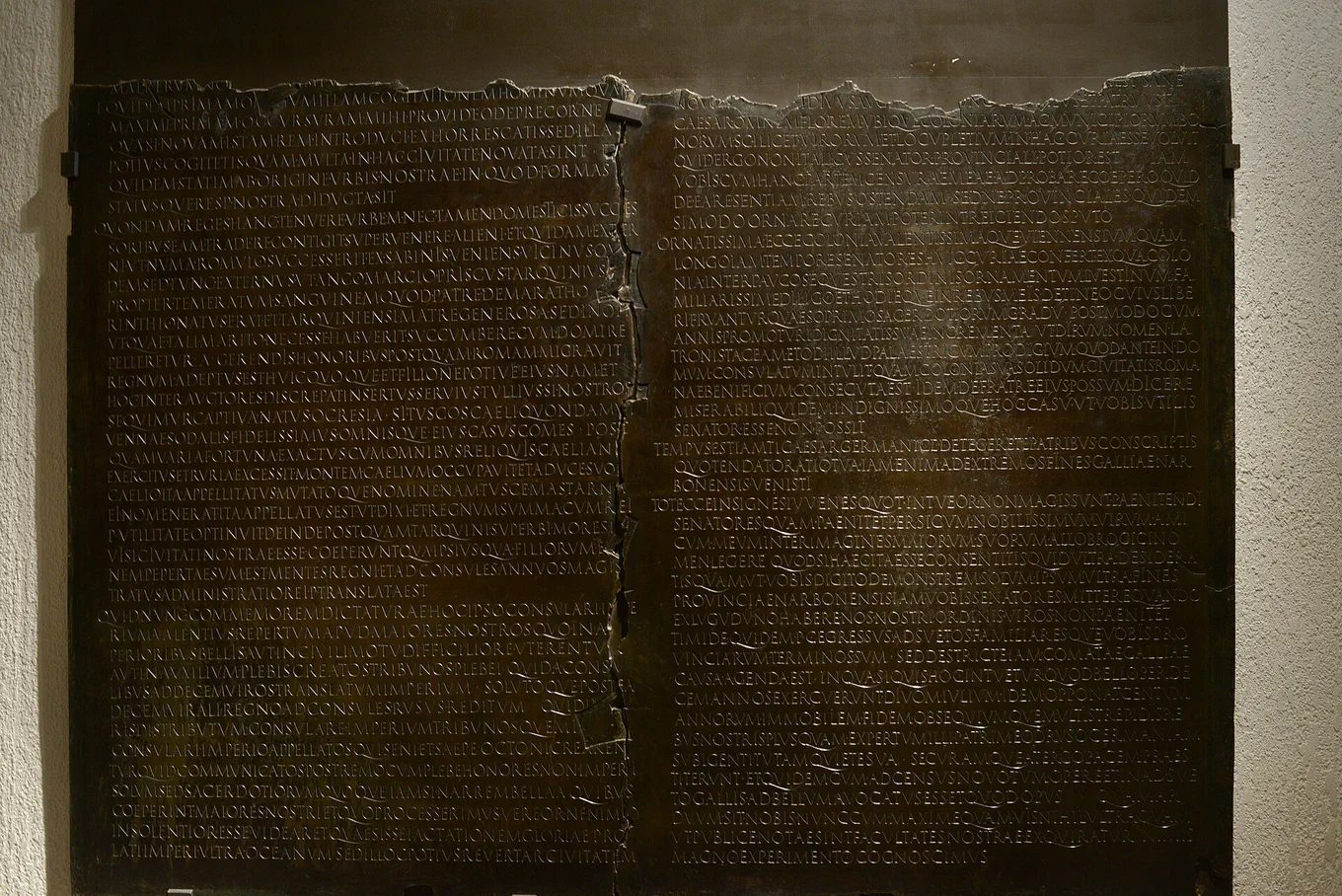
Stand here. Lugdunum, the Gallo-Roman museum at 17 rue Cléberg. The surviving lower part of the tablet, broken in two, is inside.
The bronze Claudian Tablet, recording Emperor Claudius’s speech to the Senate, in the Lugdunum museum in Lyon.Ruthven / CC0.
Readers of Robert Graves’s I, Claudius know the emperor his family took for a harmless idiot. He was born here, in Lugdunum, and his limp and stammer made his family shun him. His mother called him a monster. In AD 48, he asked the Senate in Rome to admit Gaul’s leading men. Senators kept urging him to get to the point, but the proposal was carried, and the speech was set up here in bronze. In 1528, a draper found the surviving lower part in his vineyard on the Croix-Rousse.
2 Laurent Mourguet, the Lyon tooth-puller who made Guignol
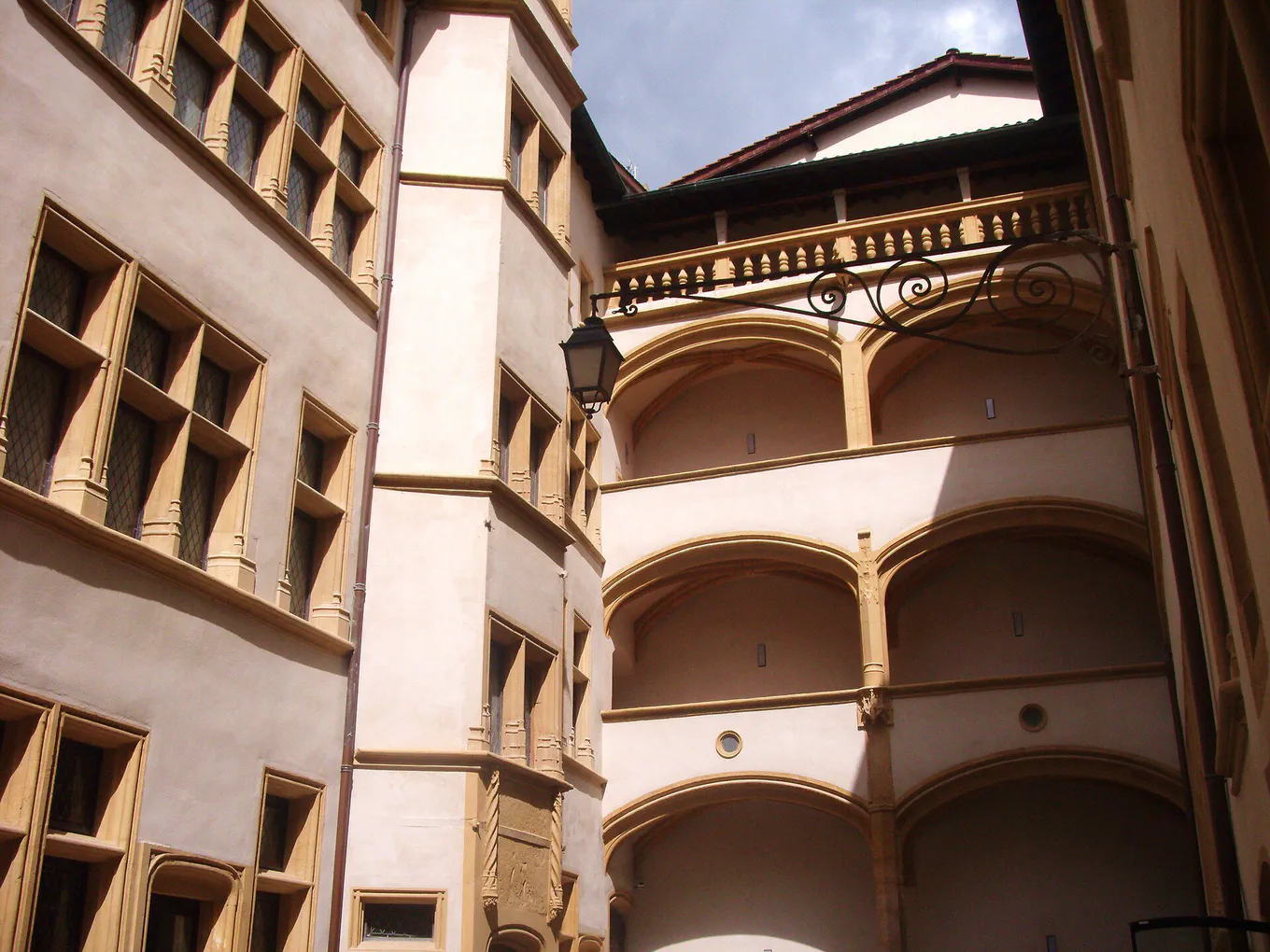
Stand here. The Musées Gadagne, 1 place du Petit Collège, in Vieux Lyon. Its puppet museum keeps the very first Guignol, Gnafron, and Madelon.
Laurent Mourguet came from a family of Lyon silk weavers, and he took up pulling teeth. The pulling was free. His money came from the medicines he sold afterwards to ease the pain, so to draw patients he set up a puppet show in front of his chair. The puppets were such a success that he gave up teeth for good. In 1808, he made a new puppet and dressed it like Lyon’s silk workers, down to the braided pigtail. He called it Guignol.
3 The storm that started Lyon’s Fête des Lumières
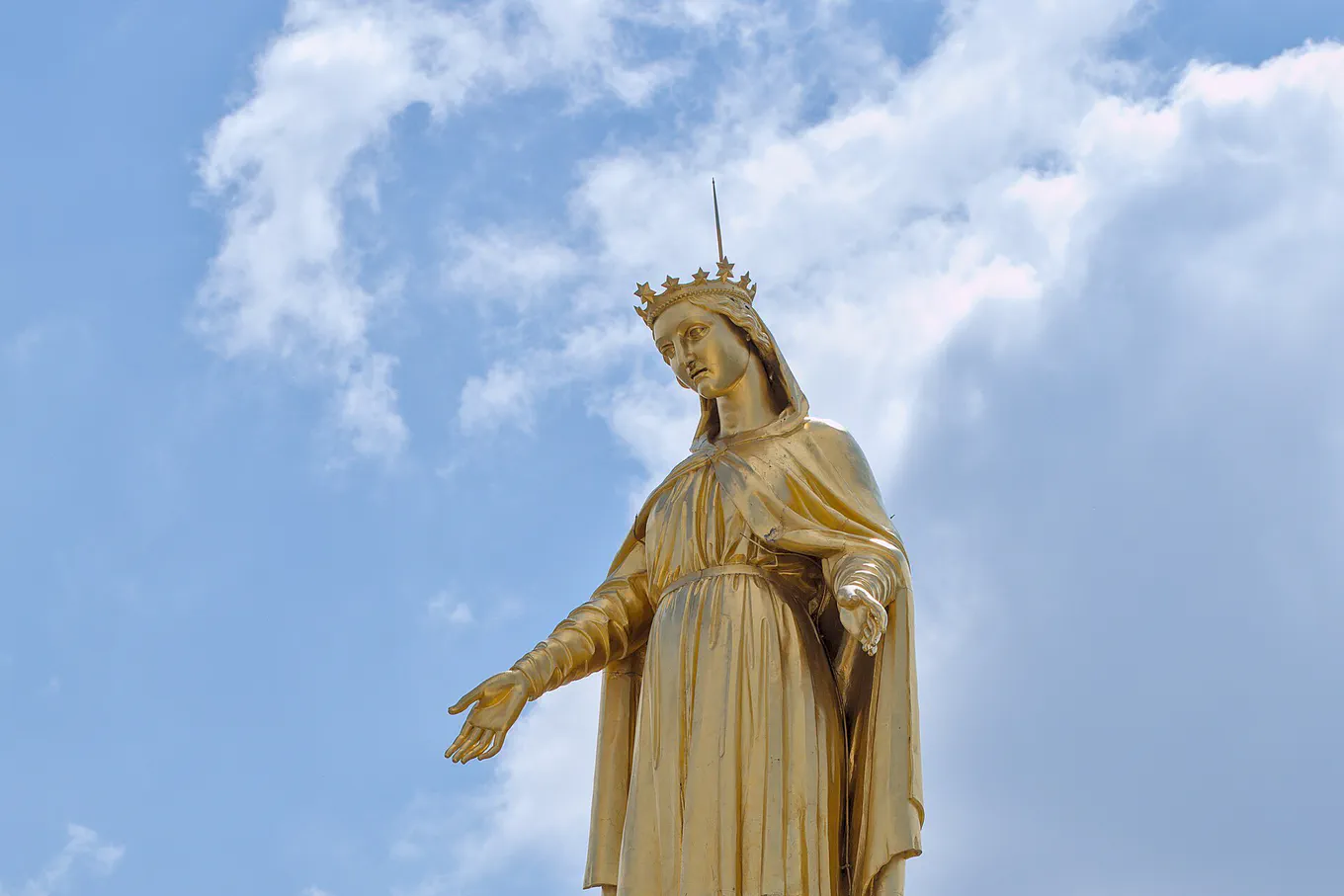
Stand here. The Chapelle de la Vierge on Fourvière hill, beside the basilica. The golden statue of the Virgin still stands on its tower.
The golden statue of the Virgin by Joseph-Hugues Fabisch on the bell tower of the Chapelle Saint-Thomas at Fourvière, Lyon.Romainbehar / Public domain.
Lyon’s Fête des Lumières, its festival of lights, began with a ceremony called off. A new golden statue of the Virgin was to be unveiled at Fourvière on 8 September 1852, but the Saône flooded and the statue wasn’t ready. The archbishop moved the day to 8 December. That morning a storm struck, and the master of ceremonies cancelled everything. Then the sky cleared, and the people of Lyon put candles in their windows anyway. Every 8 December since, the candles have gone back in the windows.
4 The Lumière brothers film their factory gates in Monplaisir
Stand here. Rue du Premier-Film, “First Film Street”, in Monplaisir. The Lumière family villa beside it is now the Institut Lumière, a museum of cinema.
Auguste and Louis Lumière are remembered for the birth of cinema, but their family business in Lyon was photographic plates. In 1895, Louis lectured in Paris on how the factory made them, and he showed a short film of the workers leaving its gates. To his surprise, the invited guests cared more about those moving black-and-white figures than about his coloured stills. The brothers are reported to have said that “the cinema is an invention without any future”, and by 1905 they had left it for colour photography.
5 Saint-Exupéry and the Little Prince on Place Bellecour
Stand here. The west end of Place Bellecour. Saint-Exupéry sits on a five-metre marble block, with the Little Prince behind him.
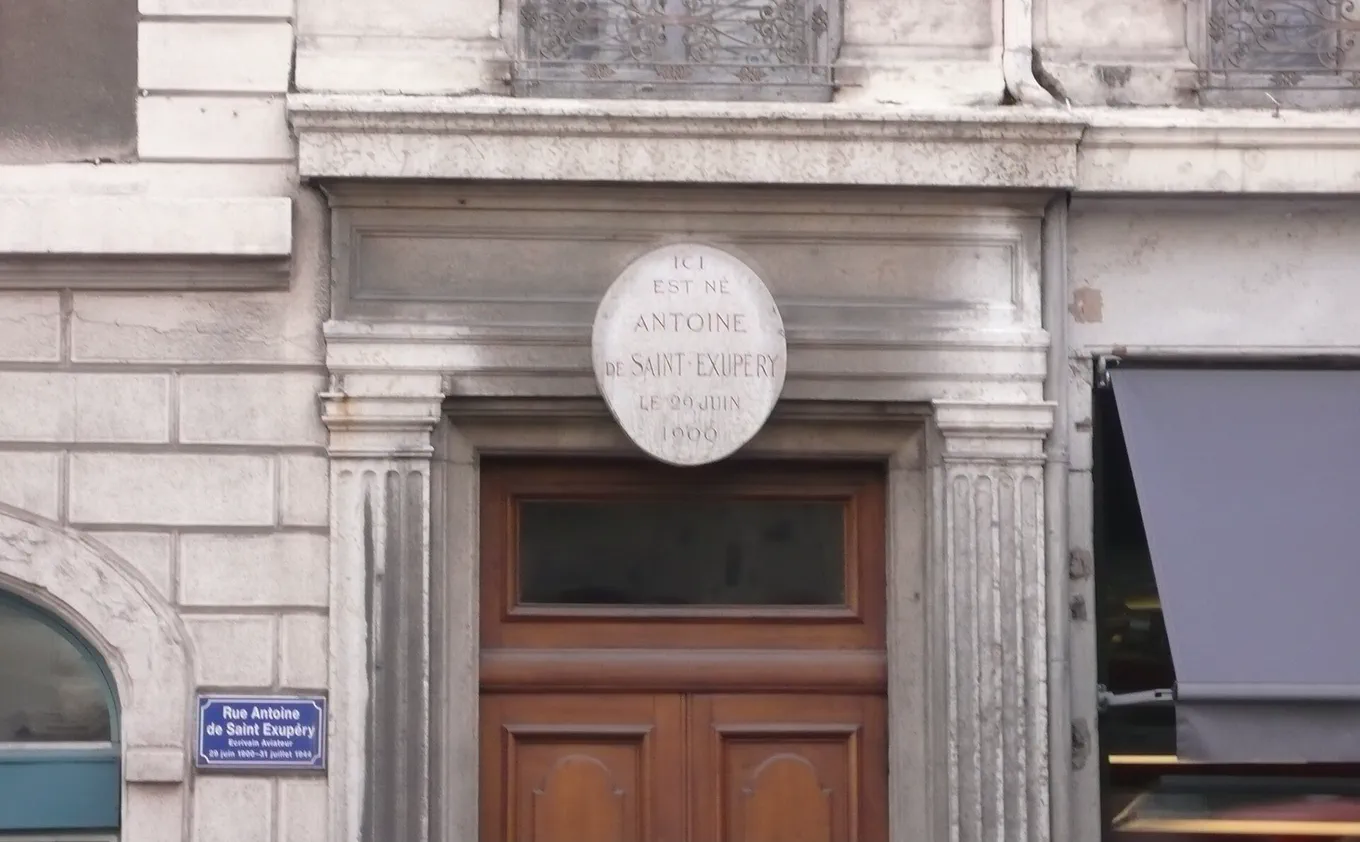
The Little Prince was written and drawn by a man born near this square, at No. 8 on the street that now bears his name. Antoine de Saint-Exupéry learned to fly in the army and became a pioneer of airmail, flying between Toulouse and Dakar when planes had few instruments. On 31 July 1944, he took off from Corsica on a reconnaissance flight over southern France and never came back.
Dirt(Bill Buford, 2020). A book on Buford’s time in Lyon, 2008 to 2013, including classes at the Institut Paul Bocuse and, at greatest length, work as a stagiaire at La Mère Brazier.
Vivre vite(Brigitte Giraud, 2022). A memoir. Brigitte Giraud examines the circumstances that led to the accidental death of her husband, Claude, in Lyon on 22 June 1999. Winner of the 2022 Prix Goncourt.
Enfant de salaud(Sorj Chalandon, 2021). A novel in which the journalist Sorj Chalandon is sent to Lyon in 1987 to cover Klaus Barbie’s trial for crimes against humanity.
Films to watch before you visit Lyon
A Man Escaped(Robert Bresson, 1956). A film. In Lyon in 1943, a Resistance fighter called Fontaine jumps from the car taking him to Montluc prison.
Army of Shadows(Jean-Pierre Melville, 1969). A film. After his escape, its hero, Gerbier, settles in Lyon, and scenes were shot on place de la Trinité.
The Clockmaker of St. Paul(Bertrand Tavernier, 1974). A film. A clockmaker in Vieux Lyon’s Saint-Paul quarter lives alone with his son, with his workshop at 4 rue de la Loge.
Hôtel Terminus: The Life and Times of Klaus Barbie(Marcel Ophüls, 1988). A documentary, named after the Lyon hotel the Gestapo used as its headquarters from late 1942.
Lucie Aubrac(Claude Berri, 1997). A film about Lucie Aubrac and her husband, Raymond, around Lyon in 1943 and 1944. The convoy attack was shot on montée de l’Observance.
Questions
Where can you see Guignol in Lyon?
At the Musées Gadagne, 1 place du Petit Collège, in Vieux Lyon. Its puppet museum keeps the very first puppets Laurent Mourguet made, Guignol and his two companions, Gnafron and Madelon, and gives Guignol a special place throughout.
When is the Fête des Lumières?
It lasts four days and peaks on 8 December. It goes back to 8 December 1852, when the people of Lyon put candles in their windows for a new golden statue of the Virgin at Fourvière. In 2026, it runs from Saturday 5 to Tuesday 8 December.
Is Lyon a UNESCO World Heritage Site?
Yes. The historic site of Lyon was listed in 1998. It takes in Fourvière and the Roman district, Vieux Lyon, the old silk district on the slopes of the Croix-Rousse, and the Presqu’île. Vieux Lyon is one of the most extensive Renaissance neighbourhoods in Europe.