Milwaukee, United States, Wisconsin, North America
If nothing else, Milwaukee gave us a Theodore Roosevelt speech that I took to heart when I first created this website. “We must all either wear out or rust out, every one of us. My choice is to wear out.”
— Nick
Three rivers meet on the western shore of Lake Michigan at Milwaukee, the most populous city in Wisconsin. Incorporated in 1846, it became a centre of German American culture and a national leader in brewing. Read on for a bullet slowed by a speech, a motorcycle from a backyard shed, a jacket a network wouldn’t allow, a brewer lost at sea, and a war over bridges.
1 Theodore Roosevelt’s speech with a bullet in his chest
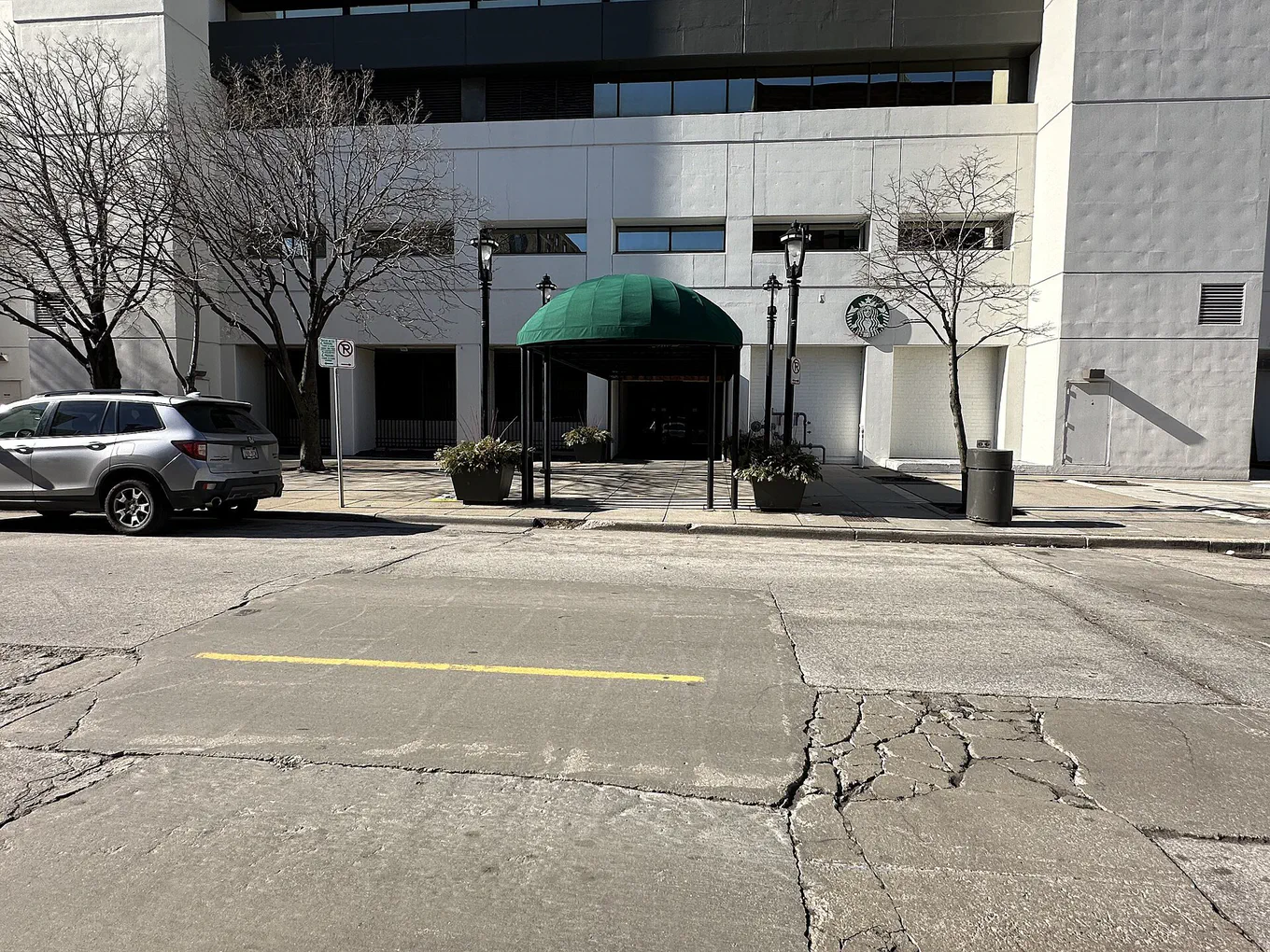
Stand here. The Hyatt Regency, at Third Street and Kilbourn Avenue, stands on the site of the Gilpatrick Hotel. Opposite, the Auditorium is now the Miller High Life Theatre.
The Hyatt Regency Milwaukee on Martin Luther King Jr. Drive, built on the site of the Gilpatrick Hotel.Bruxton / CC0.
In 1912, former president Theodore Roosevelt was running again, for the Progressive or “Bull Moose” Party. On 14 October, outside the hotel, a saloonkeeper who had followed him from New Orleans shot him in the chest. The bullet hit his steel glasses case and a 50-page copy of his speech before it lodged. Roosevelt crossed the street and gave that speech anyway, blood seeping into his shirt. It took more than that, he said, “to kill a bull moose.” He carried the bullet for the rest of his life.
2 Harley-Davidson and the backyard shed where it began
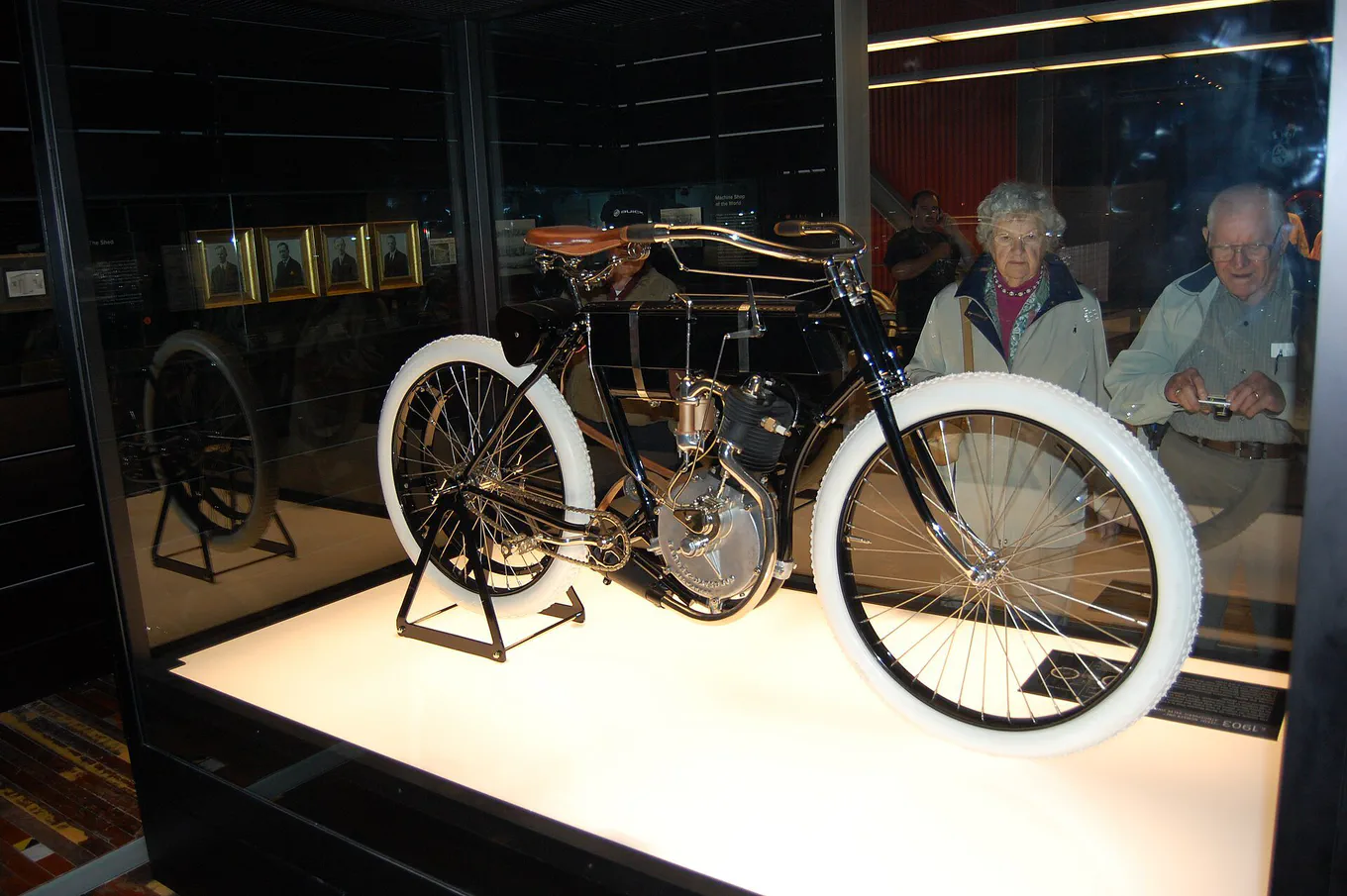
Stand here. The Harley-Davidson Museum, in the Menomonee Valley. Serial Number One sits in glass inside a lit outline of the shed, set in the floor.
Harley-Davidson started with William Harley, a 20-year-old apprentice draftsman, designing a small engine for an ordinary bicycle. He and his childhood friend Arthur Davidson built the machine in a wooden shed in the Davidson backyard, finishing in 1903. But it couldn’t climb Milwaukee’s hills unless they pedalled. They wrote it off as a learning experiment and built a new, loop-framed prototype in the 10-by-15-foot shed. Years later, the company moved the shed to its Juneau Avenue factory, where it stood for decades as a tribute.
3 The Fonz’s leather jacket and Milwaukee’s Bronze Fonz
Stand here. The Bronze Fonz, on the Milwaukee Riverwalk just south of Wells Street, unveiled in 2008 with most of the Happy Days cast there.
Happy Days, the ABC sitcom set in 1950s Milwaukee, made a star of Henry Winkler’s Fonzie. The writers wanted their cool biker in a black leather jacket, but ABC thought leather suggested criminality, so he wore a windbreaker. The writers won an exception for scenes with his motorcycle. Then they put the motorcycle in every scene he was in, even indoors, until ABC gave in. The windbreaker went in the bin. In 1980, the Smithsonian asked Winkler for one of Fonzie’s leather jackets.
4 Joseph Schlitz, the brewer whose name outlived him
Stand here. Schlitz Park, where the surviving buildings of the old Schlitz brewery are now a mixed-use development. The Brewhouse was demolished in 2013.
“The beer that made Milwaukee famous” carried the name of a man who never heard the slogan. Joseph Schlitz was the bookkeeper at August Krug’s brewery. When Krug died unexpectedly, Schlitz took over, married the widow, and renamed the brewery after himself. In 1875, travelling to Germany, he died when the SS Schiller was wrecked in fog off the Isles of Scilly. His body was never found. His will asked for the Uihlein brothers to run the brewery, and they kept his name on the beer. Americans stumbled over theirs.
5 Byron Kilbourn and Milwaukee’s Bridge War of 1845
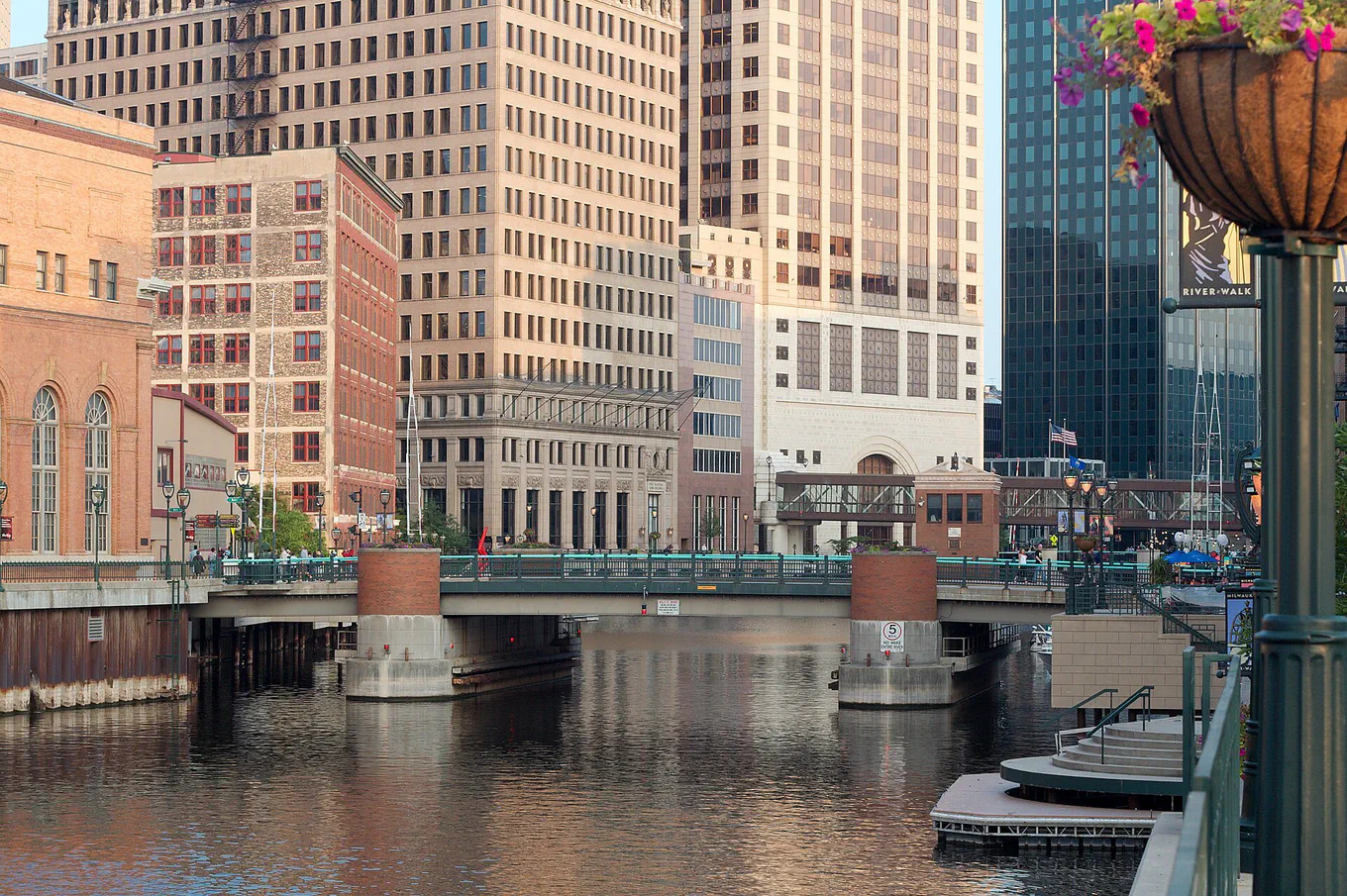
Stand here. The Juneau Avenue bridge over the Milwaukee River, where the Chestnut Street bridge stood. Many bridges downtown still cross the river at an angle.
Milwaukee began as rival towns facing each other across its river. On the west bank, Byron Kilbourn wanted Juneautown, on the east, to depend on him, so he laid out his streets with no regard for Juneautown’s. In May 1845, a schooner rammed the one bridge Kilbourn backed. A West Side mob tore down their half of the Chestnut Street bridge, and East Siders aimed a cannon at Kilbourn’s house, planning to fire clock weights. They relented only when reminded that his daughter had died the night before.
Pack nothing. Leave Friday.
Every Friday, I write a free letter, Journey, that takes us on a trip through places, stories, and ideas.
Evicted: Poverty and Profit in the American City(Matthew Desmond, 2016). Non-fiction. Desmond lived in Central Mobile Home Park, a trailer park, and then a rooming house on the north side, observing the residents.
American Dervish(Ayad Akhtar, 2012). A novel. Hayat Shah, a young Pakistani American, lives in a suburb of Milwaukee with his unhappily married parents.
Films to watch before you visit Milwaukee
Happy Days(Garry Marshall, 1974–1984). A TV sitcom about teenager Richie Cunningham and his family in 1950s and 1960s Milwaukee. The Fonz now stands in bronze on the Riverwalk.
Laverne & Shirley(Garry Marshall, Lowell Ganz, and Mark Rothman, 1976–1983). A TV sitcom. Two roommates work as bottle-cappers at the Shotz Brewery, a made-up brewery in late-1950s Milwaukee.
Major League(David S. Ward, 1989). A film set in Cleveland but shot in Milwaukee, which was cheaper. Milwaukee County Stadium played Cleveland Stadium, and its old field is now Helfaer Field.
Mr. 3000(Charles Stone III, 2004). A film about Stan Ross, the conceited star of the Milwaukee Brewers, shot partly at Miller Park and Marquette University High School.
Questions
Where was Theodore Roosevelt shot in Milwaukee?
Outside the Gilpatrick Hotel, at Third Street and Kilbourn Avenue, on 14 October 1912. The hotel was razed in 1941, and the Hyatt Regency Milwaukee went up on the site in 1979, with a 1926 plaque from the old hotel fixed to it. The Auditorium across the street, where he gave his speech, is now the Miller High Life Theatre.
Why do Milwaukee’s bridges cross the river at an angle?
Because Milwaukee grew from rival towns. In 1835, Byron Kilbourn laid out his west-bank streets with no regard for Solomon Juneau’s town on the east bank, and the angled bridges are the legacy of the two mismatched grids. The rivalry boiled over in the Bridge War of 1845, and the city of Milwaukee was formed the following January.
Is Summerfest really the world’s largest music festival?
It holds the title, certified by Guinness World Records in 1999. First held in 1968, Summerfest runs from late June into early July, taking in the Fourth of July, at Henry Maier Festival Park beside Lake Michigan. In 2021 it announced a move to three weekends.