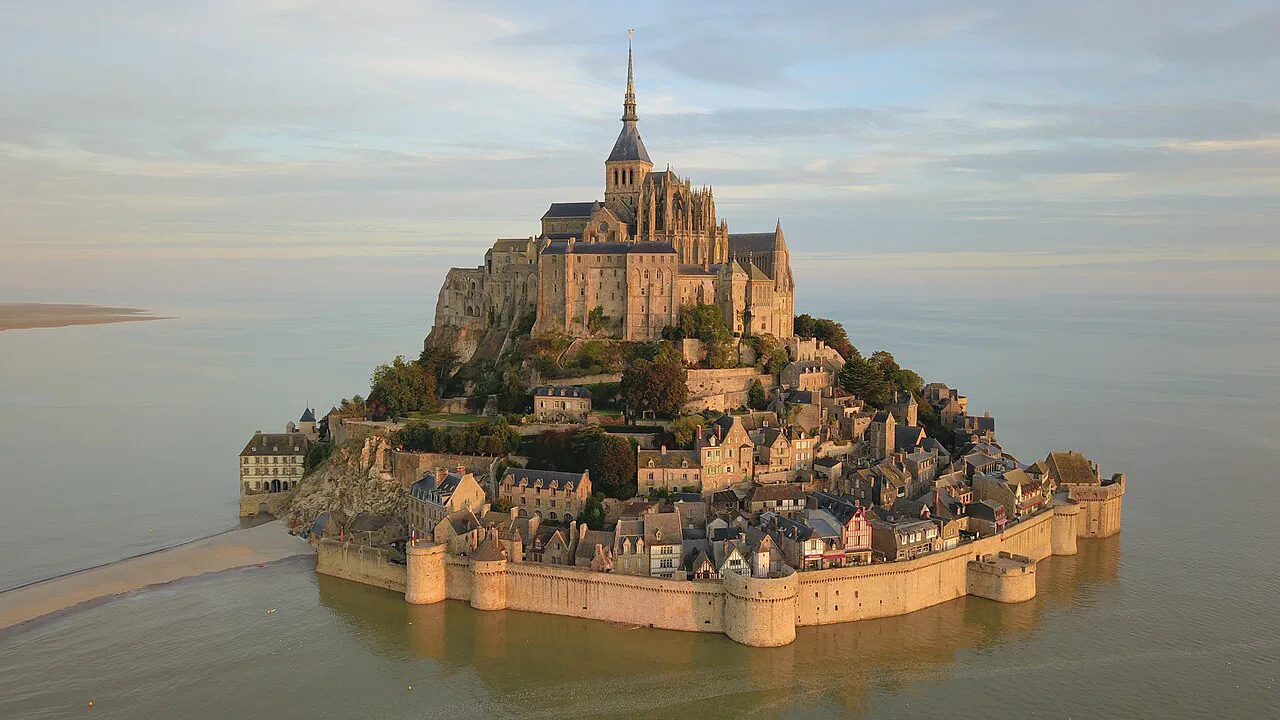
Victor Hugo came to Mont-Saint-Michel in 1836 and wrote that superlatives should be piled up there. Then, ‘all at once’, he saw a prisoner’s pale face behind a barred window. I love that, and I agree with his assessment. Mont-Saint-Michel is a magical place that feels closer to a storybook location than the real world has any right to.
— Nick
Mont-Saint-Michel is a tidal island about a kilometre off France’s north-western coast, in Normandy. Its abbey’s history begins in 708, and the Mont and its bay joined the UNESCO World Heritage list in 1979. Its stories are a bishop with a hole in his skull, Harold Godwinson in the quicksand, two abandoned English guns, Victor Hugo below a prison window, and an omelette made for the tides.
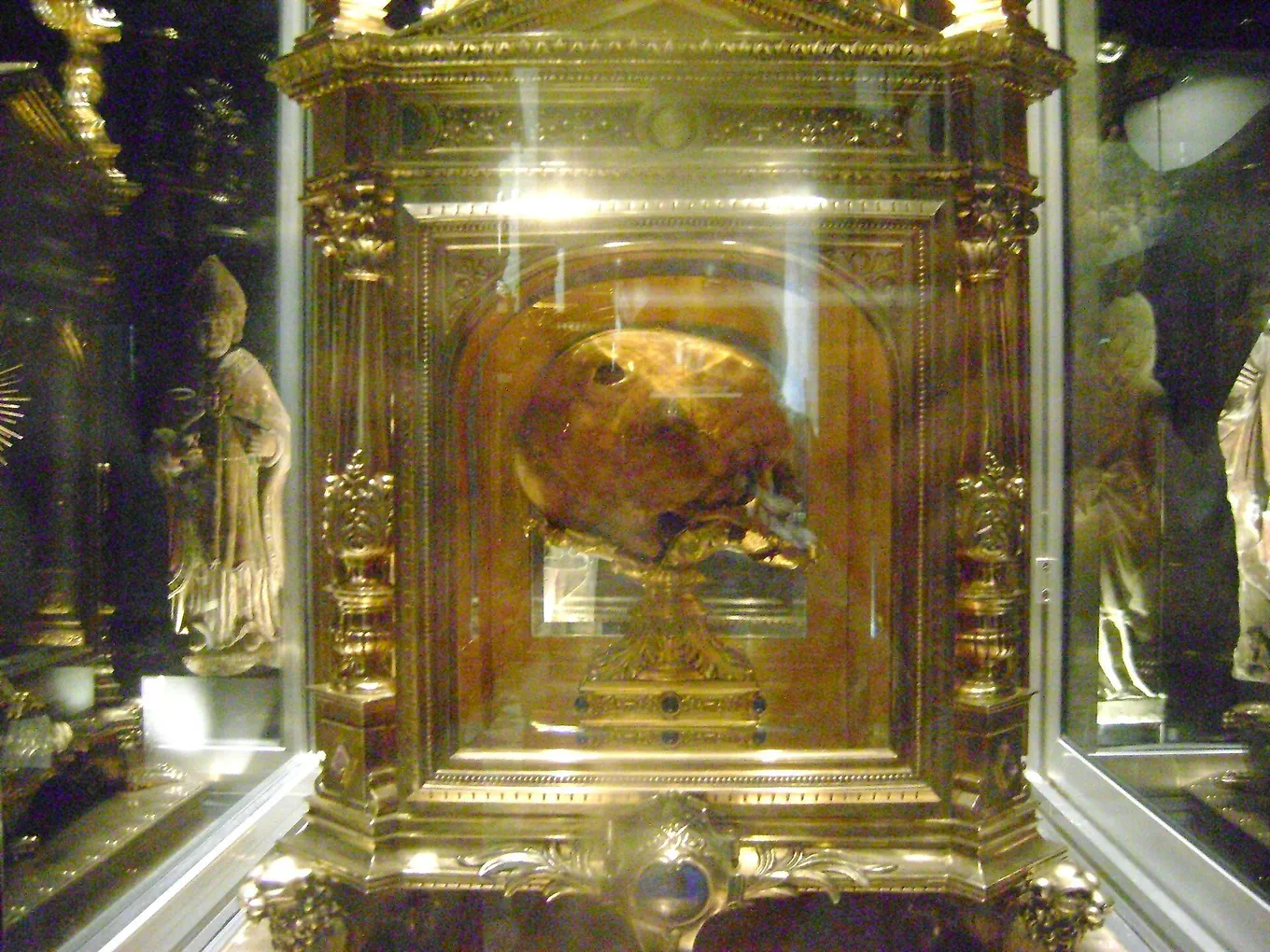
Saint Michael, the archangel in the Mont’s name, had to ask three times. In 708, the story goes, he appeared to Aubert, bishop of Avranches, and told him to build an oratory, a small chapel, on the tidal island. Aubert doubted it. When Michael came again, Aubert still hesitated, in case it was the Devil’s work. The third time, the archangel poked him in the head. The oratory was dedicated the next year, and Aubert’s skull survives, with a hole where the finger went in.
2 Harold Godwinson in the quicksand below Mont-Saint-Michel
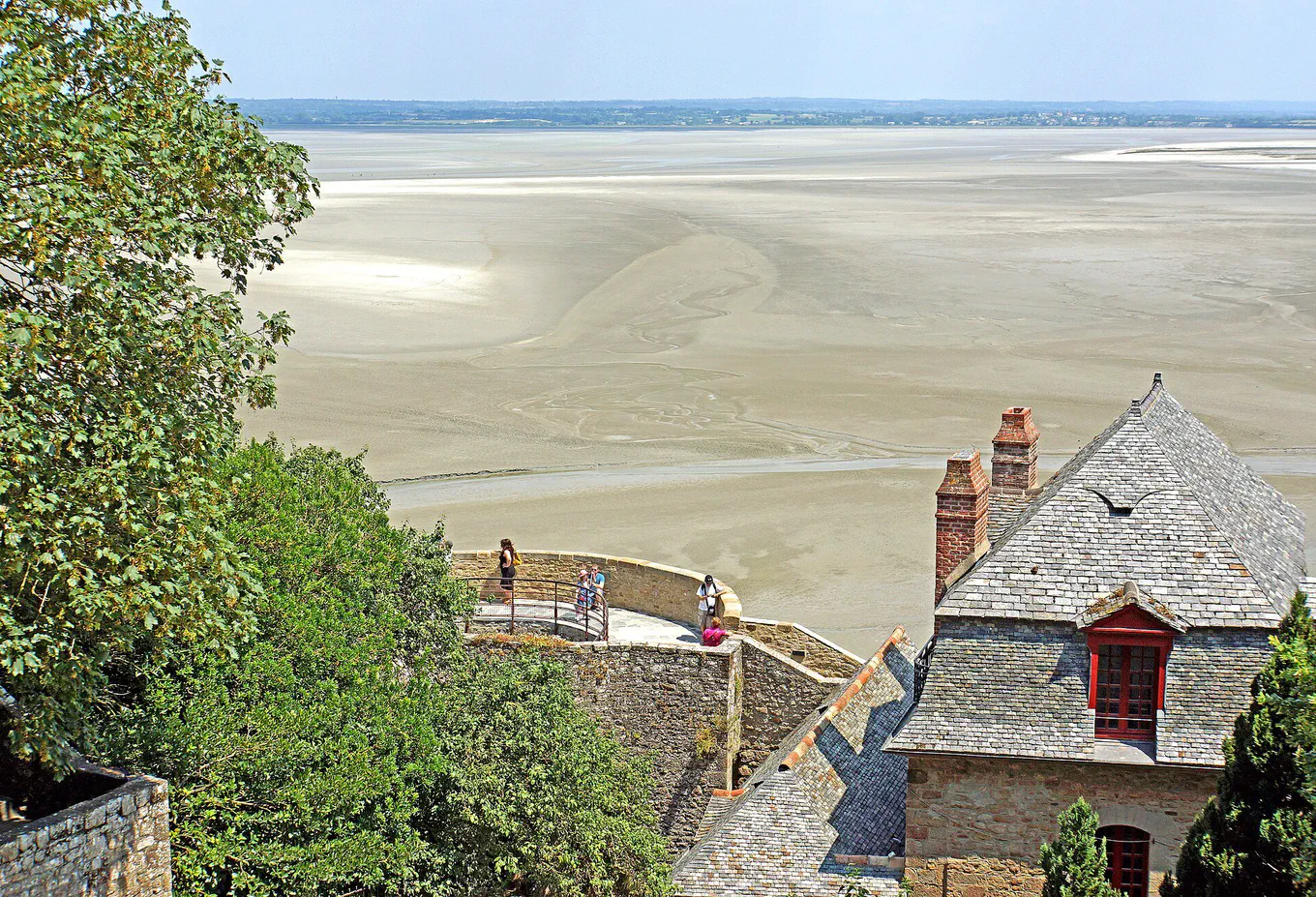
Stand here. The tidal flats below the Mont, at the mouth of the Couesnon. The bay still holds deep mud and quicksand.
The Bayeux Tapestry has a scene set below the Mont. In 1064, Harold Godwinson was apparently shipwrecked and handed over to William, Duke of Normandy. Harold went with William’s army against Brittany, and by the Mont the army got stuck in quicksand. Harold pulled two Norman soldiers out. By the Norman account, he swore on holy relics to support William’s claim to the English throne. In 1066, Harold took the crown himself, and died at Hastings, fighting the duke whose men he had saved.
3 The English guns left at the gate of Mont-Saint-Michel
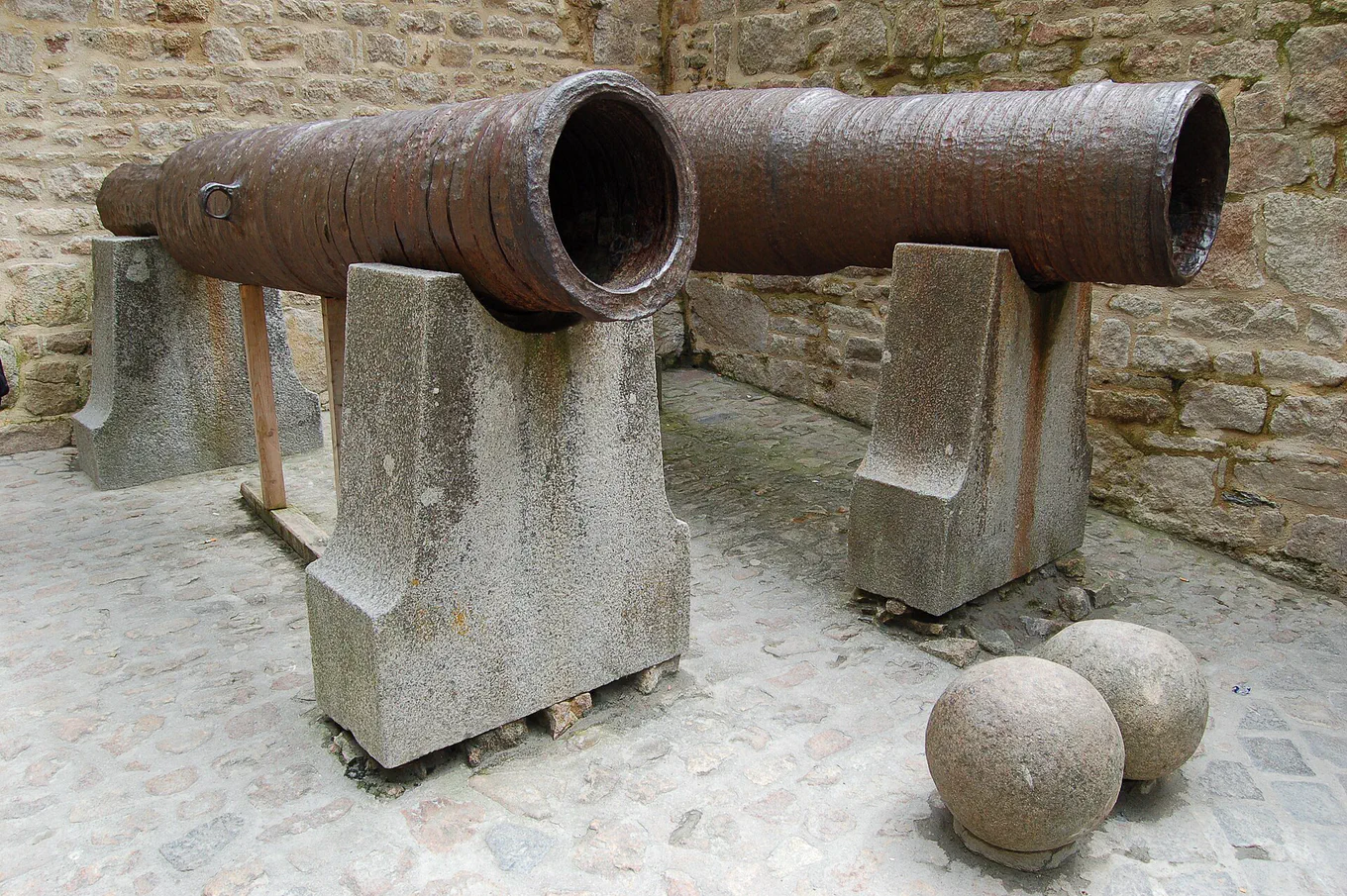
Stand here. The first courtyard inside the Mont’s main entrance, where the two bombards were listed as a historic object in 1902.
The two English bombards left behind by Thomas Scales’s army, inside the main gate of Mont-Saint-Michel.Greenshed / Public domain.
During the Hundred Years’ War, the English besieged the Mont, but they never took it. On 17 June 1434, their commander, Thomas Scales, led a fresh assault with bombards, early cannon made of wrought iron. It failed, and his men abandoned two of the guns. The French defenders recovered them. One record dates the capture earlier, to a siege of 1423. Either way, the guns the English brought to take the Mont ended up inside its gate.
4 Victor Hugo and the prisoner’s face at Mont-Saint-Michel
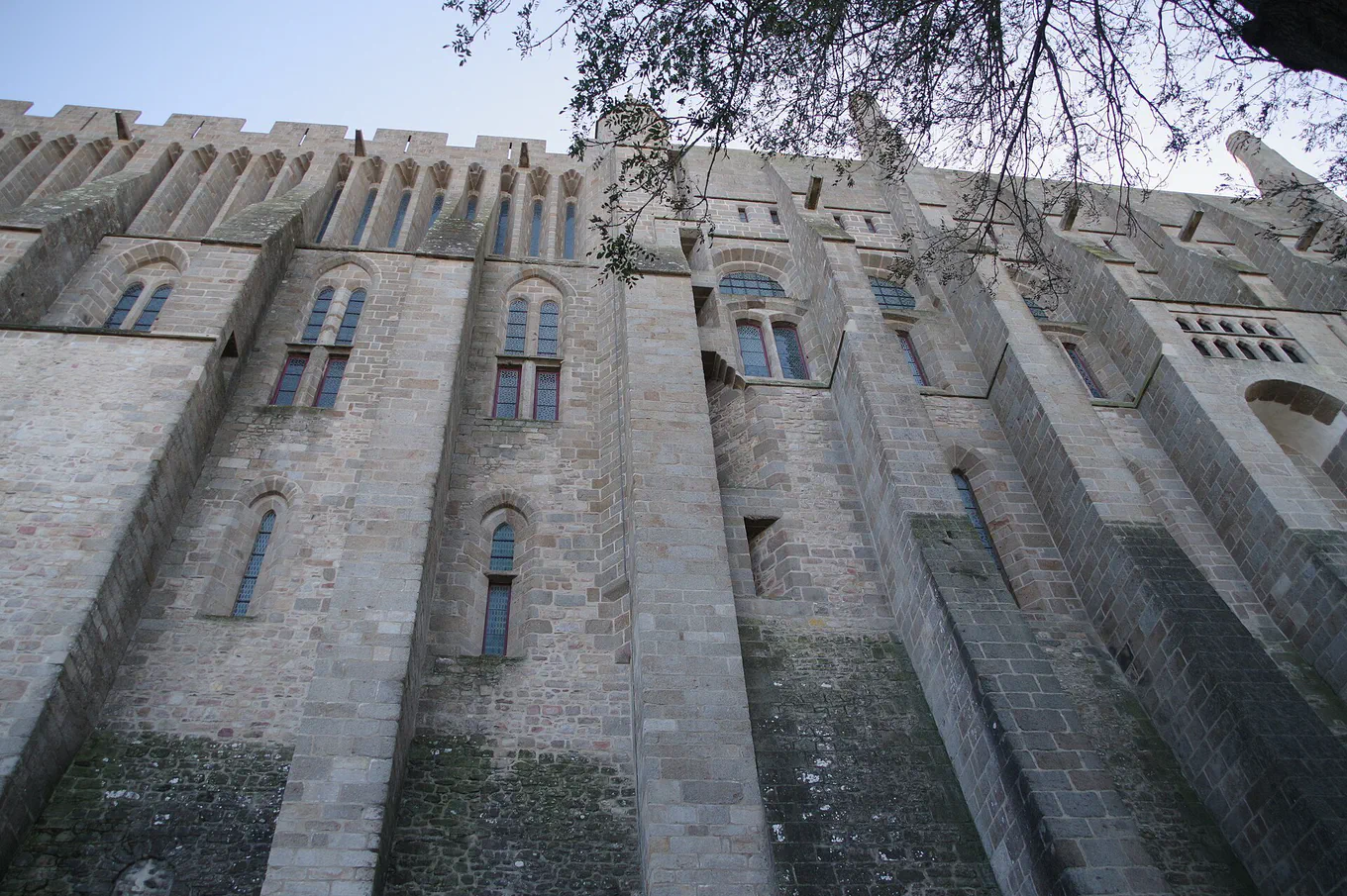
Stand here. The abbey at the top of the rock, a prison from 1791 to 1863 and listed as a Historic Monument in 1874.
Victor Hugo, the author of Les Misérables, saw the Mont in June 1836. He wrote that superlatives should be piled up there, as man had piled buildings on the rock. He described infinite space all around, the blue sea and the green land. Then, “all at once”, on an old wall above him, he saw “through a barred window, the pale face of a prisoner”. The abbey had become a jail, the Bastille of the Seas.
5 Annette Poulard’s tide omelette at Mont-Saint-Michel
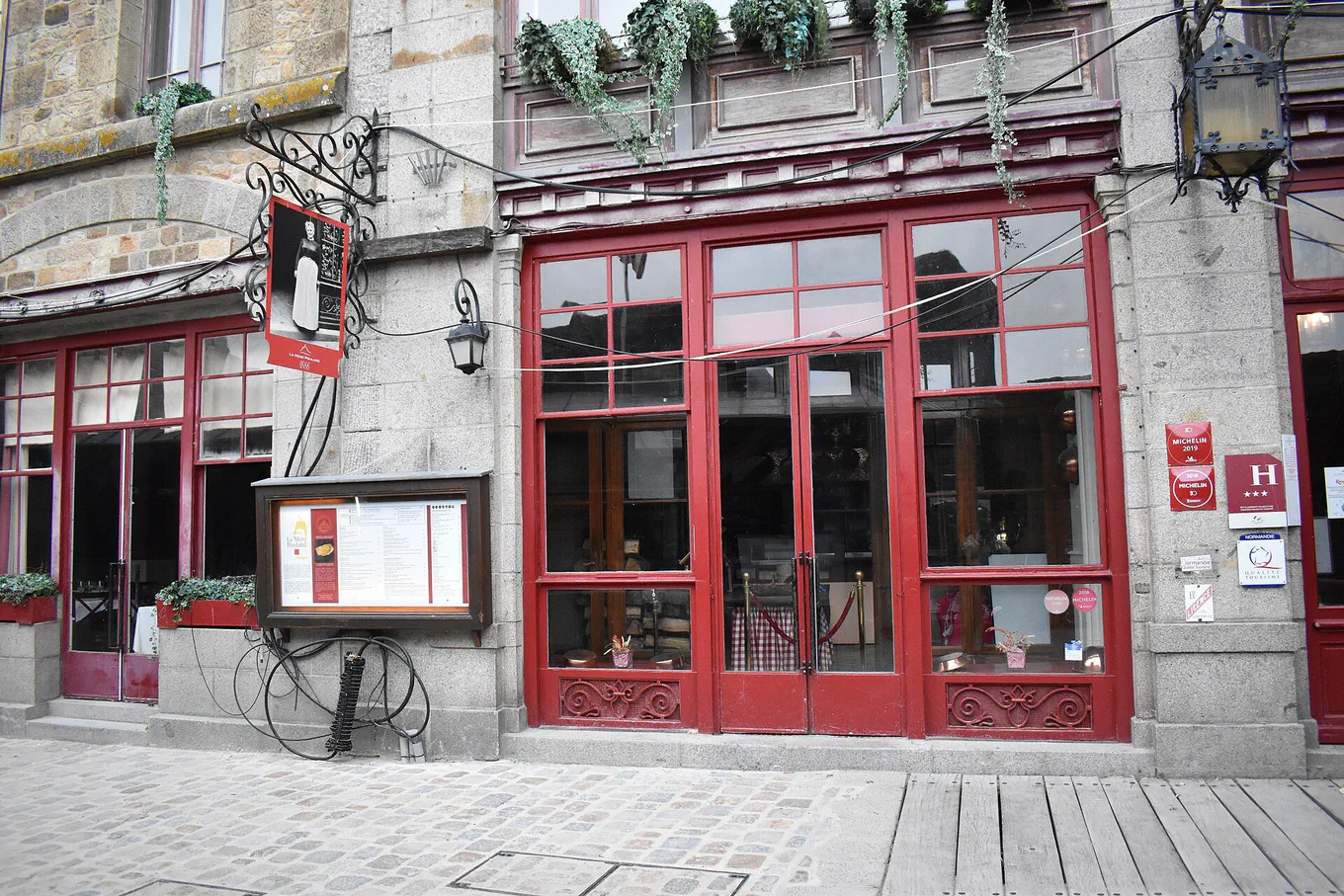
Stand here. La Mère Poulard, the restaurant that grew from Annette Poulard’s inn, with a wall of autographs from famous diners, Ernest Hemingway among them.
La Mère Poulard’s omelette was an answer to the tides. Anne Boutiaut worked as a maid for the architect given the restoration of the abbey. She married Victor Poulard in 1873, and the couple ran an inn. Its guests, almost all pilgrims, could cross to the island only at low tide, and they came and went with it. So she created an omelette several inches thick, made in copper bowls and cooked over an open fire. Paul Bocuse wrote: “Mother Poulard is France!”
Pack nothing. Leave Friday.
Every Friday, I write a free letter, Journey, that takes us on a trip through places, stories, and ideas.
Mont-Saint-Michel and Chartres(Henry Adams, 1904). A history, first printed privately for his nieces, that reflects on medieval culture through the architecture of the abbey and of Chartres.
The Legend of Mont Saint-Michel(Guy de Maupassant, 1882). A short story. A Lower Normandy peasant tells the narrator how Saint Michel kicked the Devil off the Mont, as far as Mortain.
The Horla(Guy de Maupassant, 1887). A short story. Its diarist visits Mont-Saint-Michel and questions a monk, who answers with the wind.
Films to watch before you visit Mont-Saint-Michel
To the Wonder(Terrence Malick, 2012). A film. Its scenes shot in France include Mont-Saint-Michel.
Tangled(Nathan Greno and Byron Howard, 2010). A Disney film. Its Kingdom of Corona is based on Mont-Saint-Michel.
The Walking Dead: Daryl Dixon(David Zabel, 2023). A TV series. An American post-apocalyptic horror drama in which a resistance network has its main settlement at Mont-Saint-Michel.
Questions
Where is Bishop Aubert’s skull?
Not on the Mont. The skull of Aubert, the bishop credited with founding Mont-Saint-Michel, is kept at the Saint-Gervais Basilica in Avranches. Legend says the hole in it is where the archangel’s finger went in. Sceptics say it is a relic of trepanation, a hole deliberately cut in the skull.
Is Mont-Saint-Michel still an island?
Yes, a tidal island about a kilometre off the Normandy coast. In 1879, a raised causeway was built, and it stopped the tide scouring the silt around the Mont. In July 2014, a new bridge by the architect Dietmar Feichtinger opened, part of a project to make Mont-Saint-Michel an island again.
How big are the tides at Mont-Saint-Michel?
The sea rises and falls about 14 metres between its highest and lowest marks, and the tide is one of the fastest-rising in Europe. The bay holds areas of deep mud and quicksand, the same sands where Harold Godwinson pulled two Norman soldiers free in 1064.