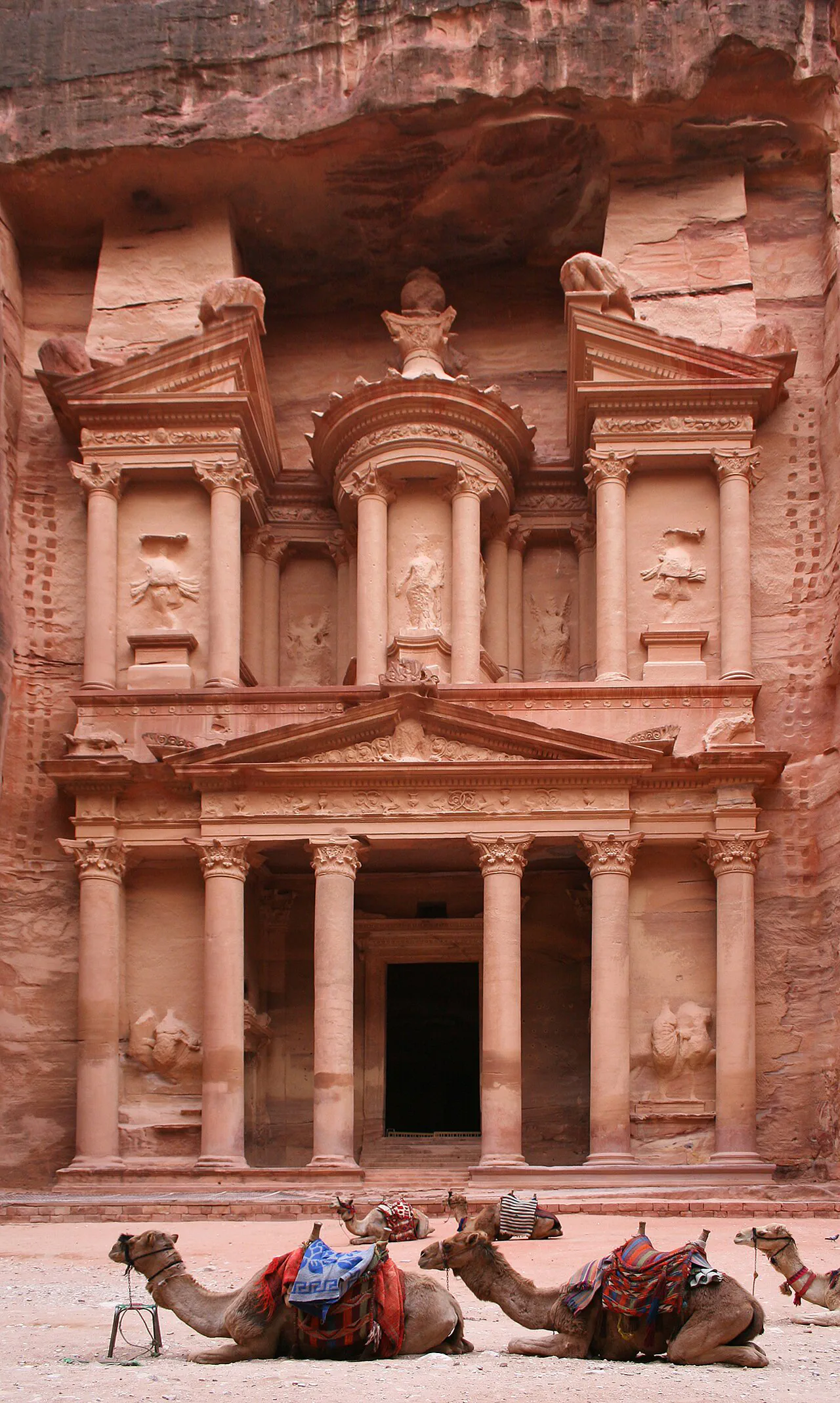
The Treasury is the Grail temple in The Last Crusade, the film that gave us the classic line, ‘Son… I think they hit us.’ Before the movie came out, a few thousand people a year apparently made the trip. Now it’s almost a million. That’s the power of a good story.
— Nick
Petra is an ancient city carved from sandstone in southern Jordan. The Nabataeans, a nomadic Arab people, settled there in the 4th century BC and later made it the capital of their kingdom, and the colour of its rock gives it the name Rose City. Its stories here are a disguised Swiss traveller, a poet who hadn’t seen it, a Poirot murder, a nurse who married into a cave, and Indiana Jones.
On 22 August 1812, Johann Ludwig Burckhardt, a Swiss traveller disguised as Sheikh Ibrahim Ibn Abdallah, became the first modern European to see Petra. Heading for Cairo, and then the Niger, he heard of ruins near Aaron’s tomb, so he told his guide he wanted to sacrifice a goat there. The guide led him through the valley. Burckhardt dared not linger or take detailed notes, in case he was unmasked as a treasure-seeking infidel. He died in Cairo in 1817, buried under his travelling name, and never reached the Niger.
2 John Burgon and Petra’s rose-red city
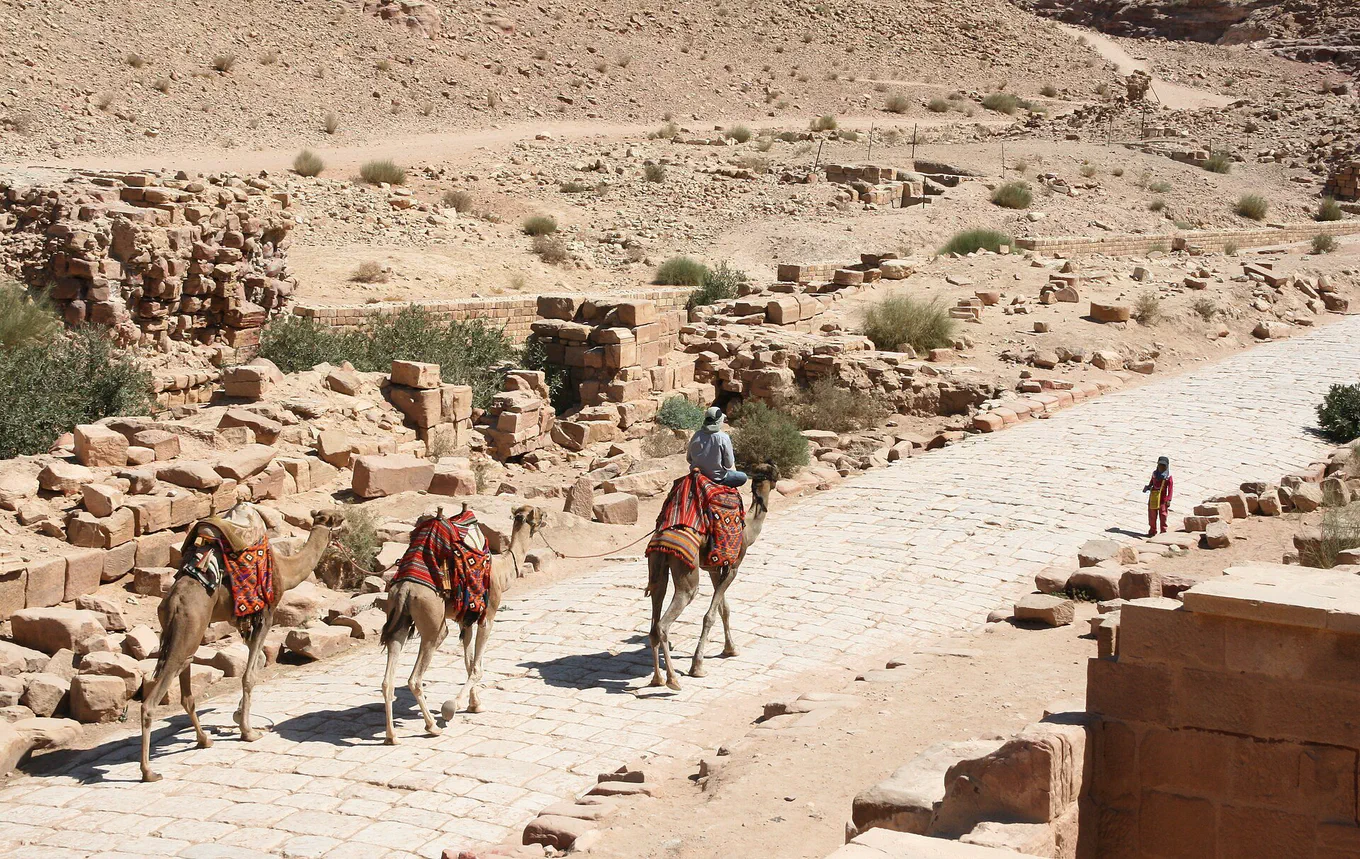
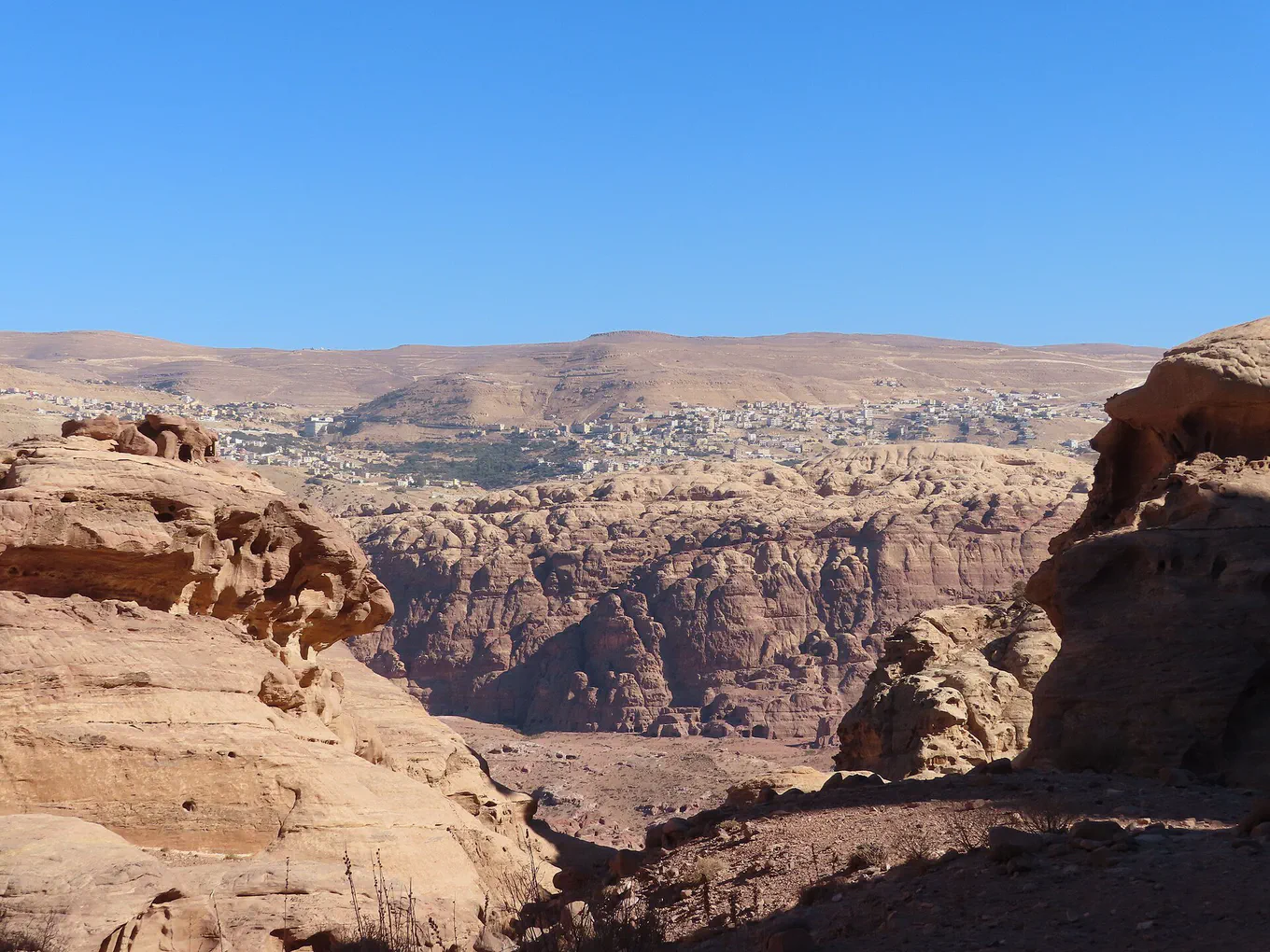
Stand here. The valley floor of the city centre, where sandstone cliffs still almost enclose the site on three sides.
John William Burgon was an Oxford student in 1845 when he won the Newdigate Prize with a poem calling Petra “a rose-red city half as old as time”. He had never seen it. At Easter 1862, he finally reached Petra and spent four and a half days there. On Easter Day he wrote that it was the most astonishing place he had ever visited, its sandstone cliffs “in colour unrivalled”. The same letter goes on, “But there is nothing rosy in Petra by any means.”
3 Agatha Christie’s Appointment with Death among Petra’s cliffs
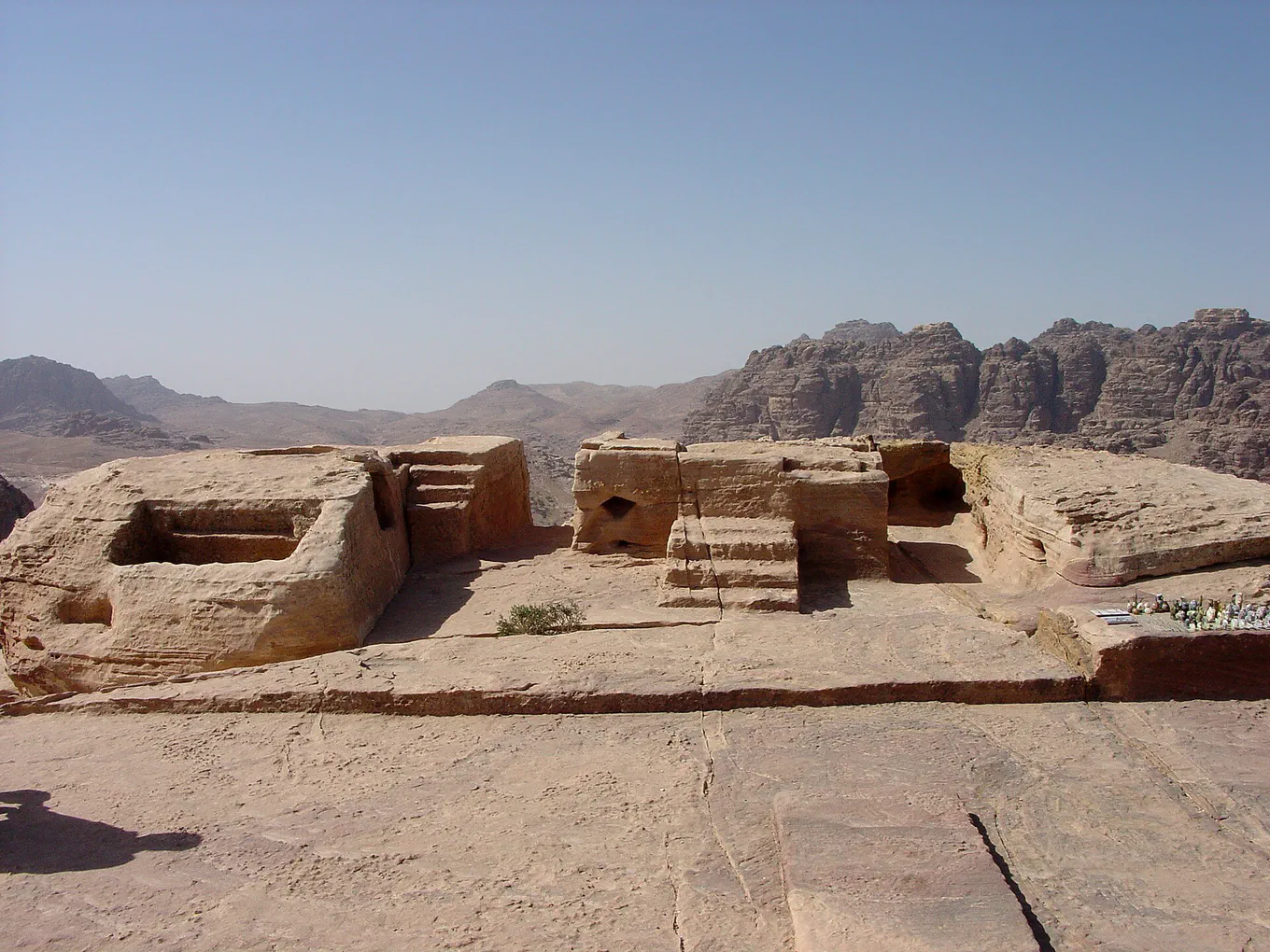
Stand here. The High Place of Sacrifice, which Christie’s characters climb, and the cave tombs. Both are still reached on foot inside the site.
Agatha Christie’s 1938 novel Appointment with Death finds Hercule Poirot in Jerusalem, where he overhears Raymond Boynton tell his sister, “You do see, don’t you, that she’s got to be killed?” She is their stepmother, a sadistic tyrant. On the family’s trip to Petra, Mrs Boynton is found dead among the red cliffs, and Poirot gives himself 24 hours to solve it. When the novel was filmed in 1988, the murder moved to Qumran, near the Dead Sea.
In Married to a Bedouin, Marguerite van Geldermalsen, a New Zealand nurse, tells how, in 1978, a Bedouin souvenir-seller invited her and a friend to stay the night in his cave at Petra. She married him, and lived in a 2,000-year-old cave, learning Arabic, fetching water by donkey, baking bread daily, and running the local clinic. Then, in 1985, the Jordanian government moved the Bedouin out of their caves to a village on the hill above. She went with them.
5 Indiana Jones and the Grail temple at the Treasury
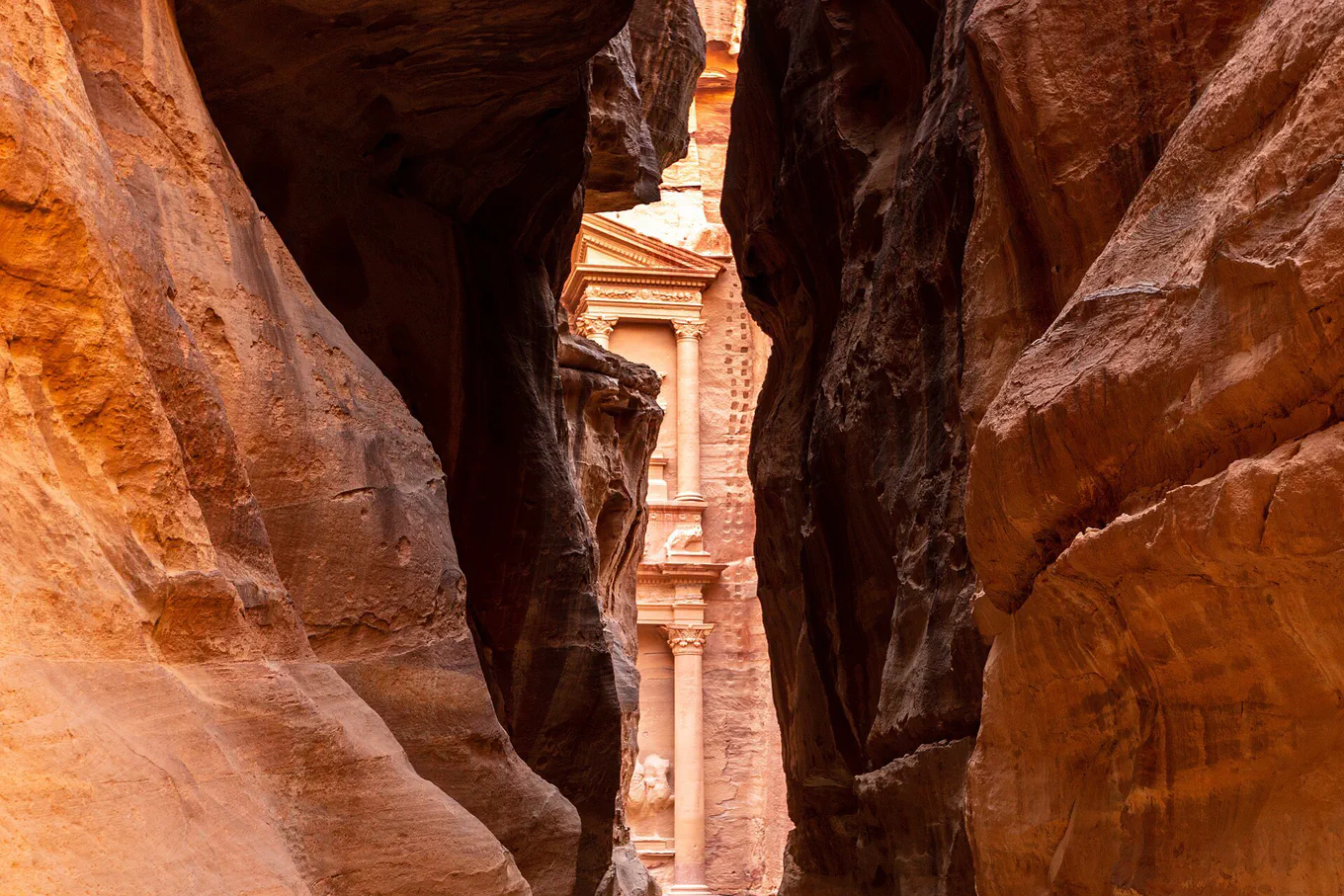
Stand here. Al-Khazneh, the Treasury, where the Siq ends. Its carved façade is still the most visited monument in Petra.
The Treasury’s façade is the entrance to the temple of the Holy Grail in Indiana Jones and the Last Crusade. In August 1988, the day after shooting in Venice, the cast and crew moved to Petra, as guests of King Hussein and Queen Noor. The temple’s interior was filmed at Elstree Studios in England, and behind the real carving is a plain chamber. Before the film came out, only a few thousand visitors a year made the trip. Since then, the number has grown to almost a million.
Travels in Syria and the Holy Land(Johann Ludwig Burckhardt, 1822). A travel memoir. His own account of hiring a guide to Aaron’s tomb, and his guess that the ruins at Wadi Musa were Petra.
Petra(John William Burgon, 1845). A prize poem of 370 lines in rhymed couplets, about the sandstone city its author had never seen.
Married to a Bedouin(Marguerite van Geldermalsen, 2006). A memoir. A New Zealand nurse’s life in a Petra cave from 1978, and the move to Umm Sayhoun above it in 1985.
Appointment with Death(Agatha Christie, 1938). A Poirot novel. The Boynton family’s trip to Petra, with a climb to the High Place of Sacrifice.
Films to watch before you visit Petra
Indiana Jones and the Last Crusade(Steven Spielberg, 1989). A film. In its climax, the Treasury’s façade is the entrance to the resting place of the Holy Grail.
Sinbad and the Eye of the Tiger(Sam Wanamaker, 1977). A film. The Treasury, Al-Khazneh, appears in one of its scenes.
Jinn(Mir-Jean Bou Chaaya, 2019). A Jordanian supernatural TV series. Teenagers from a private school in Amman go on a field trip to Petra, known as home to ancient demons and strange phenomena.
Questions
Is the Grail temple in Indiana Jones and the Last Crusade real?
Its front is. The façade of Al-Khazneh, the Treasury at Petra, plays the entrance to the temple of the Holy Grail. The temple’s interior scenes were filmed at Elstree Studios in England. Behind the real façade is a plain main chamber with three antechambers, the smaller rooms off it.
How long is the Siq at Petra?
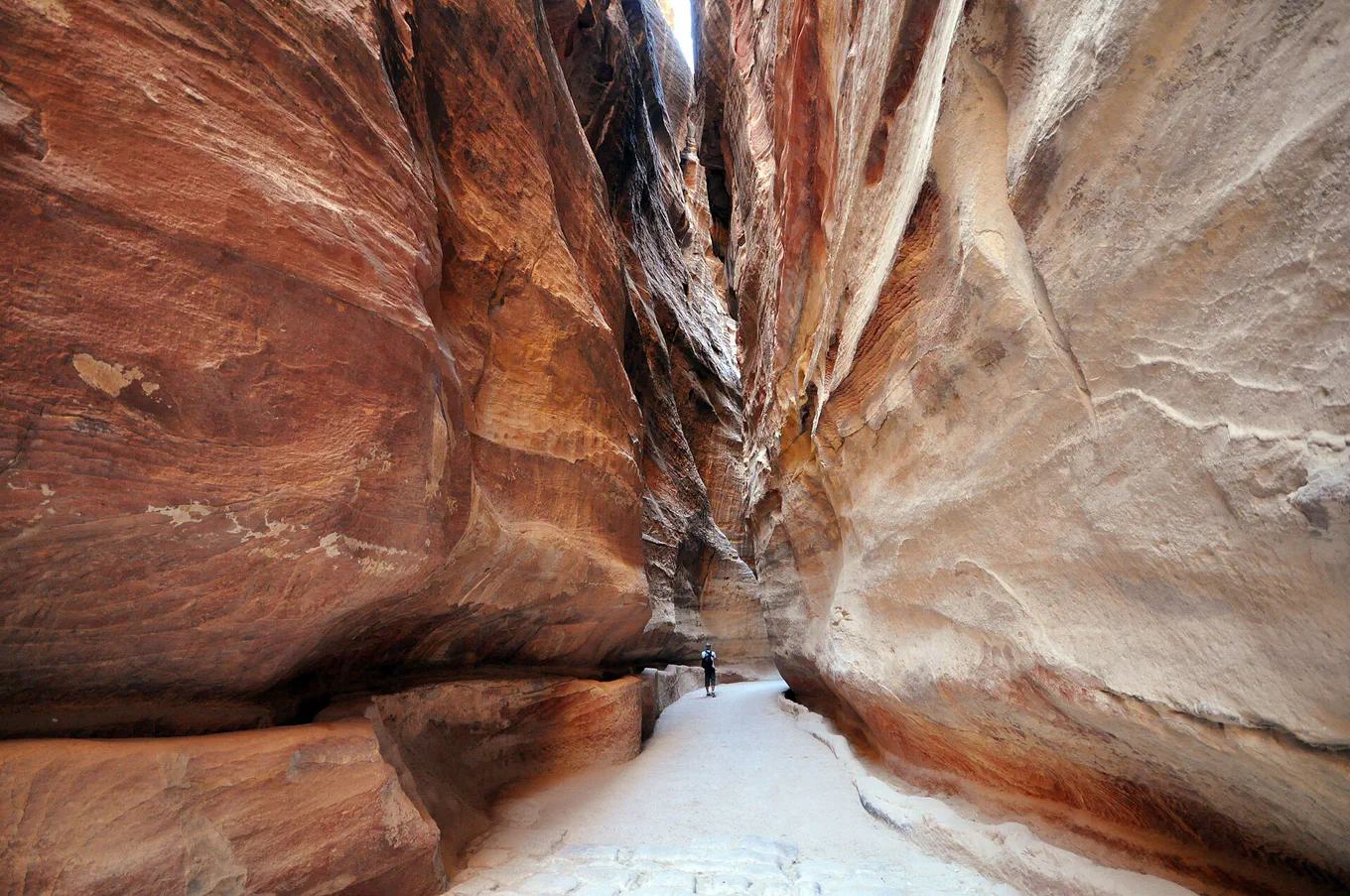
About 1.2 kilometres. The Siq is the main entrance to Petra, a narrow gorge no more than 3 metres wide in places, between walls 91 to 182 metres high. It is a natural fault in the rock, split apart by tectonic forces and later worn smooth by water, and it ends at the Treasury.
How do you get to the Monastery at Petra?
On foot. A path of nearly 800 steps climbs from the city’s central basin, about 40 minutes’ walk. The Monastery, Ed-Deir, is carved into the hills north-west of the centre, with a façade 47 metres high, and it is Petra’s second most visited monument after the Treasury.