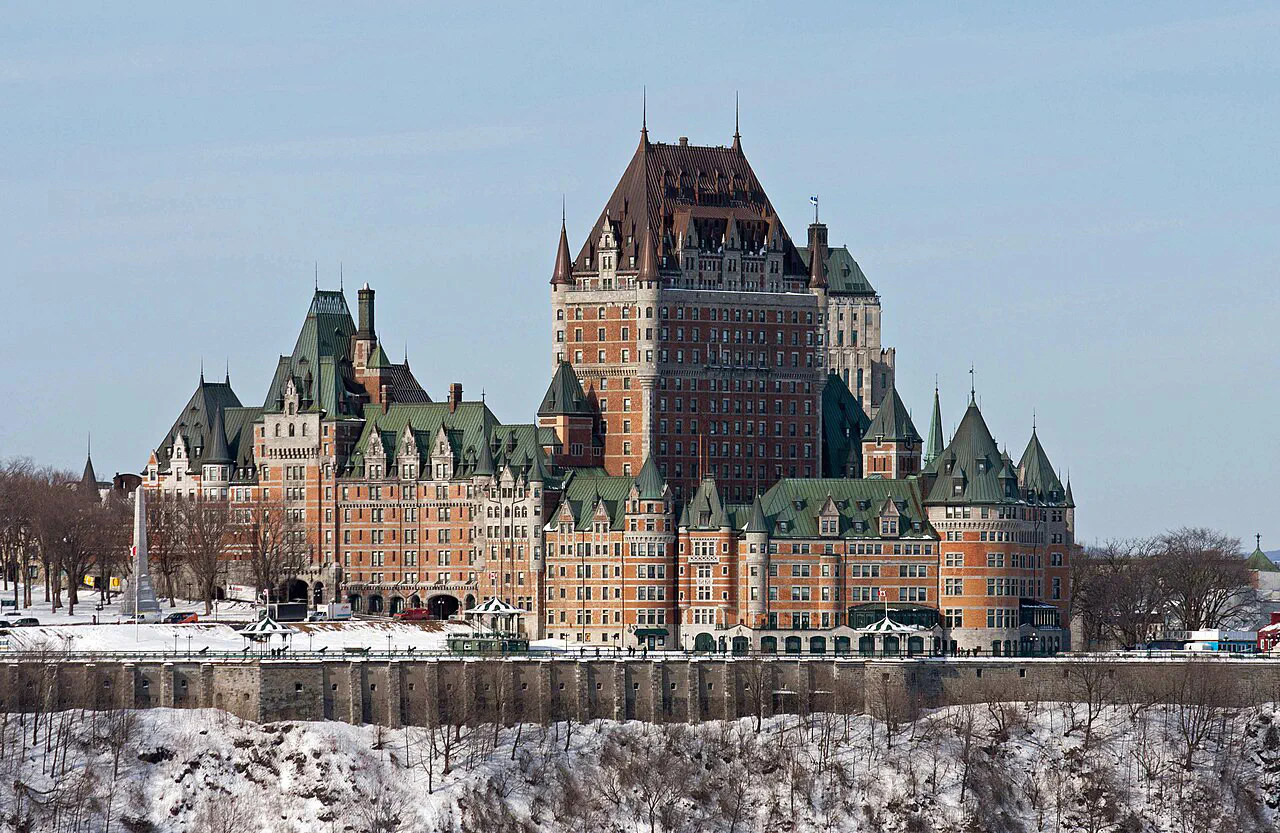
Quebec City, the capital of the province of Quebec in Canada, stands on and below a cliff where the Saint Lawrence narrows. Samuel de Champlain founded it in 1608. Its stories here are an explorer’s betrayal, a plot against the founder, two generals fatally wounded in one battle, a prime minister kept out of the talks he hosted, and a Hitchcock ending the diocese refused.
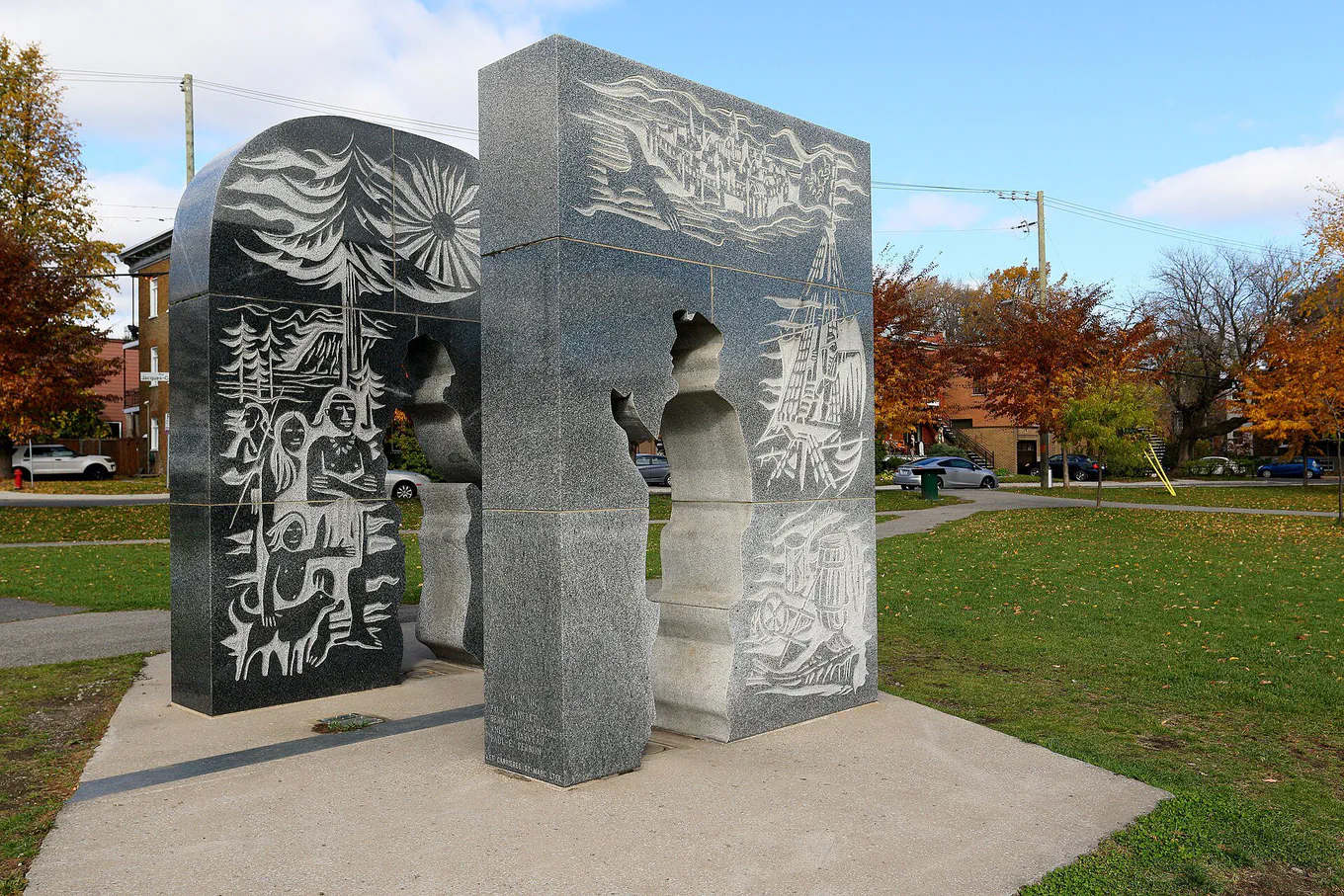
1 Jacques Cartier and Chief Donnacona on the Saint-Charles River
Stand here. Cartier-Brébeuf National Historic Site, on the Saint-Charles River in La Cité-Limoilou. A park and interpretation centre mark where Cartier wintered.
Jacques Cartier, the French explorer, spent the winter of 1535–36 with his ships frozen in at the mouth of the Saint-Charles, near the Iroquoian village where Quebec City now stands. Scurvy killed 25 of his men. The rest were saved by an Iroquoian brew of conifer bark, and the French stripped a whole tree in a week. In May, Cartier tricked the chief, Donnacona, into a meeting, seized him and his sons, and promised to bring him back in twelve moons. None of the ten he took ever came home.
2 Champlain and the locksmith’s plot at Place Royale
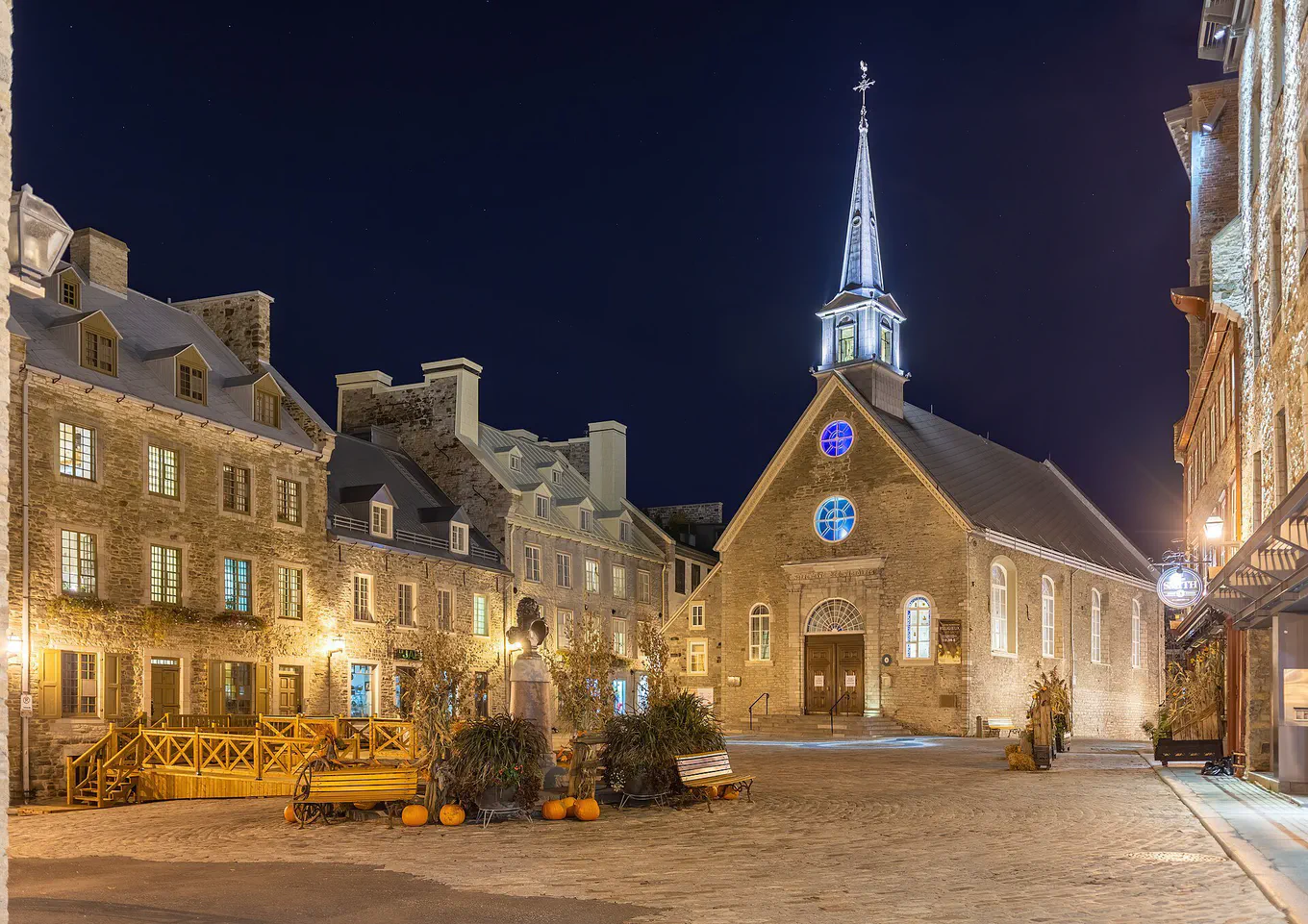
Stand here. Place Royale, in the Lower Town of Old Quebec, often called the cradle of French civilisation in America.
Place Royale and the church of Notre-Dame-des-Victoires in the Lower Town of Old Quebec, at night.Wilfredor / CC0.
In Catch Me If You Can, this square stands in for France, and the church behind the arrest scene is Notre-Dame-des-Victoires. It was built on the ruins of the Habitation, the fort Samuel de Champlain put up when he founded Quebec in 1608. A locksmith, Jean Duval, plotted to kill Champlain and hand the settlement to the Basques or Spaniards. Another locksmith gave Duval away, and he was hanged in full view of all. Then came winter. Of the 28 who spent it there, only 8 were left in May.
3 Wolfe, Montcalm and the cliff to the Plains of Abraham
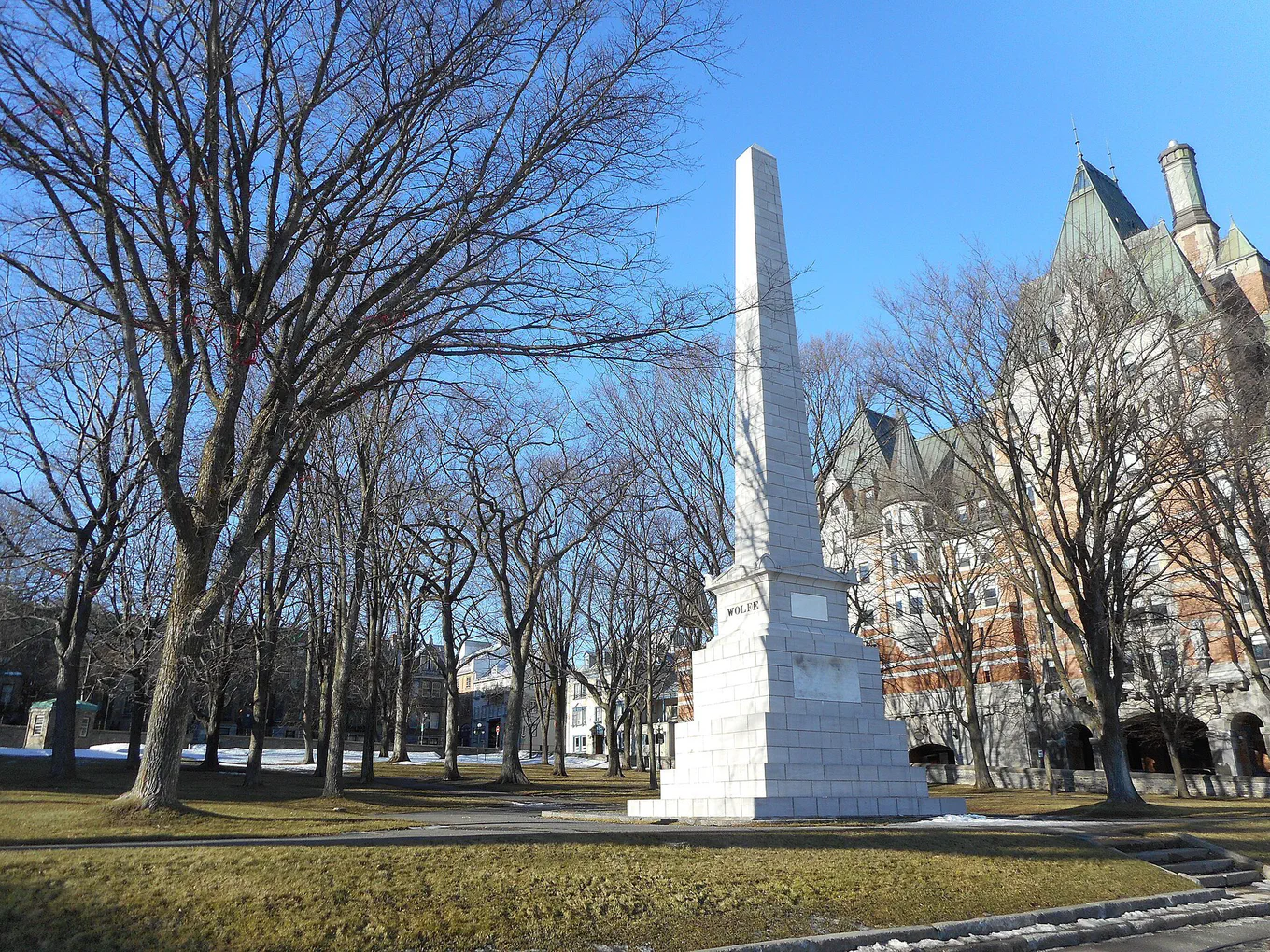
Stand here. The Plains of Abraham, in Battlefields Park. In Governors’ Garden, beside the Château Frontenac, an 1828 monument honours both generals.
James Wolfe is the dying general in Benjamin West’s famous painting. By September 1759, Wolfe had besieged Quebec for three months and fallen ill. Then, early on the 13th, his army climbed a 53-metre cliff from the river to the plains above. He won, but he was shot in the chest and died. The French commander, Montcalm, was hit riding back to the city. Told his wound was mortal, he said, “All the better, I will not see the English in Quebec.”
4 Churchill, Roosevelt and the host left out at the Citadelle
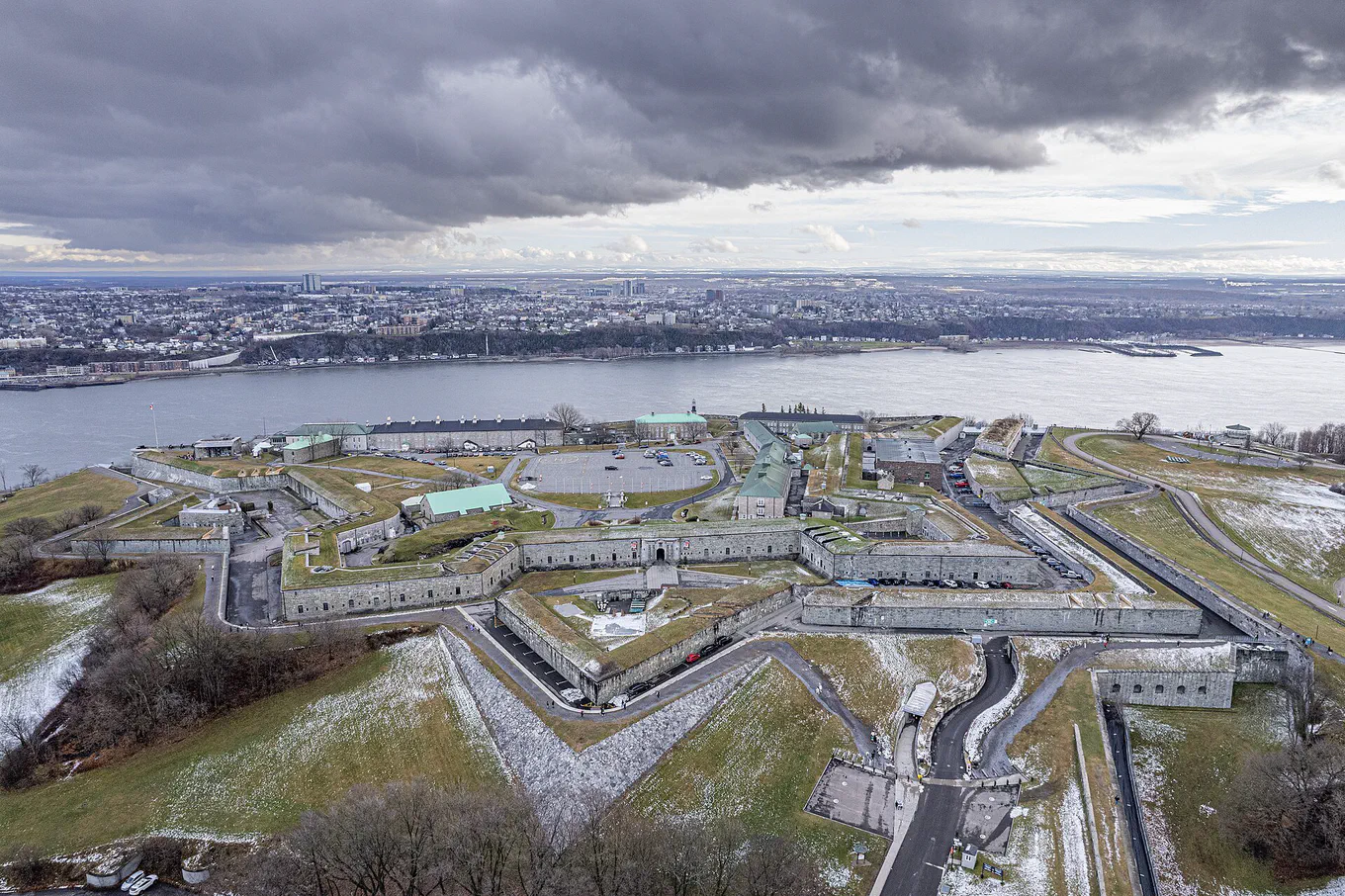
Stand here. The Citadelle of Quebec. Still an army base, it holds a permanent exhibit on the Quebec Conferences.
Winston Churchill and Franklin D. Roosevelt met at the Citadelle in August 1943 and agreed to begin talks on planning the invasion of France. Their host was Canada’s prime minister, William Lyon Mackenzie King. Churchill suggested King join every discussion, but Roosevelt vetoed it, so King sat in on none of them, though he was photographed and filmed with both men. On Citadelle notepaper, the two leaders signed a secret atomic agreement. When a statue of the conference later went up in the city, King was left out.
I Confess, Alfred Hitchcock’s film, stars Montgomery Clift as a Catholic priest who hears a killer’s confession and won’t break its seal, even when he’s suspected himself. Hitchcock shot it here in 1952 and planned to use the city’s churches for free. The script followed an old French play, and the priest was executed at the end. The diocese objected to the execution and withdrew its permission. The writer refused to change it, so Hitchcock brought in another. On screen, the priest is never executed.
Shadows on the Rock(Willa Cather, 1931). A novel. Euclide Auclair stands on Cap Diamant, watching the last ship of the season leave for France.
Bury Your Dead(Louise Penny, 2010). A crime novel. During Winter Carnival, a body found at the Morrin Centre draws Chief Inspector Gamache in, and the search for Champlain’s grave is a key plot-line.
Les Plouffe(Roger Lemelin, 1948). A novel set in Quebec City, following the ups and downs of the Plouffes, a working-class family.
Films to watch before you visit Quebec City
I Confess(Alfred Hitchcock, 1953). A film. Montgomery Clift as a priest bound by confession, shot in the church of Saint-Zéphirin-de-Stadacona and at the Château Frontenac.
Catch Me If You Can(Steven Spielberg, 2002). A film. Place Royale stands in for Montrichard, France, with Notre-Dame-des-Victoires behind the arrest scene.
Guardian: The Lonely and Great God(Kim Eun-sook, 2016). A TV series. A South Korean series starring Gong Yoo, filmed overseas mainly in Quebec City. Its red door is the Théâtre Petit Champlain’s emergency exit.
Questions
Is Quebec City a walled city?
Yes. The ramparts around Old Quebec are the only fortified city walls left in the Americas north of Mexico. They were first built in 1690 to defend the Upper Town, whose other sides are guarded by steep cliffs, and the old town has been a UNESCO World Heritage Site since 1985.
Where is General Montcalm buried?
Montcalm died early on 14 September 1759, and that morning he was buried in a shell hole under the choir of the Ursuline church. On 11 October 2001, his remains were moved from the Ursuline convent to a new mausoleum in the cemetery of the Hôpital-Général de Québec.
Can you visit the Citadelle where Churchill and Roosevelt met?
Yes. The Citadelle is still an active military base, home of the Royal 22e Régiment since 1920, but visitors can tour its state rooms. It holds the regiment’s museum and a permanent exhibit on both Quebec Conferences, and draws about 200,000 visitors a year.