Rotterdam, in South Holland, sits at the North Sea mouth of the Rhine, Meuse, and Scheldt, and is Europe’s largest seaport. It began with a dam on the river Rotte in 1270 and was rebuilt after German bombing destroyed nearly all of its centre in 1940. Its stories here are the Pilgrim Fathers’ farewell, Jackie Chan’s slide, a bronze Erasmus, Piet Blom’s cube houses, and a stowaway painter.
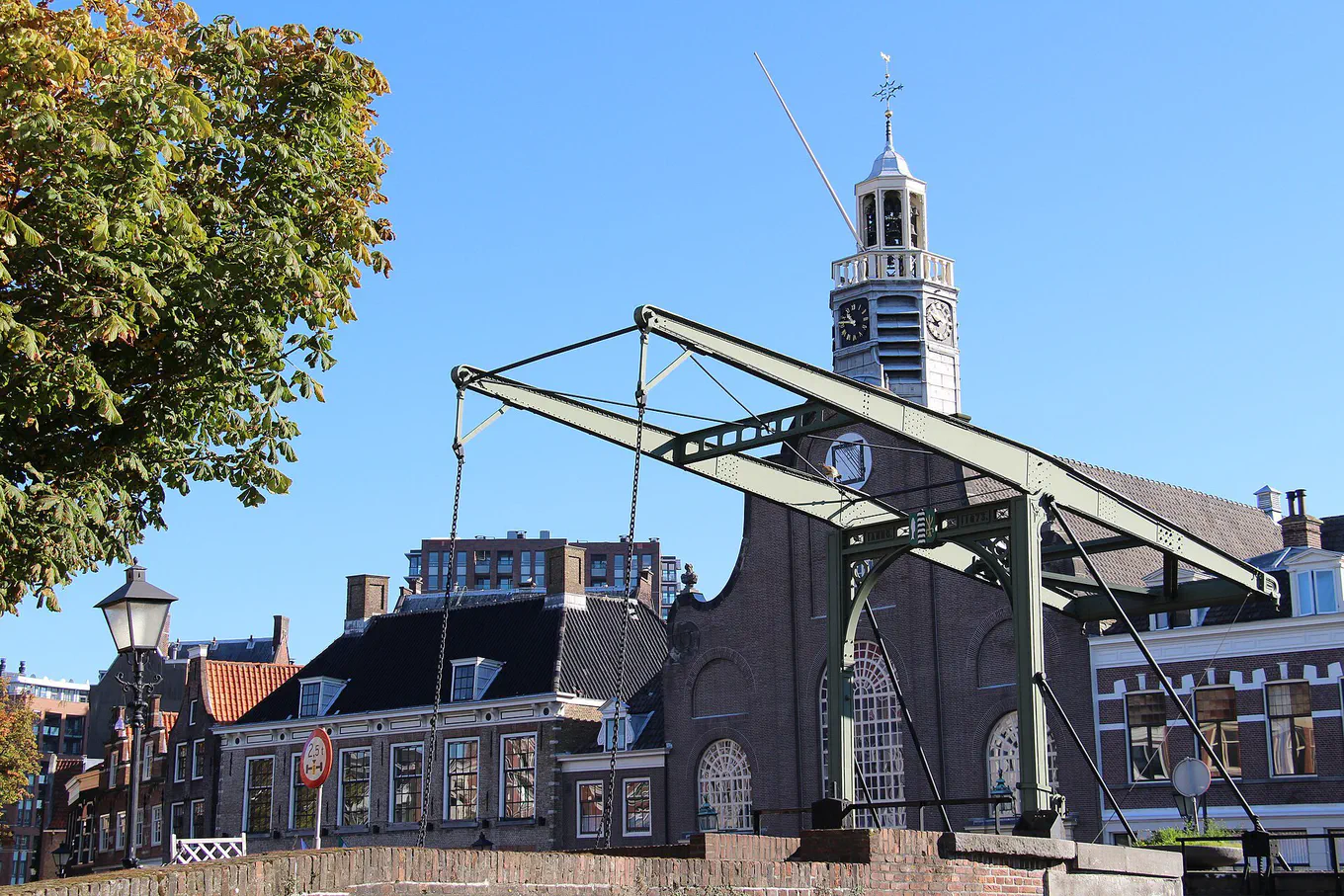
1 The Pilgrim Fathers’ last prayer on the quay at Delfshaven
Stand here. The quay by the Pilgrim Fathers Church in Delfshaven. The church, which dates to the 14th century, still holds services, concerts, and weddings.
In July 1620, the Pilgrim Fathers, remembered for the Mayflower, began their voyage on this quay. They were English Separatists who had spent eleven years in Leiden, and their children were growing more Dutch than English. According to the chronicles, they knelt here in prayer, and their pastor, John Robinson, preached a farewell sermon as their ship, the Speedwell, sailed. But the Speedwell let in water, and they crossed on the Mayflower alone. For years they waited for Robinson to follow. In 1625, he was buried in the Pieterskerk.
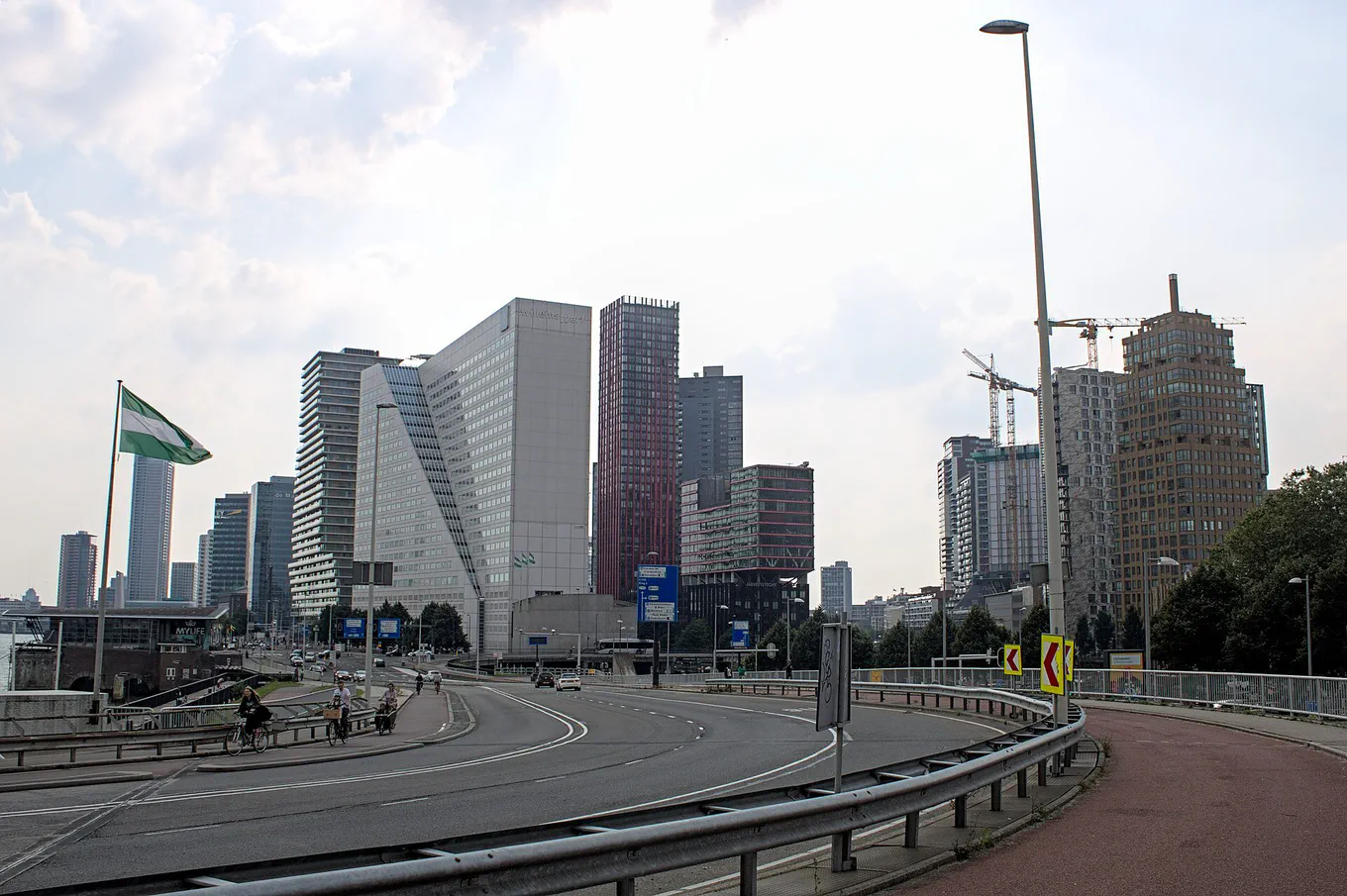
Who Am I?, the 1998 action film starring Hong Kong’s Jackie Chan, saves its showpiece for this tower, cast as the villains’ headquarters. Chan’s character fights his way up to the roof, where only one way out remains, a 21-storey slide down the building’s narrowing diagonal glass face. Chan did the stunt himself, without a safety harness. Then he did it again, sliding the whole building several times to get enough tumbles and spins. He walked away with nothing worse than an ankle injury.
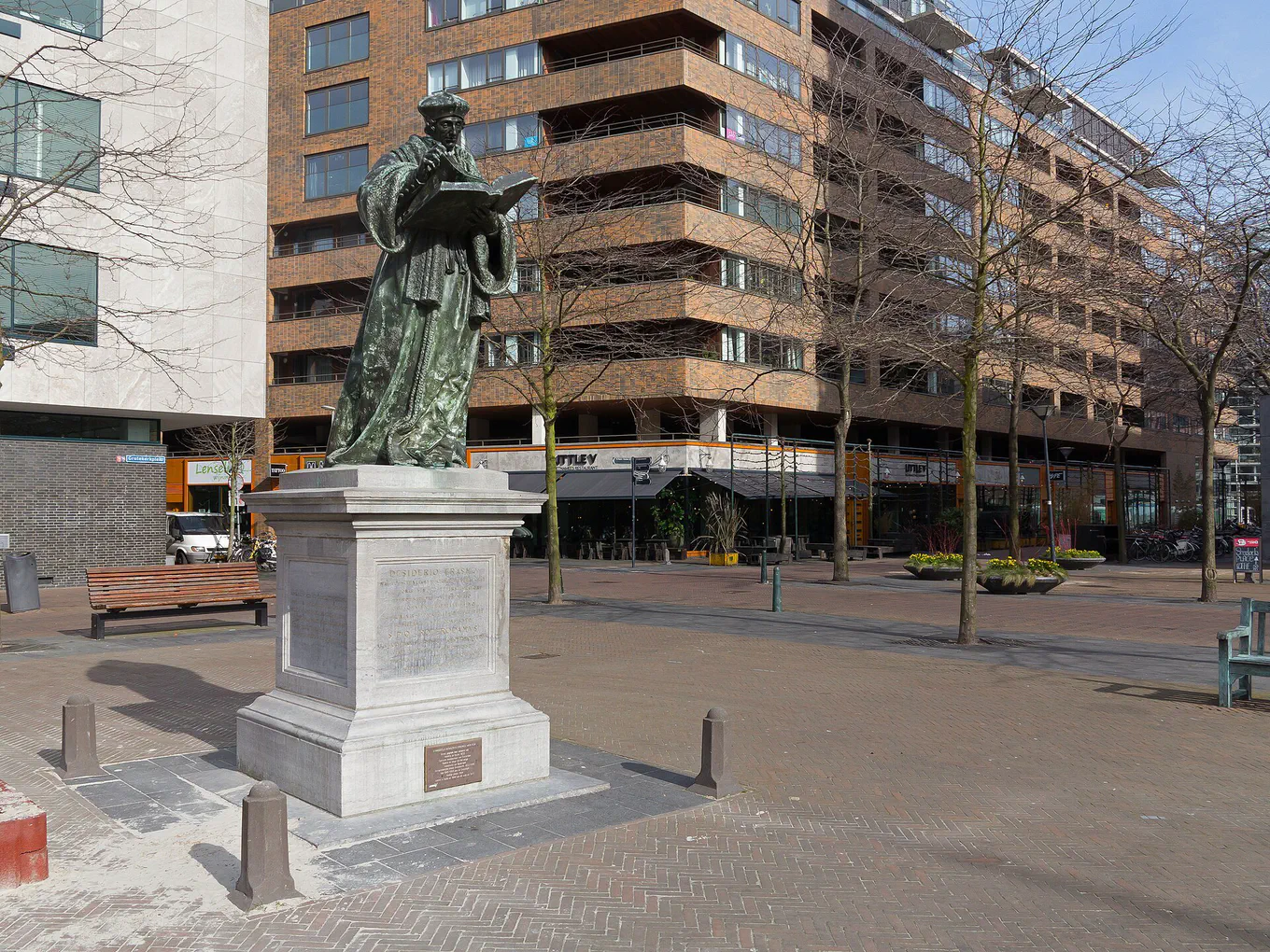
3 Erasmus’s bronze statue, buried in the war, by the Laurenskerk
Stand here. Grotekerkplein, in front of the Laurenskerk. Hendrick de Keyser’s bronze Erasmus stands reading a large Bible, on this spot since 1964.
Known in English as Erasmus of Rotterdam, the Renaissance scholar who wrote The Praise of Folly lived in the city for only four years and never came back. The city claimed him anyway. Spanish troops once threw his stone statue into a canal, and in 1622 this bronze took its place, the oldest bronze statue in the Netherlands. In the Second World War, it was buried under a museum courtyard. In July 1945, it rose again, intact, in a city whose centre had gone.
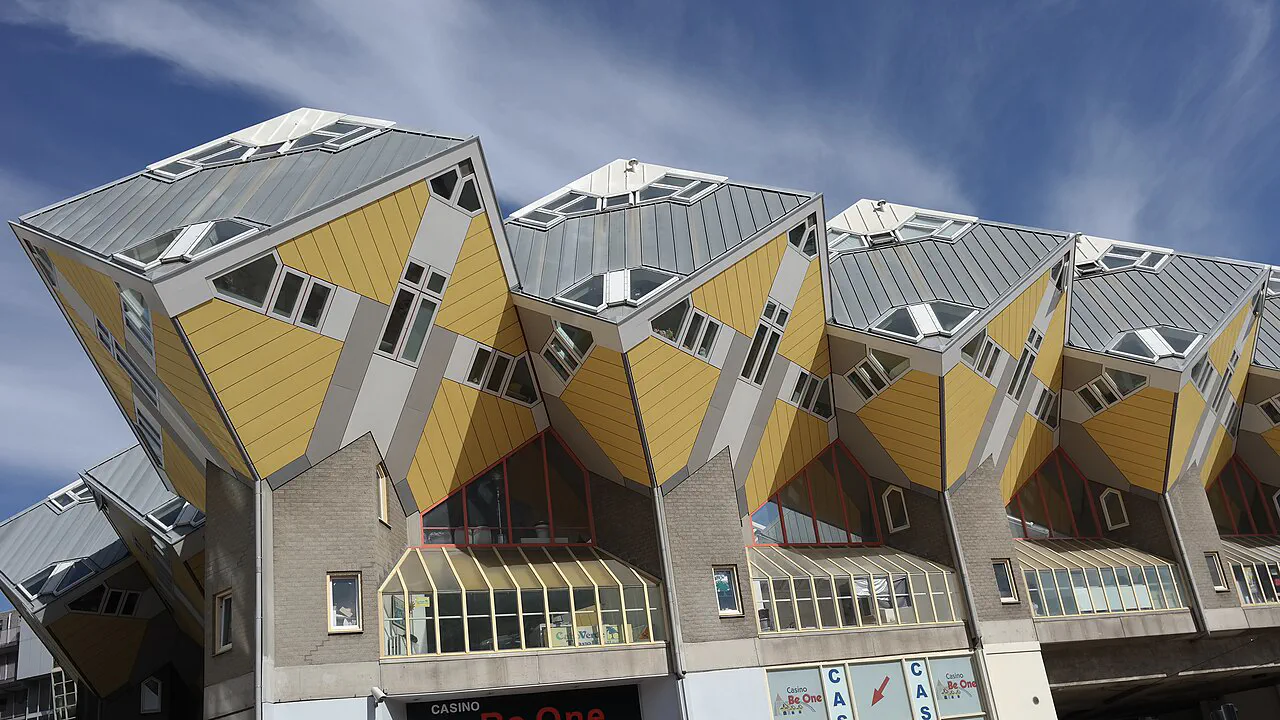
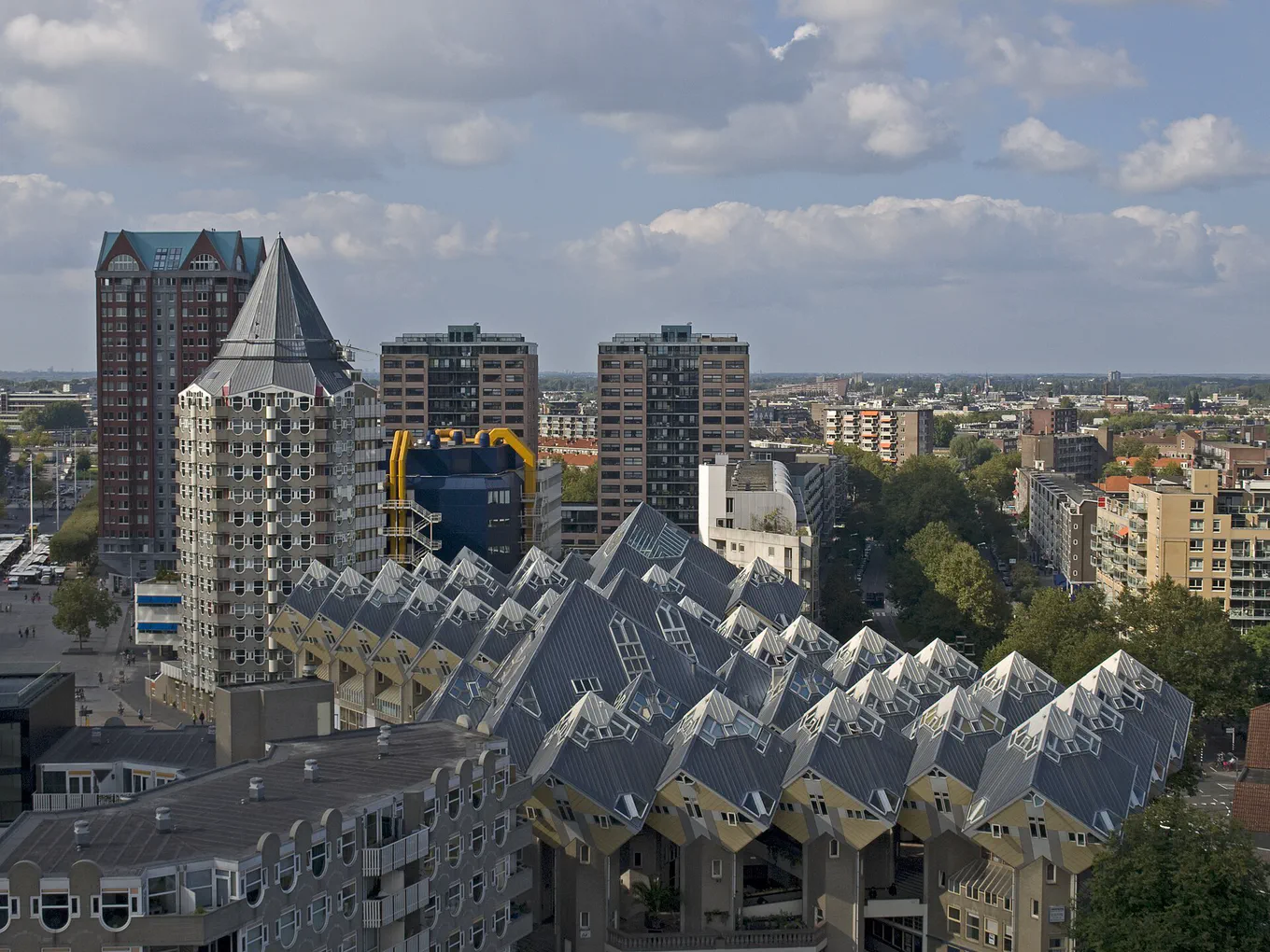
4 Piet Blom’s forest of tilted cube houses above the Blaak
Stand here. Above the Blaak, by Blaak station and the Old Harbour. One cube is a furnished show house open to visitors, and the two largest are a hostel.
Rotterdam’s cube houses began with a politician’s boredom. Hans Mentink, in charge of planning, had grown tired of practical buildings, so he asked Piet Blom, out of work since his Helmond cubes, to plan the Old Harbour. His answer was a village lifted over a seven-lane road, its houses tipped on their corners on hexagonal pylons, each cube a tree and the whole a forest. The 1977 plan had 55 houses, but not all of them were built. From their tilted windows, the people inside see the street below.
5 Willem de Kooning stows away from Rotterdam to America
Stand here. Zaagmolenstraat 11–13, in the Oude Noorden district. A plaque on the front of the house marks where de Kooning was born.
Willem de Kooning, the painter of the Woman series, was born in Rotterdam. As a boy, he left school to work for a firm of commercial artists, and he took evening classes at the city’s art academy. In 1926, he went to America as a stowaway, on the Shelley, a British freighter bound for Argentina, and came ashore at Newport News, Virginia. By the 1950s, he was leading American painting into abstract expressionism. Since 1998, Rotterdam’s art academy has carried his name.
Pack nothing. Leave Friday.
Every Friday, I write a free letter, Journey, that takes us on a trip through places, stories, and ideas.
Karakter(F. Bordewijk, 1938). A novel set mainly in Rotterdam from after the First World War to the late 1930s. Its main character is the illegitimate son of the bailiff A.B. Dreverhaven.
De langverwachte(Abdelkader Benali, 2002). A novel. It moves from multicultural Rotterdam to Morocco and back, portraying a migrant world in the city. It won the Libris Literatuurprijs in 2003.
Pietje Bell(Chris van Abkoude, 1914). A children’s book by a Rotterdam writer. Its hero is a Rotterdam shoemaker’s son, and Pieter Bell, nicknamed “Jan Plezier”, is a cheerful shoemaker on the Breestraat.
Films to watch before you visit Rotterdam
Karakter (Character)(Mike van Diem, 1997). A film. In 1930s Rotterdam, a dreaded bailiff is found dead with a knife stuck in his stomach. It won the Academy Award for Best Foreign Language Film.
Pietje Bell (Peter Bell)(Maria Peters, 2002). A comedy drama film. In 1930 Rotterdam, Peter Bell is a spirited ten-year-old whose pranks delight his friends and frustrate adults.
Flikken Rotterdam(Eyeworks, 2016). A TV series. A police drama set in Rotterdam, first broadcast on 8 January 2016, made by the same directors and writers as Flikken Maastricht.
Questions
Can you go inside the cube houses in Rotterdam?
Yes. One owner opened a furnished show cube, the Kijk-Kubus museum house, which opens to visitors each season. Since 2009, the two large cubes have been a Stayokay hostel. The houses stand by Blaak station, the Market Hall, and the Old Harbour.
Where did the Pilgrim Fathers leave from in Rotterdam?
From Delfshaven, which grew up as the port of Delft and joined Rotterdam in 1886. They prayed on the quay near the Old Church, now the Pilgrim Fathers Church, before the Speedwell sailed in July 1620. Robert Weir’s painting of their departure, Embarkation of the Pilgrims, is in the rotunda of the US Capitol.
Why does Rotterdam look so modern?
Because German bombing in the Second World War destroyed nearly all of the city centre, and Rotterdam was rebuilt gradually from the 1950s to the 1970s. The Laurenskerk, which kept only its tower and walls and was restored by 1968, is the only remnant of the medieval city.