San Jose, United States, California, North America
IBM built the first hard disk in San Jose in 1956. It was the size of two kitchen fridges and held five million characters. I briefly worked for IBM forty years later, when it was being eclipsed by others… but it’s easy to forget just how much the company has contributed.
— Nick
San Jose sits in the Santa Clara Valley at the southern end of San Francisco Bay. Founded in 1777 as California’s first civilian settlement, it was the state’s first capital and now calls itself the “Capital of Silicon Valley”. Its stories here are a widow’s house of 160 rooms, two raised fists, a stranger at César Chávez’s door, the first hard disk, and a tower that lit the sky.
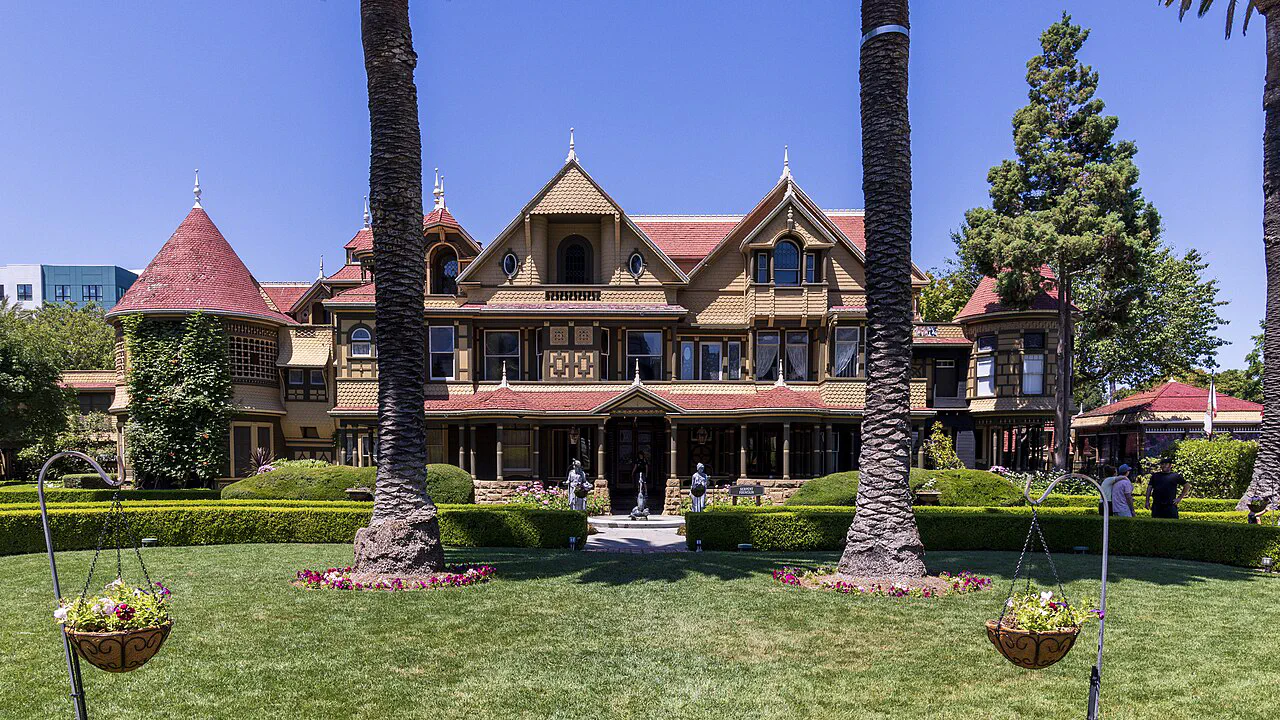
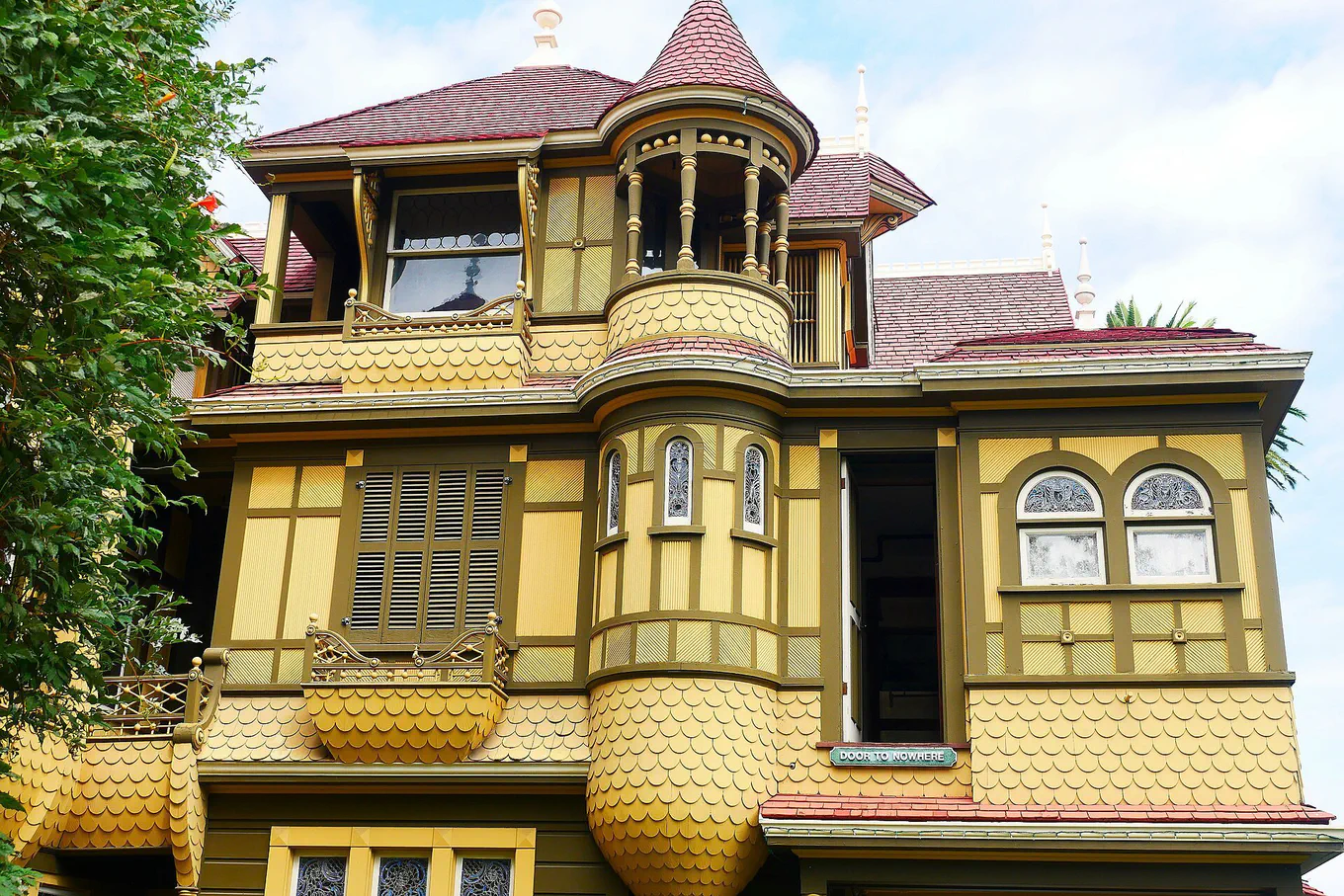
In Winchester (2018), shot partly here, Helen Mirren plays Sarah Winchester, haunted in her San Jose mansion. The real Sarah, a firearms magnate’s widow, bought an eight-room farmhouse here and kept building. Legend says she built without end, a maze to confuse the ghosts of people killed by Winchester rifles. There is no evidence for that. She stopped many times, and after the 1906 earthquake brought down her seven-storey tower and top floors, she stopped again. Doors still open onto nothing where balconies had been.
2 Tommie Smith, John Carlos, and San José State’s empty spot
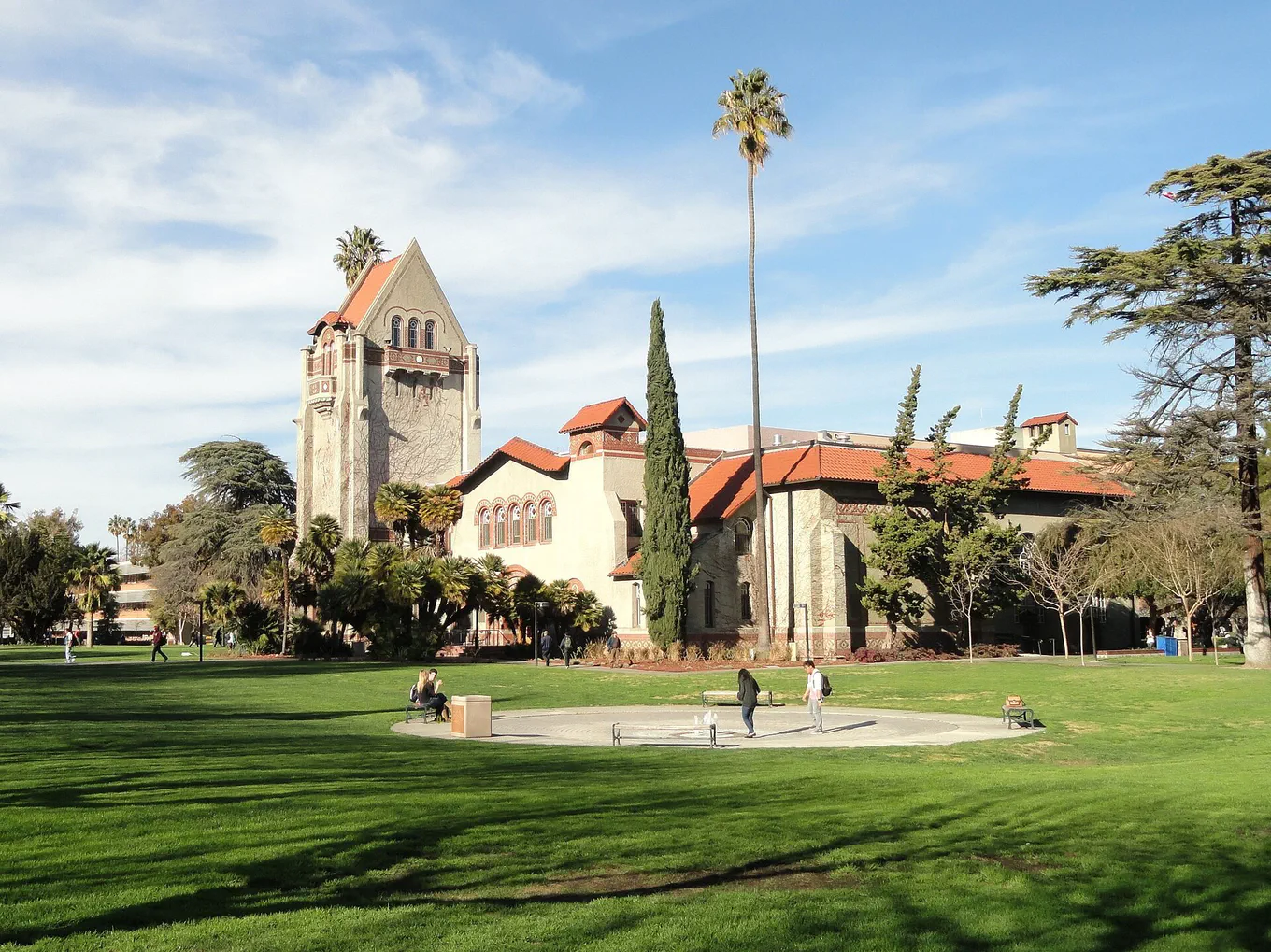
Stand here. The Victory Salute statue, on the lawn by Tower Hall and Robert D. Clark Hall at San José State University. Its second-place spot is empty.
Tower Hall at San José State University, the campus where the Victory Salute statue stands.Daderot / CC0.
The black-gloved fists of the 1968 Mexico City Olympics belonged to two students from here. Tommie Smith and John Carlos, gold and bronze in the 200 metres, took their medals shoeless, in black socks for black poverty, heads bowed. Both were expelled from the Games. Peter Norman, the Australian silver medallist, wore their human-rights badge and was ostracised by conservatives in the Australian press. When this statue went up in 2005, Norman asked to be left out, so visitors could stand in his place. A year later, Smith and Carlos carried his coffin.
3 César Chávez and the stranger at his San Jose door
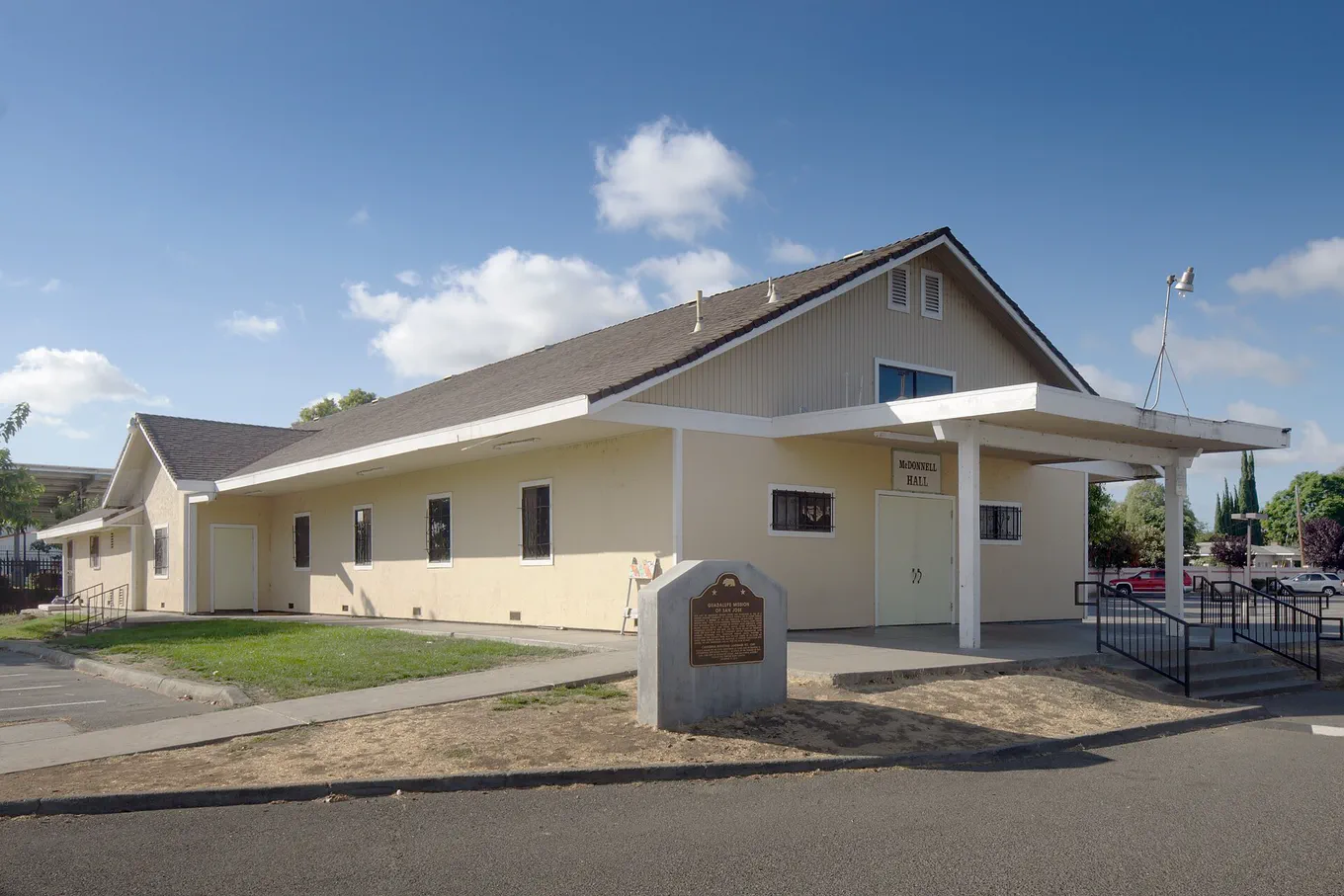
Stand here. McDonnell Hall, the 1953 chapel on the grounds of Our Lady of Guadalupe Parish, East San Antonio Street, where Chávez began organising farm workers.
Before César Chávez co-founded the United Farm Workers, he lived in Sal Si Puedes, an East Side neighbourhood whose name means “get out if you can”. One evening in June 1952, a stranger came to his door. Fred Ross was an organiser for the Community Service Organization. Chávez was suspicious of “this gringo”, as he later put it, but Ross started talking, and two hours later Chávez was won over. That night, Ross wrote in his journal, “I think I found the guy I’m looking for.”
4 Rey Johnson’s “baloney slicer” and the first hard disk, San Jose
Stand here. The former IBM lab at 99 Notre Dame Avenue, downtown, still stands as a city landmark. Its plaque and displays are in storage.
IBM developed the first hard disk drive in this building. In 1952, the company sent Rey Johnson, a former high-school science teacher, to start a small lab here, with half its work up to him. He chose random-access storage. His team tried rods, strips, tapes, and flat plates before settling on aluminium disks, which warped at speed until they glued two together. Disbelieving IBM executives called it the “baloney slicer”. In 1956, the first one shipped. It was the size of two kitchen refrigerators, and held five million characters.
5 J. J. Owen’s San Jose light tower and the Eiffel Tower
Stand here. History Park, in Kelley Park, where a half-size replica, 115 feet tall, has stood since 1977. The original straddled Market and Santa Clara streets.
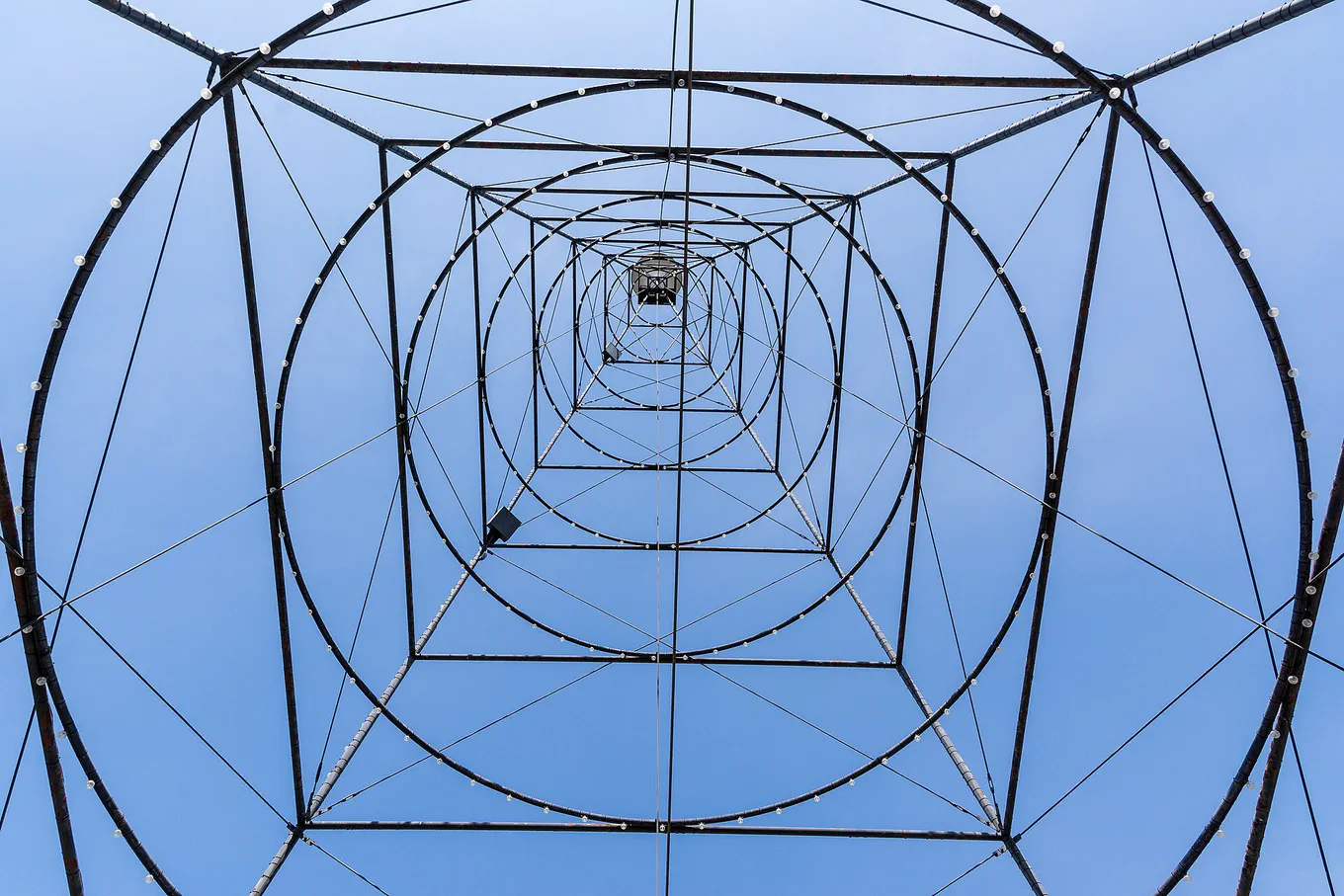
San Jose argued that its light tower inspired the Eiffel Tower, until a mock trial in 1989 found Paris had the idea on its own. J. J. Owen, publisher of the San Jose Mercury, wanted one immense light high over downtown to make night as day. His 237-foot tower was lit in 1881, over Market and Santa Clara streets. But by History San José’s account, its arc lights lit the sky, not the streets. Farmers complained it kept their chickens from roosting. Police sold birds that flew into it to restaurants.
Pack nothing. Leave Friday.
Every Friday, I write a free letter, Journey, that takes us on a trip through places, stories, and ideas.
Swift Justice(Harry Farrell, 1992). A history, and an Edgar Award winner. The 1933 murder of Brooke Hart, and a mob’s lynching of two men in St. James Park.
Jury Rigging in the Court of Public Opinion(John D. Murphy, 2007). A history of the Brooke Hart case that takes issue with Farrell’s approach.
The Refugees(Viet Thanh Nguyen, 2017). A short story collection. In one story, a boy works at his parents’ convenience store in a Vietnamese enclave in San Jose.
Films to watch before you visit San Jose
Winchester(Michael and Peter Spierig, 2018). A horror film. Helen Mirren as Sarah Winchester, haunted in her mansion on South Winchester Boulevard in 1906, and filmed partly there.
Valley of the Heart’s Delight(written and produced by John D. Murphy, 2006). A film about the same case, and the lynchings in St. James Park, across from the county jail.
Searching(Aneesh Chaganty, 2018). A mystery thriller film set in San Jose, where David Kim lives with his daughter, Margot, and played out almost entirely on computer screens and smartphones.
Questions
Can you still see San Jose’s electric light tower?
Not the original. Already damaged by a windstorm in February 1915, it collapsed into the street on 3 December that year. It telescoped into itself, and no one was hurt. A replica about half the size, 115 feet high, has stood in History Park, in Kelley Park, since 1977.
Was San Jose the first capital of California?
Yes. San Jose became the capital of the territory on 15 December 1849, and the state’s first capital when California joined the Union in 1850. Legislators met there until 1851. The first capitol is gone, and the Plaza de César Chávez, with two historical markers, now covers the site.
Is “Do You Know the Way to San Jose” really about San Jose?
Yes. Hal David’s lyrics for Burt Bacharach’s 1968 song follow a San Jose native who failed to break into show business in Los Angeles and is going home. David had been stationed in San Jose in the Navy. Dionne Warwick disliked the song and had to be talked into recording it, but it won her first Grammy.