Some time in the 90s, I went for an hour’s ski training on the dry slope in Southampton with some IBM colleagues, purely for a lark. I bumped into a girl I’d known vaguely at a previous job. Gentle reader, I fell in love and married her.
— Nick
Southampton is a port city in Hampshire, England, at the top of Southampton Water, about 80 miles south-west of London. It became a city in 1964, and today its port is the UK’s busiest cruise terminal. Its stories here are a plotter beheaded at the town gate, the Mayflower’s barrel-maker, Jane Austen back at a ball, three brothers who missed the Titanic, and the man behind the Spitfire.
1 The Earl of Cambridge and the plot outside the Bargate
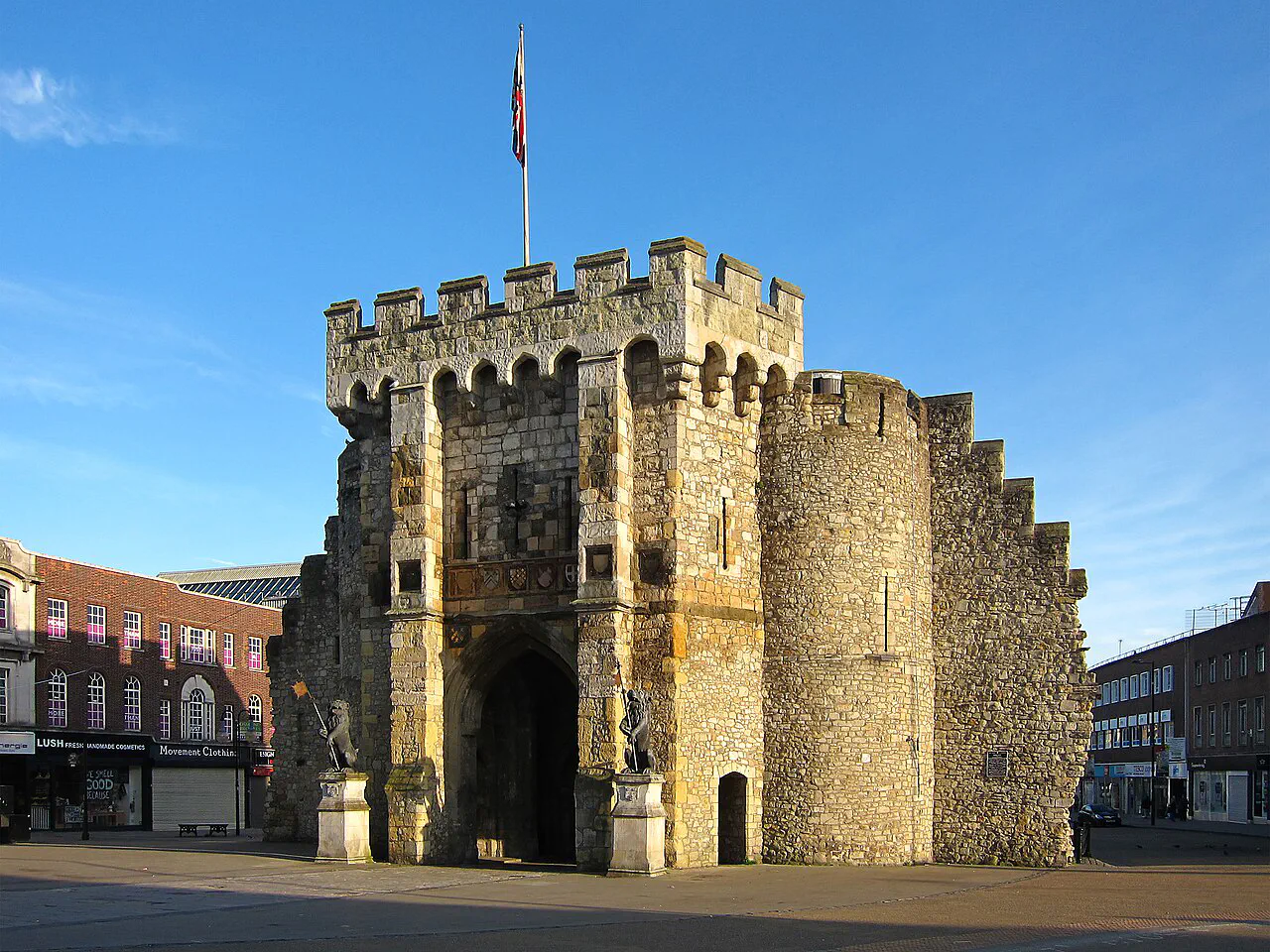
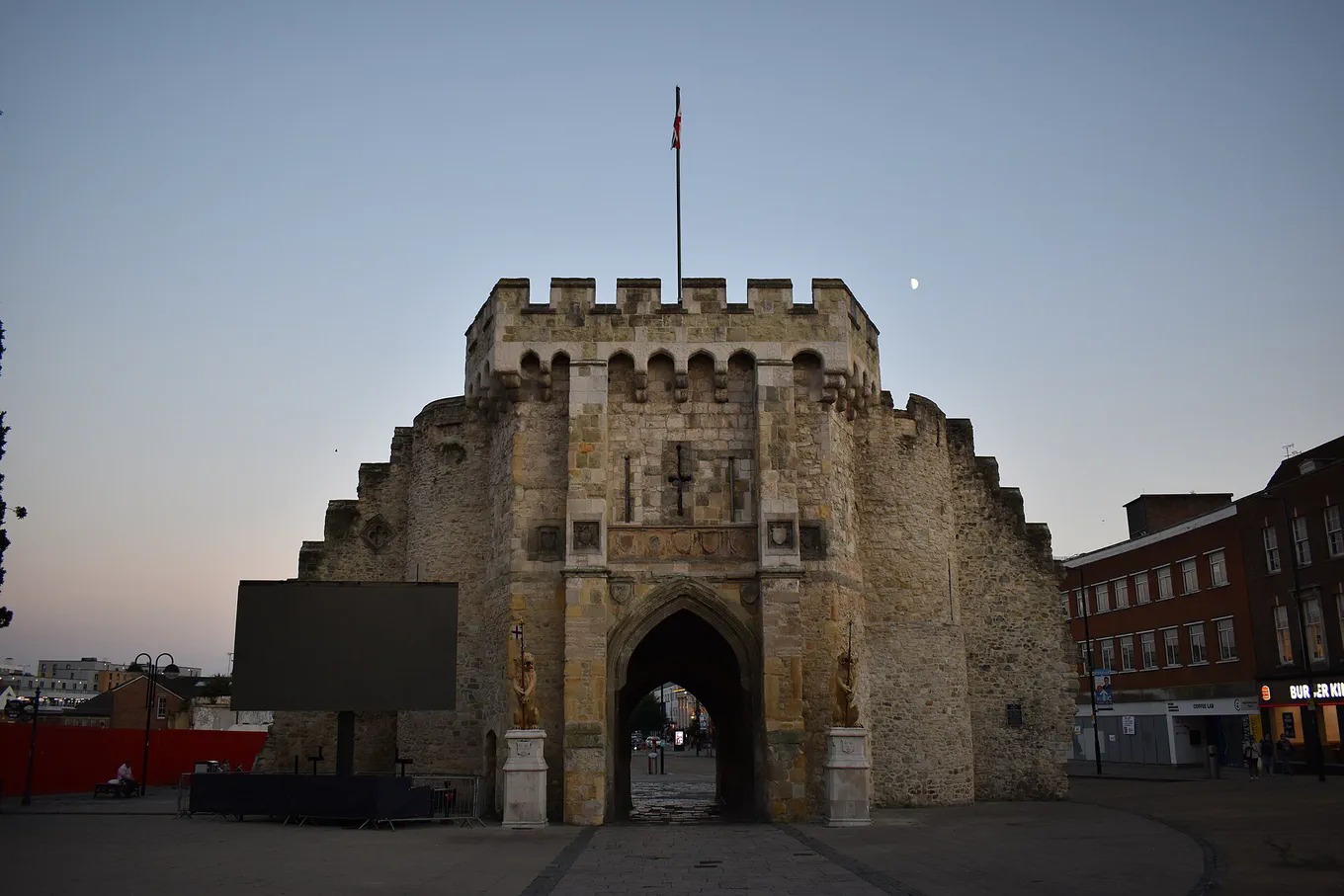
Stand here. The Bargate, the gatehouse built around 1180 as the main way through Southampton’s town walls. The ground outside it was a medieval execution site.
Act 2 of Shakespeare’s Henry V unmasks traitors at Southampton, and they were real. In 1415, as the king was about to sail for France, Richard, Earl of Cambridge, a grandson of Edward III, planned to put his brother-in-law, Edmund Mortimer, on the throne instead. But on 31 July, Mortimer himself told the king. Then he sat on the commission that condemned Cambridge, who was beheaded outside the Bargate. Henry sailed six days later. Cambridge’s grandsons became kings anyway, as Edward IV and Richard III.
2 John Alden, the Mayflower’s barrel-maker hired at Southampton
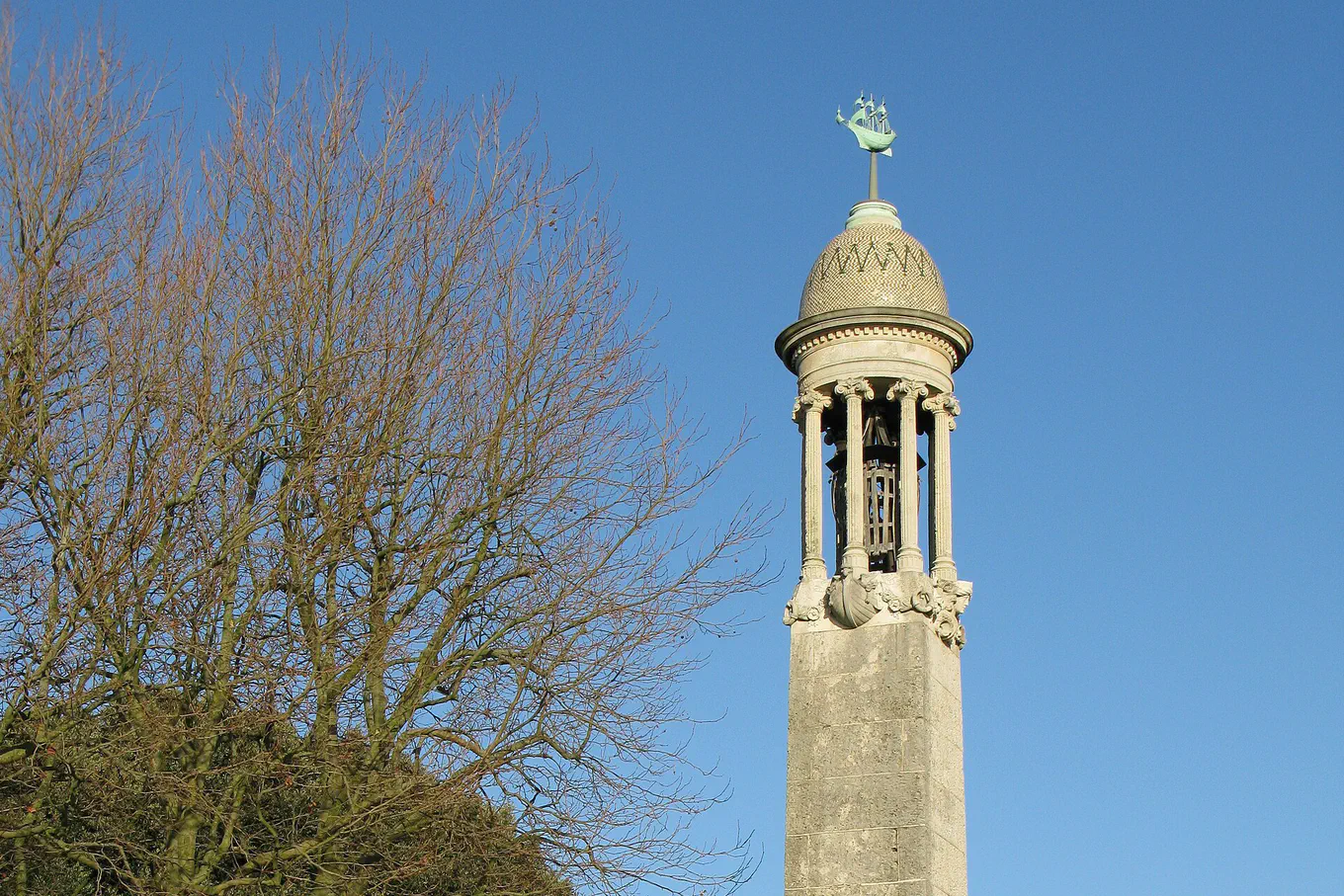
Stand here. The Pilgrim Fathers’ Memorial on the Western Esplanade, a fifty-foot stone column from 1913, topped by a model of the Mayflower.
At Southampton in 1620, the Pilgrims first saw the Mayflower, taking on supplies, and its captain hired John Alden, about 21, to make and mend the barrels. Alden could have gone back to England. Instead he stayed in Plymouth Colony, married Priscilla Mullins, whose whole family died in the first winter, and became the last surviving signer of the Mayflower Compact. Longfellow later put them in a poem, in which Priscilla asks, “Why don’t you speak for yourself, John?” No seventeenth-century record supports a word of it.
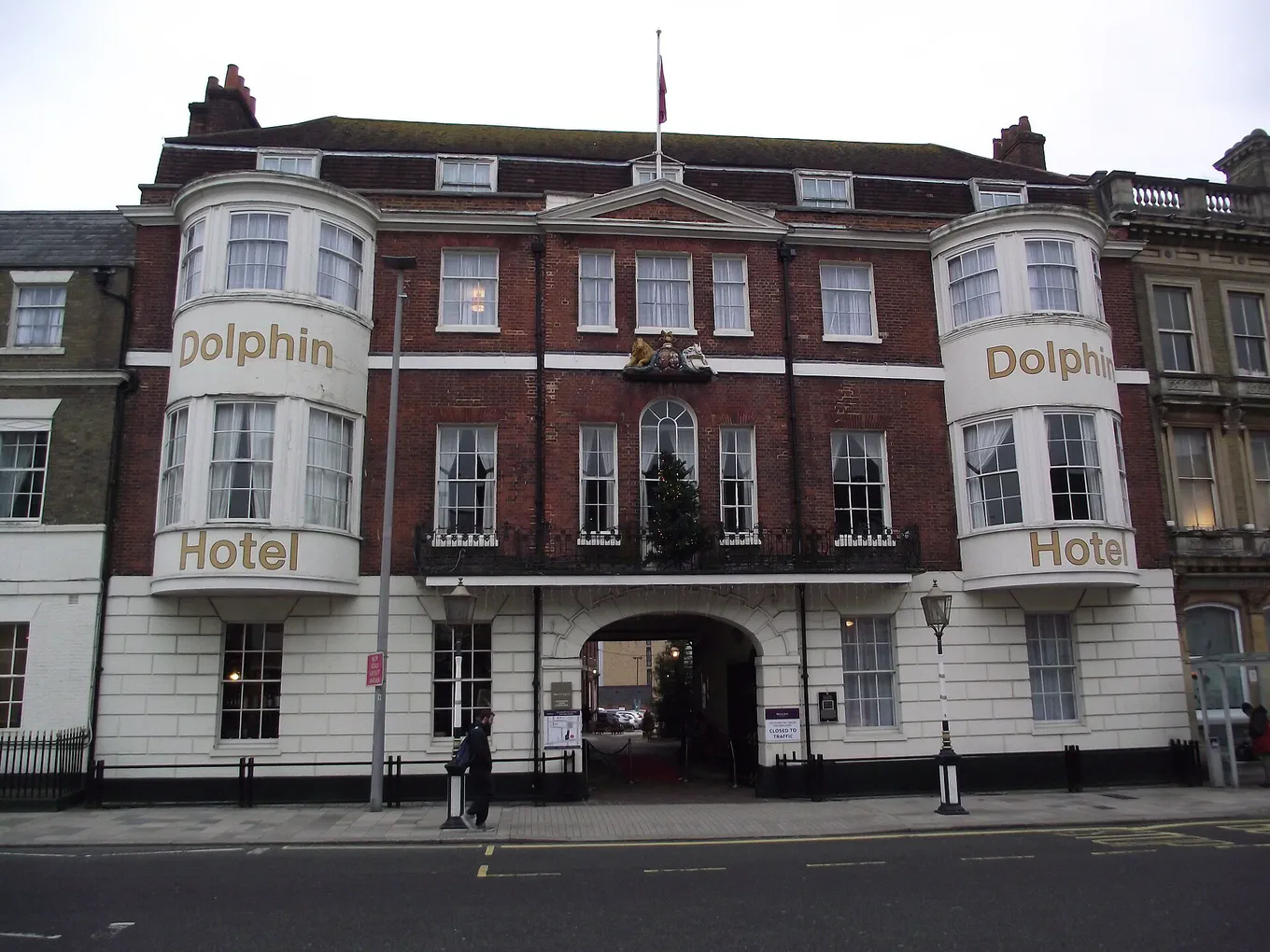
Jane Austen caught typhus in Southampton as a schoolgirl, and is said to have nearly died. Her aunt, fetching her own daughter, caught it and died. Austen came back at almost eighteen, visiting cousins, and danced at a ball at the Dolphin. In December 1808, living in the town, she returned for another ball. She wrote to her sister Cassandra that it was the same room she had danced in fifteen years before. In spite of “the shame of being so much older”, she felt “quite as happy now as then”.
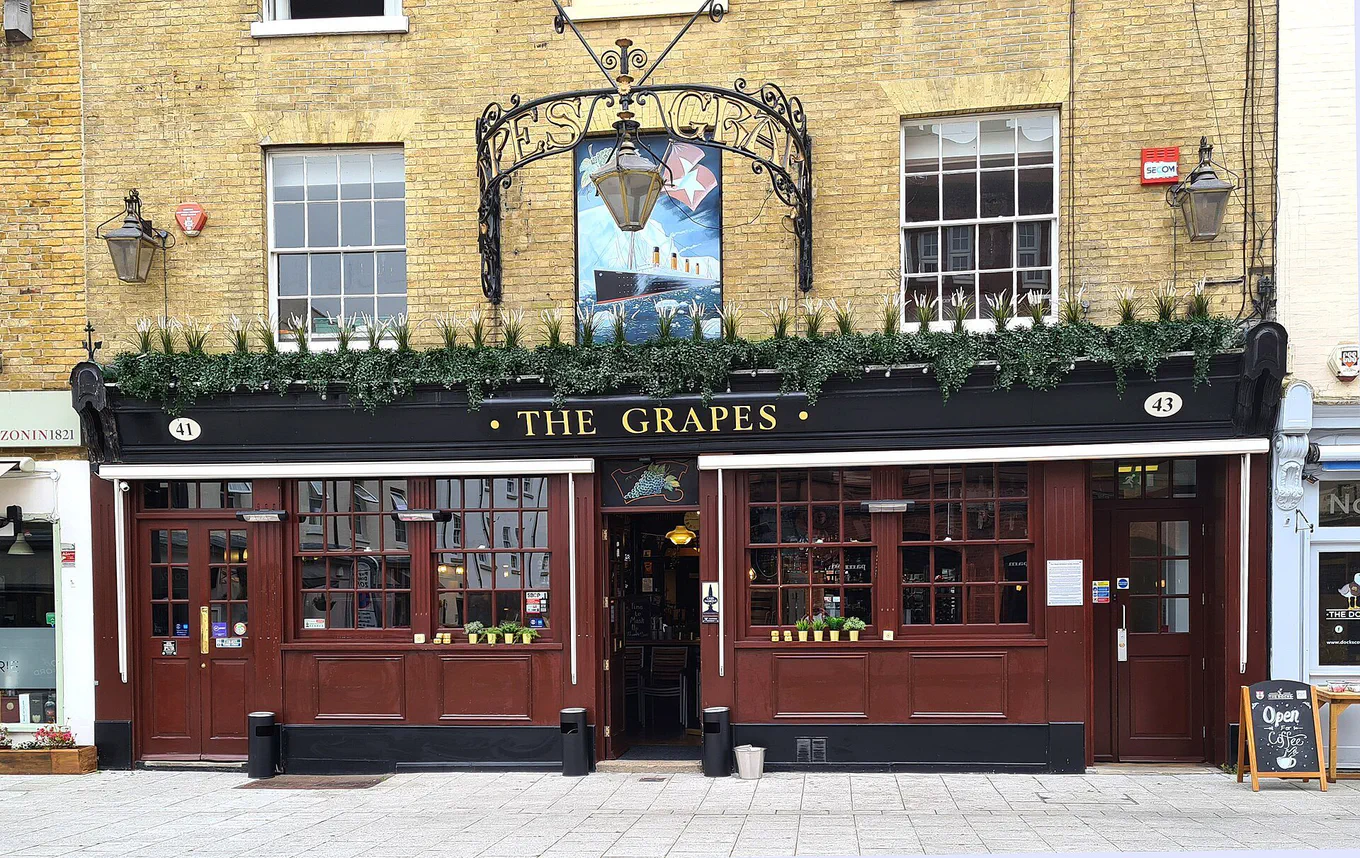
On the morning the Titanic sailed from Southampton, 10 April 1912, three stokers, the brothers Alfred, Tom, and Bertram Slade, were drinking at the Grapes. On the way to the ship, by one account, a train blocked their path. Other crewmen dashed across in front of it, and the brothers waited. They reached the gangway at 11.59, as it was being drawn up, and the officer refused to lower it. He had taken on men to replace them. The Slades were listed as deserters. Their replacements never came back.
Leslie Howard played R. J. Mitchell in The First of the Few, a 1942 film about the man who designed the Spitfire at Supermarine, in Woolston, and the film suggests rest might have saved him. But Mitchell didn’t work himself to death. He had surgery for cancer, kept working, and even earned his pilot’s licence. Then the cancer came back. He spent his last conscious hours in his garden and died in June 1937, aged 42. The first production Spitfire rolled off the Woolston line the following year.
Pack nothing. Leave Friday.
Every Friday, I write a free letter, Journey, that takes us on a trip through places, stories, and ideas.
Henry V(William Shakespeare, c. 1599). A play. In Act 2, in a council chamber at Southampton, Henry unmasks the Earl of Cambridge’s plot against him.
Jane Austen’s Letters(Jane Austen, 1807–1808). Her letters to her sister Cassandra, written from the house the family rented in Castle Square, Southampton.
Fingers in the Sparkle Jar(Chris Packham, 2017). A memoir set in Southampton, where the TV presenter and wildlife expert spent his childhood. He was diagnosed with Asperger syndrome as an adult.
Films to watch before you visit Southampton
The First of the Few(Leslie Howard, 1942). A film. Howard plays R. J. Mitchell, designing the Spitfire at Supermarine, the aircraft firm at Woolston, Southampton.
A Night to Remember(Roy Ward Baker, 1958). A film. The Titanic sails from Southampton on 10 April 1912, bound for New York on her maiden voyage.
Titanic(James Cameron, 1997). A film. Rose boards the ship at Southampton with her fiancé, and Jack and Fabrizio are let aboard only moments before it leaves.
Containment(Neil Mcenery-West, 2015). A film. Set in a 1970s council tower block in Weston, Southampton, and filmed in the Weston tower blocks.
Questions
Where did the Titanic sail from in Southampton?
From what was then called the White Star Dock, a deep-water dock that had opened in 1911. The ship had been towed to Berth 44 on arrival, ready for its passengers. The ship left at noon on 10 April 1912, on its maiden voyage to New York.
Did King Canute really try to hold back the tide at Southampton?
Almost certainly not. The story was written down in the twelfth century by Henry of Huntingdon, and the historian Malcolm Godden calls it a legend. A sign on Canute Road claims the spot for 1028, but Westminster, Bosham, the Wirral, and Gainsborough claim it too.
How much of Southampton’s medieval town wall survives?
About half of the two-kilometre circuit, mostly on the north and west sides, with 13 of its 29 towers and six of its eight gates, the Bargate among them. The walls are Grade I listed, but safety rules keep visitors off most of the wall-top.