Gutenberg spent his Strasbourg years hiding a new process from his own partners, which is one reason the first trace of the printing press we have is a lawsuit. (He adapted a wine press, by the way. Most good ideas are borrowed from somewhere.)
— Nick
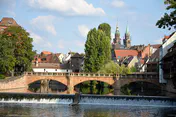
Strasbourg sits on France’s eastern border, on the Rhine, facing the German town of Kehl. It became French in 1681, was German again from 1871 to 1918, and is now the official seat of the European Parliament. Its stories here are a printer’s secret, a summer of dancing, a student afraid of heights, an anthem written overnight, and a general’s oath.
1 Gutenberg’s secret press and the Strasbourg lawsuit
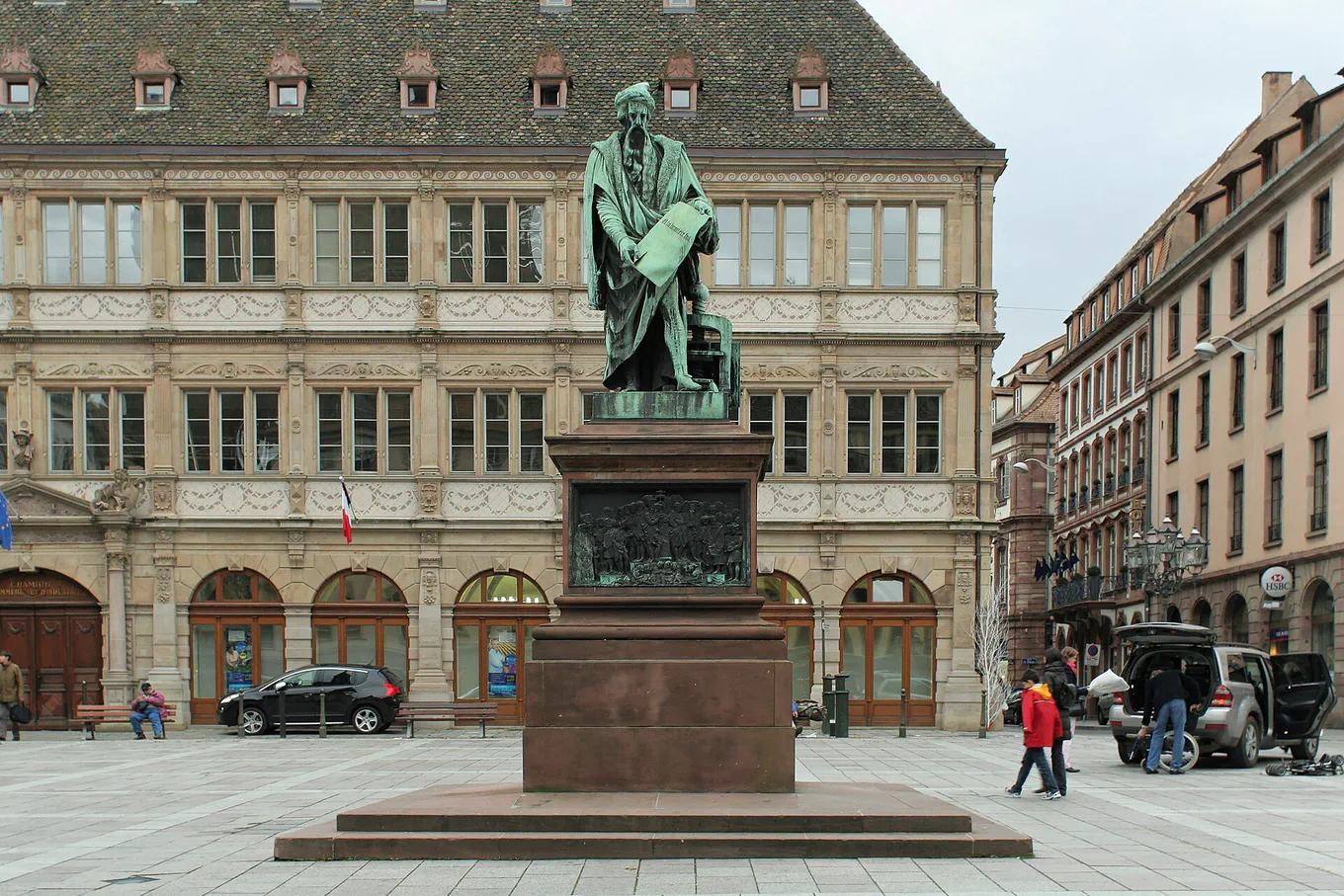
Stand here. Place Gutenberg, on the Grande Île, where his bronze statue has stood since 1840, holding a page that reads “And there was light” in French.
Johannes Gutenberg, the inventor of the printing press, had a secret in Strasbourg. His partners were paying for mirrors to sell to pilgrims at Aachen, and for a new process he kept to himself. Then one partner, Andreas Dritzehn, died of plague, and in 1439 his brother sued to take his place. Gutenberg largely won. But the court record mentions a press, forms, large quantities of metal, and his order to take apart and hide “the objects in the press”. It is the first known trace of his printing.
2 Strasbourg’s dancing plague of 1518 and the horse-market stage
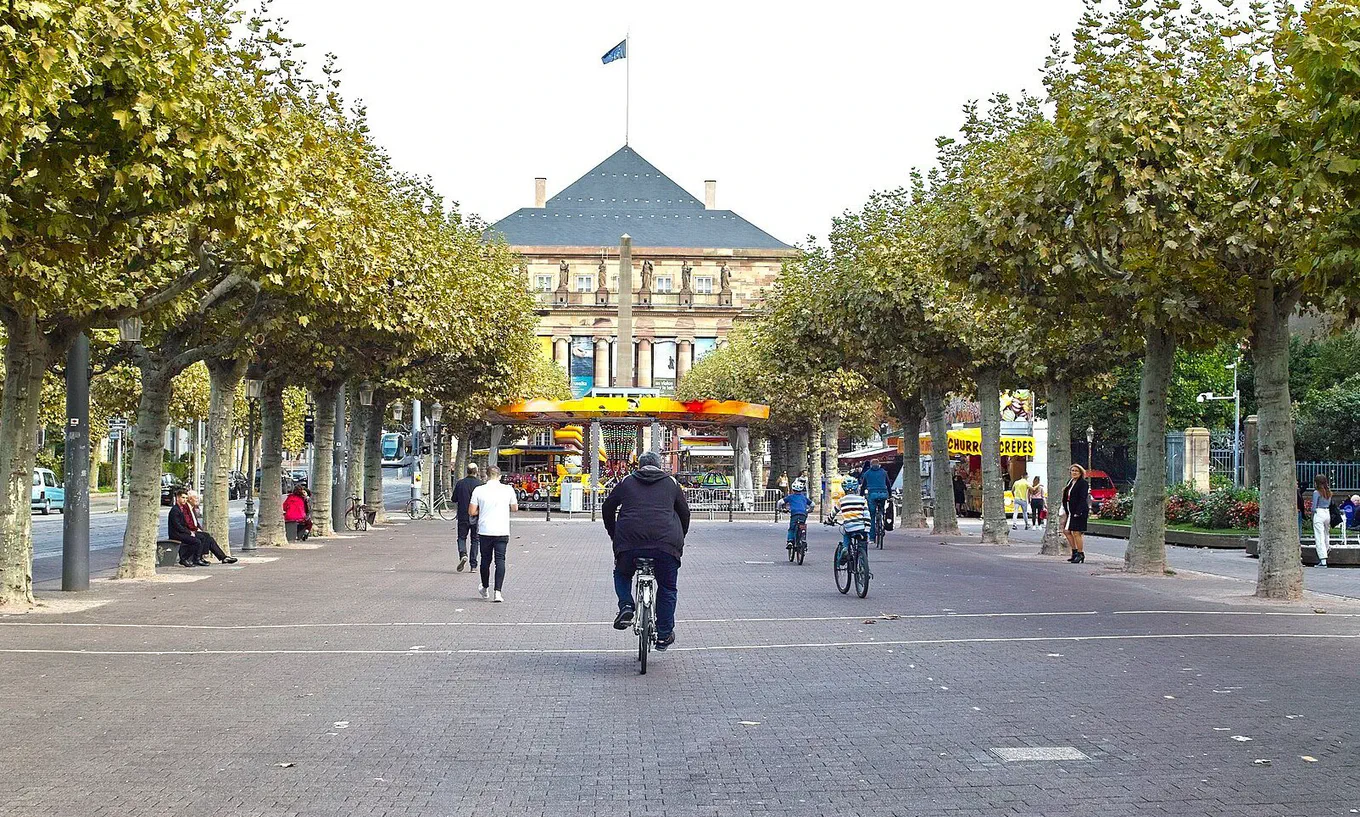
Stand here. Place Broglie, once the horse market, where the city put up a platform for the dancers. The town hall and opera house stand here today.
The dancing plague behind Jonathan Glazer’s film Strasbourg 1518 began, by most accounts, with one woman. On 14 July, Frau Troffea started dancing in the street, and kept going for a week, stopping only to sleep. Physicians blamed overheated blood, best danced out, so the council turned guild halls into dance floors, built stages in the markets, and paid musicians. Within a month, one chronicle counted four hundred dancers. The council pulled the stages down, all but banned music, and sent the worst afflicted to a saint’s shrine in red shoes.
3 Goethe cures his fear of heights on Strasbourg Cathedral
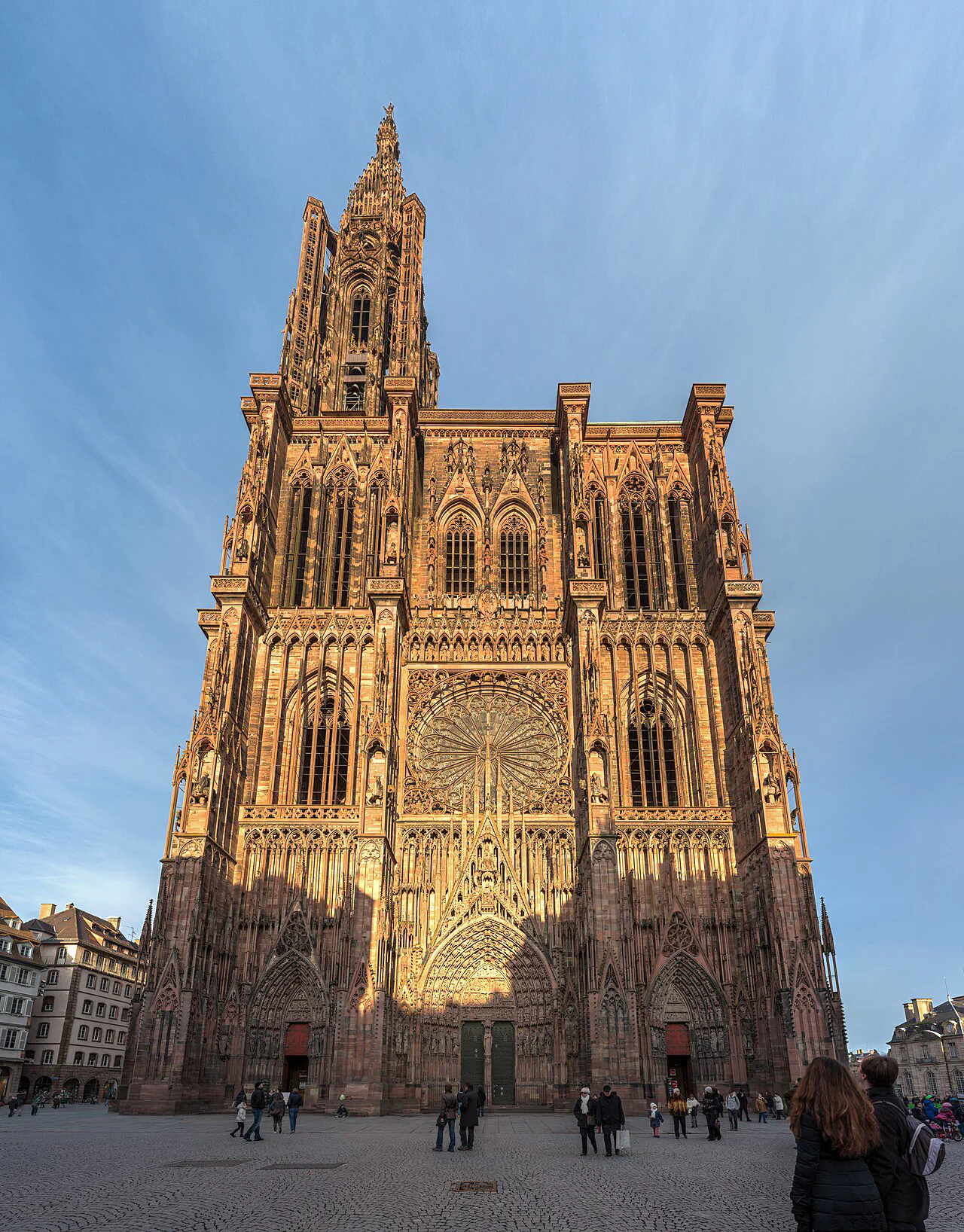
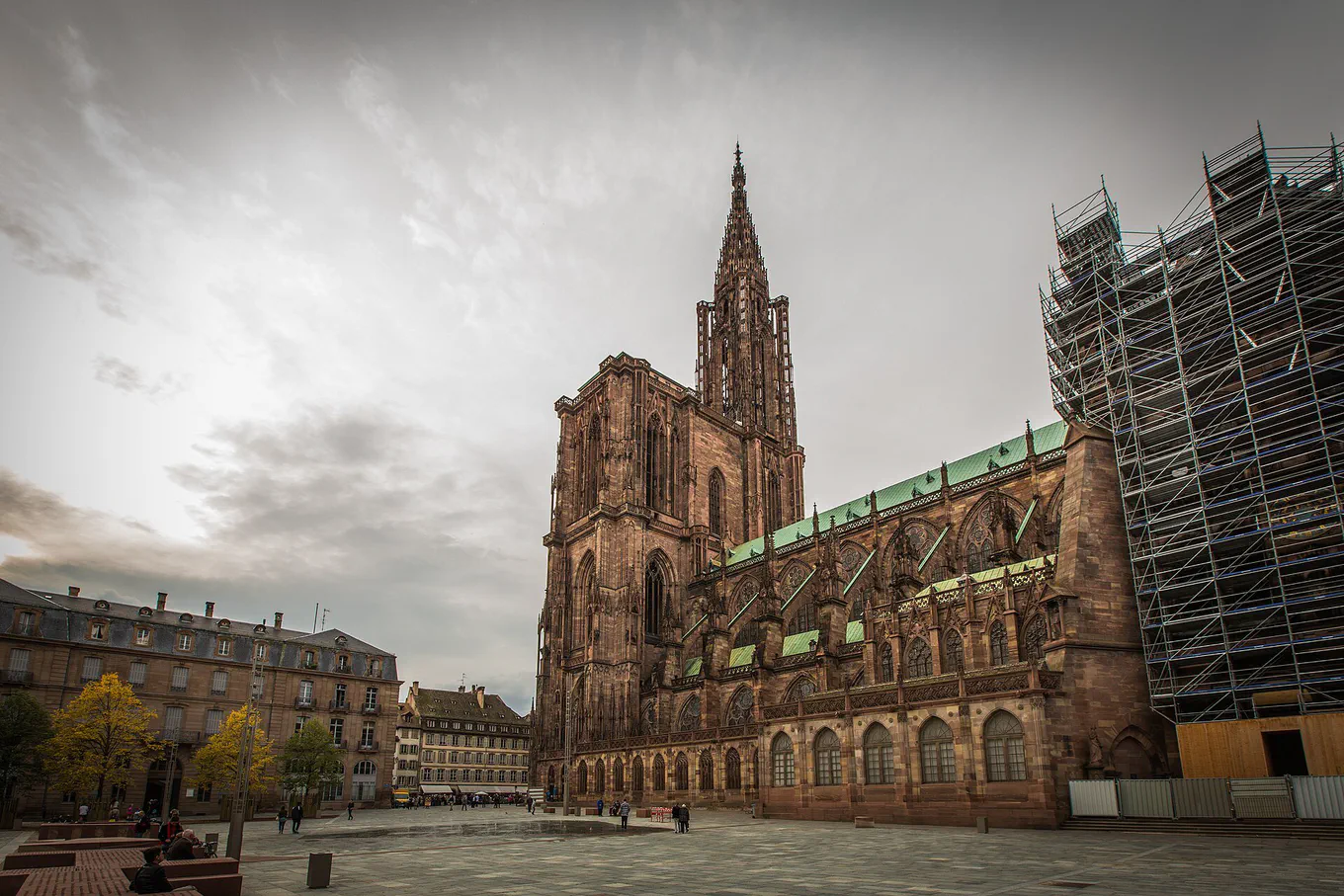
Stand here. Strasbourg Cathedral. From Place du Château, on its right side, 332 steps climb to the platform on the west front. Goethe went higher still.
In 1770, Johann Wolfgang von Goethe came to Strasbourg to finish his law studies. He was troubled, he wrote later, by a giddiness that seized him whenever he looked down from a height. So he climbed, alone, to the highest summit of the cathedral tower, then the tallest building in the world. From the top, he wrote, it was exactly like being lifted into the air in a balloon. He put himself through that fear and torment again and again, until it left him quite indifferent.
4 La Marseillaise, written overnight for Strasbourg’s mayor
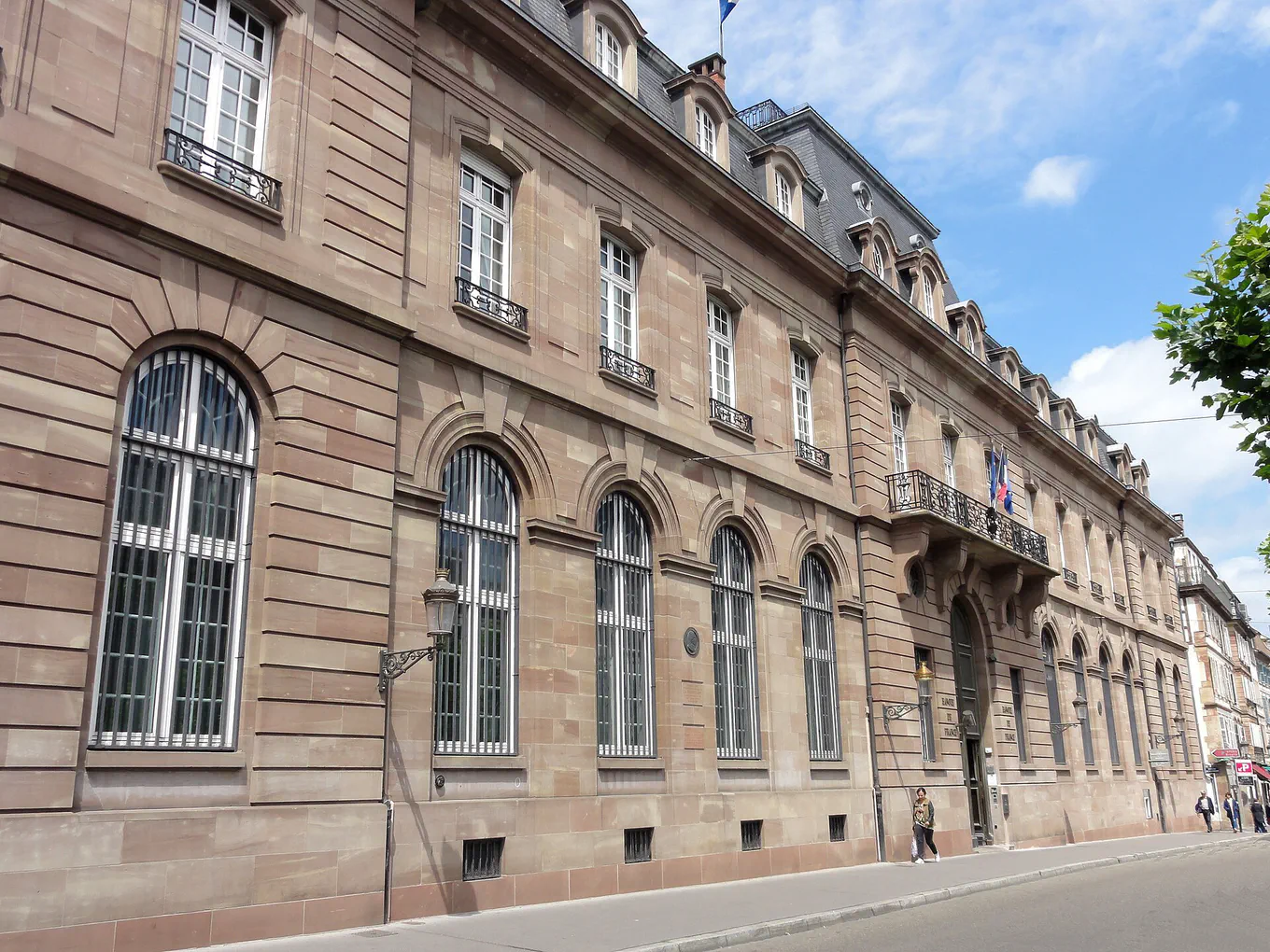
Stand here. Place Broglie again. The Banque de France, built in 1925 where the mayor’s house stood, carries medallions of him and the songwriter.
La Marseillaise, France’s national anthem, was written in Strasbourg. In April 1792, with France newly at war with Austria, the mayor, Philippe-Frédéric de Dietrich, lamented over dinner that the country had no anthem. He asked his guest Rouget de Lisle, a captain of engineers, for a song to rally the soldiers. Rouget wrote it that night, and it was first sung in the mayor’s living room. Volunteers from Marseille carried it into Paris and gave it their name. In December 1793, the Revolution guillotined the mayor who had asked for it.
5 Leclerc’s Kufra oath and the flag on Strasbourg Cathedral
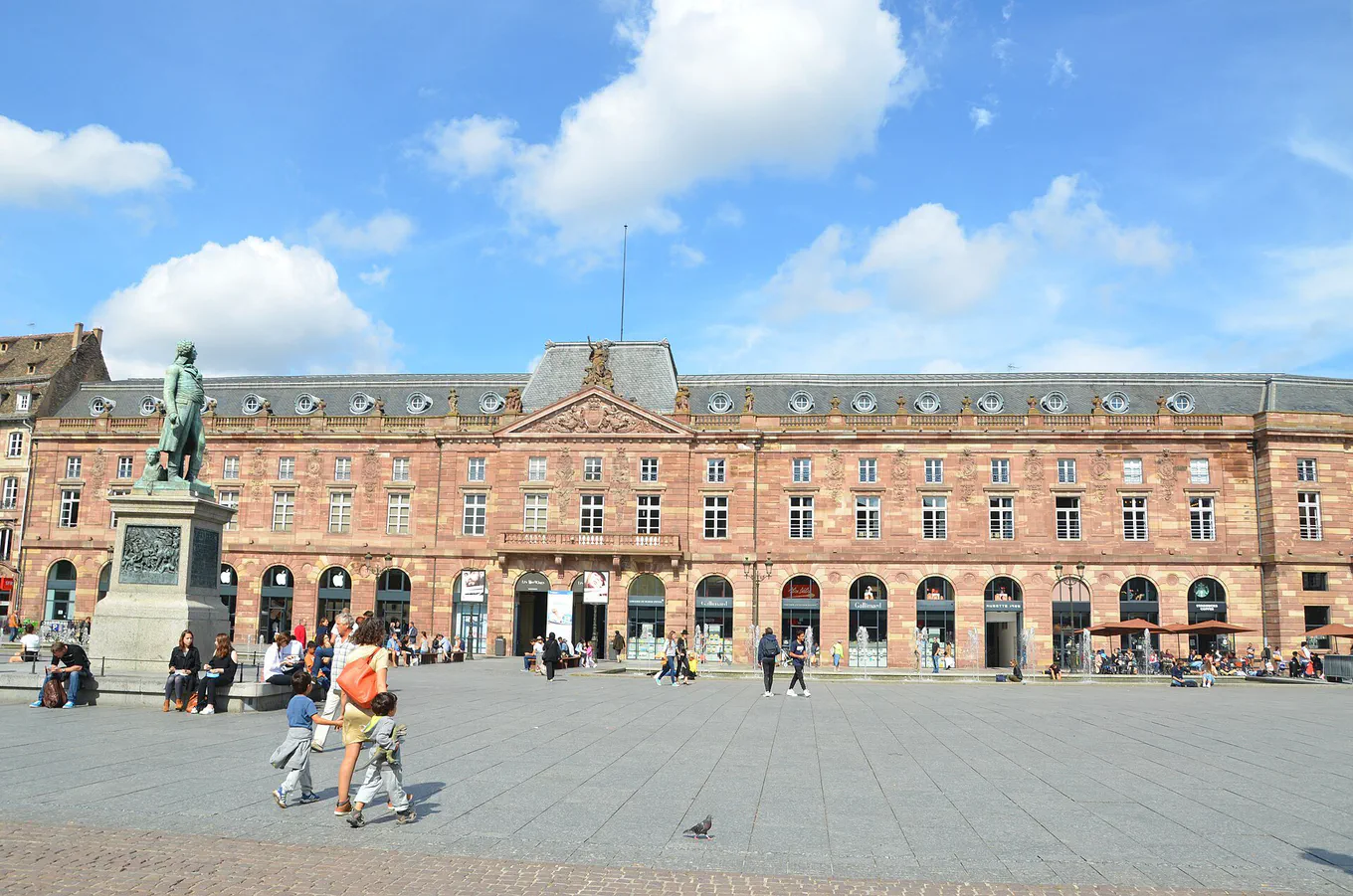
Stand here. Place Kléber, the city’s central square, where Leclerc reviewed his troops after the liberation of Strasbourg.
The statue of General Kléber in front of the Aubette on Place Kléber, Strasbourg’s central square.Zéphyrios / CC0.
More than three years before his division entered Paris, General Philippe Leclerc, of the Free French, made a promise about Strasbourg. In March 1941, his men forced the Italian and Libyan garrison at Kufra to surrender. There he had them swear not to lay down their arms until “our colours, our beautiful colours” flew over Strasbourg Cathedral, in a city Germany then held. On 23 November 1944, his 2nd Armoured Division liberated Strasbourg. That day the French flag, with the Cross of Lorraine, went up on the cathedral spire.
Pack nothing. Leave Friday.
Every Friday, I write a free letter, Journey, that takes us on a trip through places, stories, and ideas.
Dichtung und Wahrheit(Poetry and Truth) (Johann Wolfgang von Goethe, 1811–1833). A memoir. In Part II, Book IX, he climbs the cathedral tower alone to cure his giddiness.
The Life and Opinions of Tristram Shandy, Gentleman(Laurence Sterne, 1761). A novel. In Slawkenbergius’s Tale, Diego tries to pass unnoticed through Strasbourg with an enormous nose.
A Time to Dance, a Time to Die(John Waller, 2008). A history of the dancing plague of 1518, by the historian who suggested stress-induced mass hysteria.
Films to watch before you visit Strasbourg
Sherlock Holmes: A Game of Shadows(Guy Ritchie, 2011). A film. Filming moved to Strasbourg for two days in February 2011, on, around, and inside the cathedral.
In the City of Sylvia(José Luis Guerín, 2007). A film. A young man wanders central Strasbourg looking for a woman he met in a bar six years earlier.
The Duellists(Ridley Scott, 1977). A film. It opens in Strasbourg in 1800, as a hussar nearly kills the mayor’s nephew in a duel.
Questions
Can you climb Strasbourg Cathedral?
Yes. The way up starts on Place du Château, on the right side of the cathedral, and 332 steps lead to the main platform at the top of the 66-metre west front.
How old is the Strasbourg Christmas market?
Strasbourg has held its Christmas market, the Christkindelsmärik, around the cathedral since 1570, which makes it one of the oldest in Europe. Today it takes place mainly on Place Kléber, Place Broglie, Place du Marché aux Cochons de Lait, and around the cathedral.
Why is the European Parliament in Strasbourg?
Strasbourg is the Parliament’s official seat, and it has been a seat of European institutions since 1949. The Council of Europe, separate from the European Union, was among the first there, and it is still based in the city with its European Court of Human Rights.