Tbilisi is the capital and largest city of Georgia, on the banks of the Kura River, and more than 1.3 million people, almost a third of the country’s population, live there. It was founded in the 5th century. Its stories are a king’s falcon in a hot spring, a playwright’s widow on Mtatsminda, a sign painter’s legendary flowers, a Bolshevik bank raid, and a film-maker sent to a labour camp.
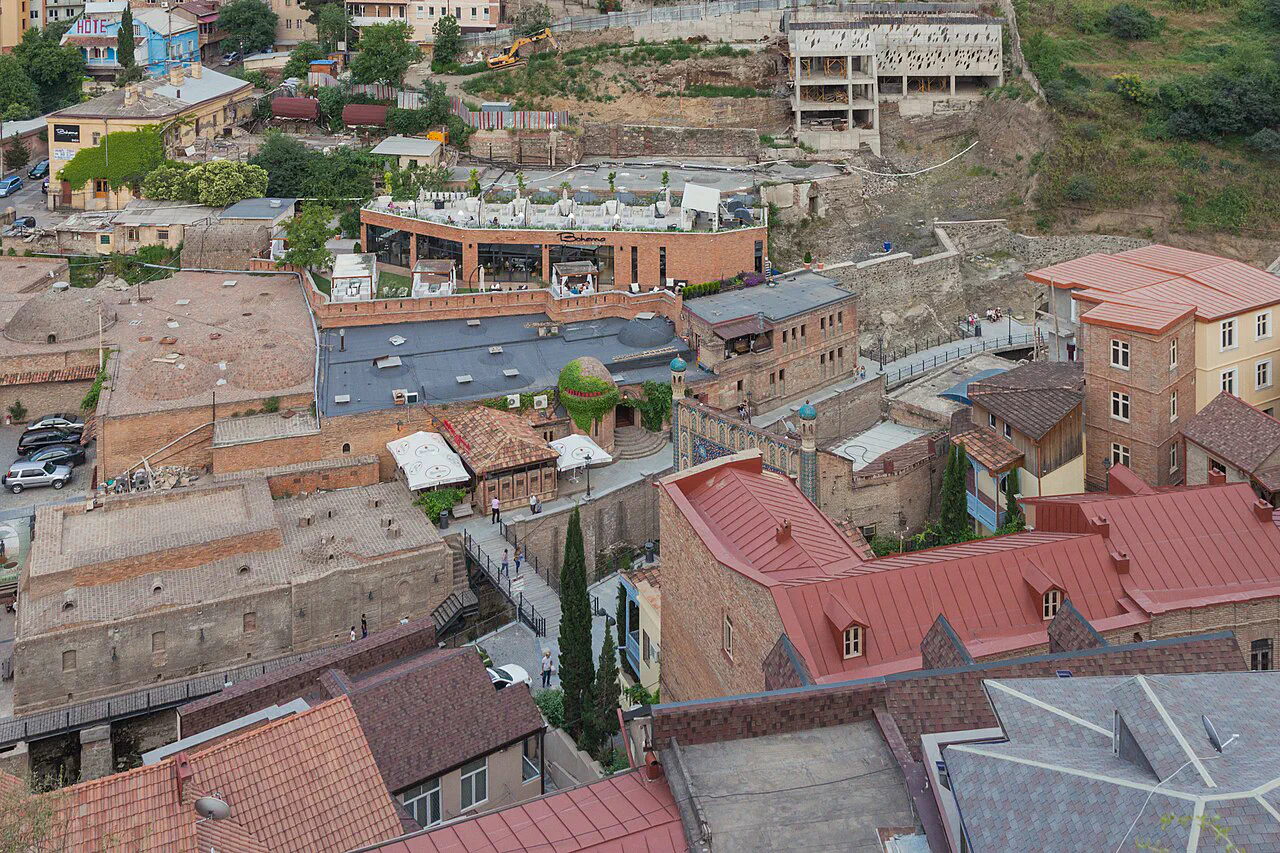
The story goes that in the 5th century, Vakhtang I, king of Iberia in eastern Georgia, went hunting with his falcon in the thick forest here. The falcon caught a pheasant, but both birds fell into a hot spring and died of the burns. The king was so struck by the springs that he cleared the forest and built a city. Some tellings make the bird a hawk. Either way, the city was named for the water that killed the birds. Tbilisi means “the place of warmth”.
2 Griboyedov, Nino and the grave on Mtatsminda
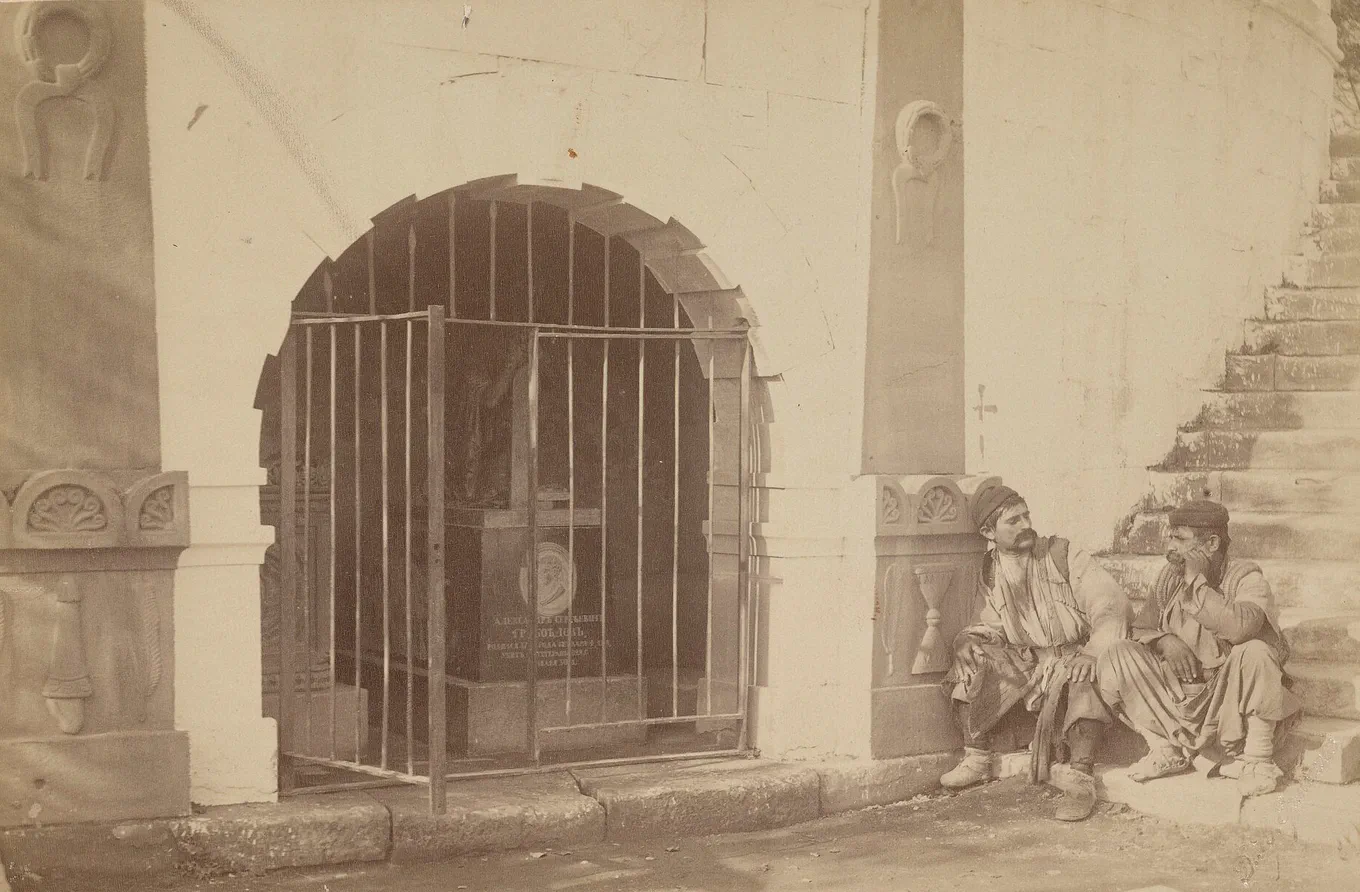
Stand here. Griboyedov’s grave, in a grotto by St David’s Church in the Mtatsminda Pantheon, with his wife beside him. Take the funicular to the middle station.
Griboyedov’s tomb in its grotto beside St David’s Church on Mtatsminda, photographed by Dmitri Ermakov in the late 19th century.Dmitri Ermakov / Public domain.
Alexander Griboyedov, the Russian diplomat who wrote the comedy Woe from Wit, married Nino Chavchavadze, a Georgian prince’s daughter of 15 or 16, in 1828. Months later he was sent to Persia as envoy, and a mob stormed the Russian embassy in Tehran and killed him. Nino, pregnant, gave birth early at the news, and the baby lived a few hours. She buried him here, as he wished, and never remarried. Her monument asks, “Your mind and works are immortal in Russian memory, but why has my love outlived you?”
3 Pirosmani’s million roses for a French actress in Tbilisi
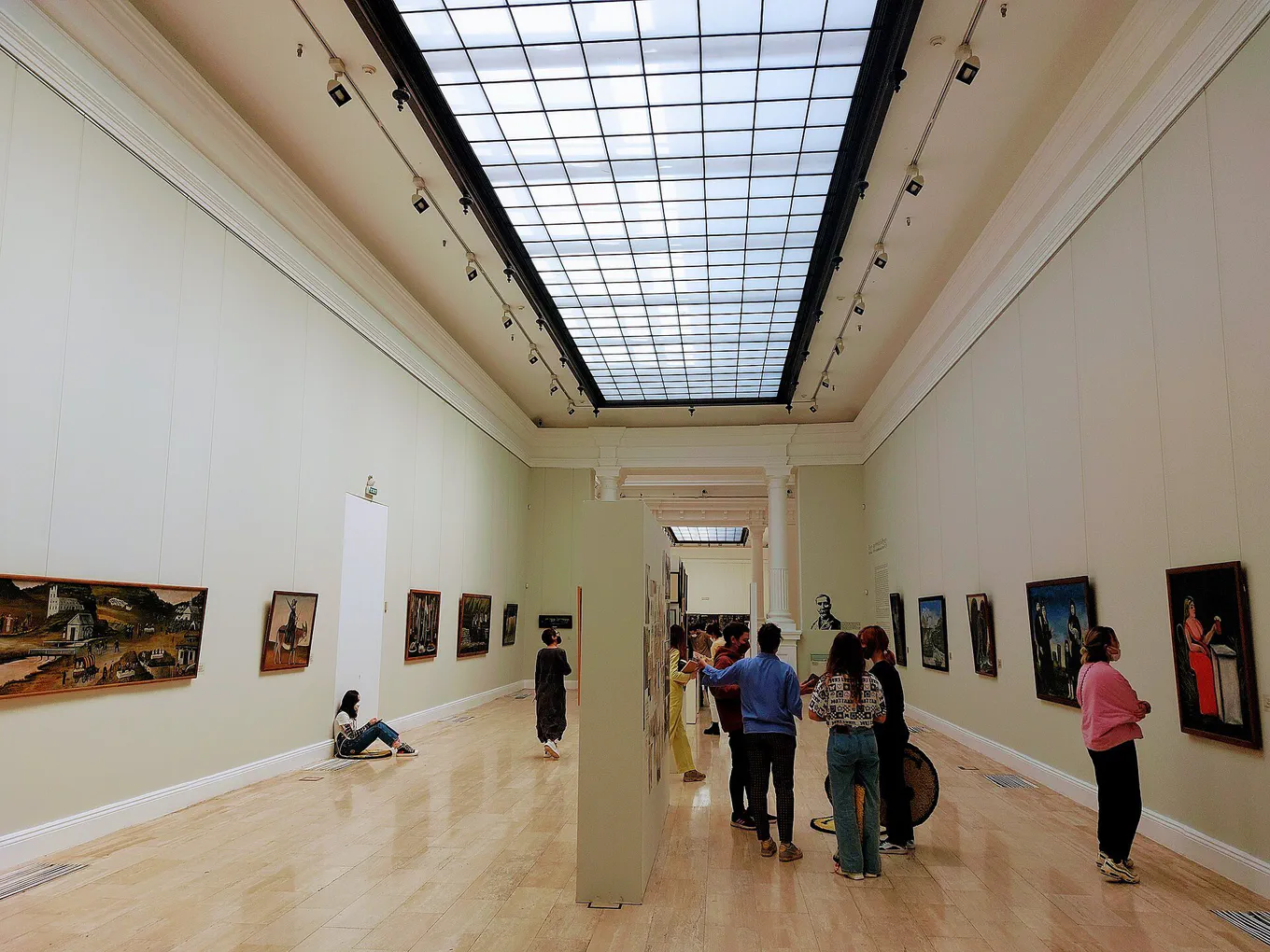
Stand here. The Pirosmani hall of the National Gallery, 11 Shota Rustaveli Avenue, in the former Temple of Glory building.
When Alla Pugacheva sang “Million Roses” in 1982, its Russian lyrics drew on the life of Niko Pirosmani. Pirosmani taught himself to paint and lived by painting tavern signs. In 1905, legend has it, he fell for Marguerite de Sèvres, a French actress on tour, and traded his share of a milk stand and all he owned for flowers. She woke to carriages full of them outside her hotel. Little of it is documented. His death is. He died in 1918, of malnutrition and liver failure. His grave went unrecorded.
4 Stalin’s ally Kamo and the bank raid on Freedom Square
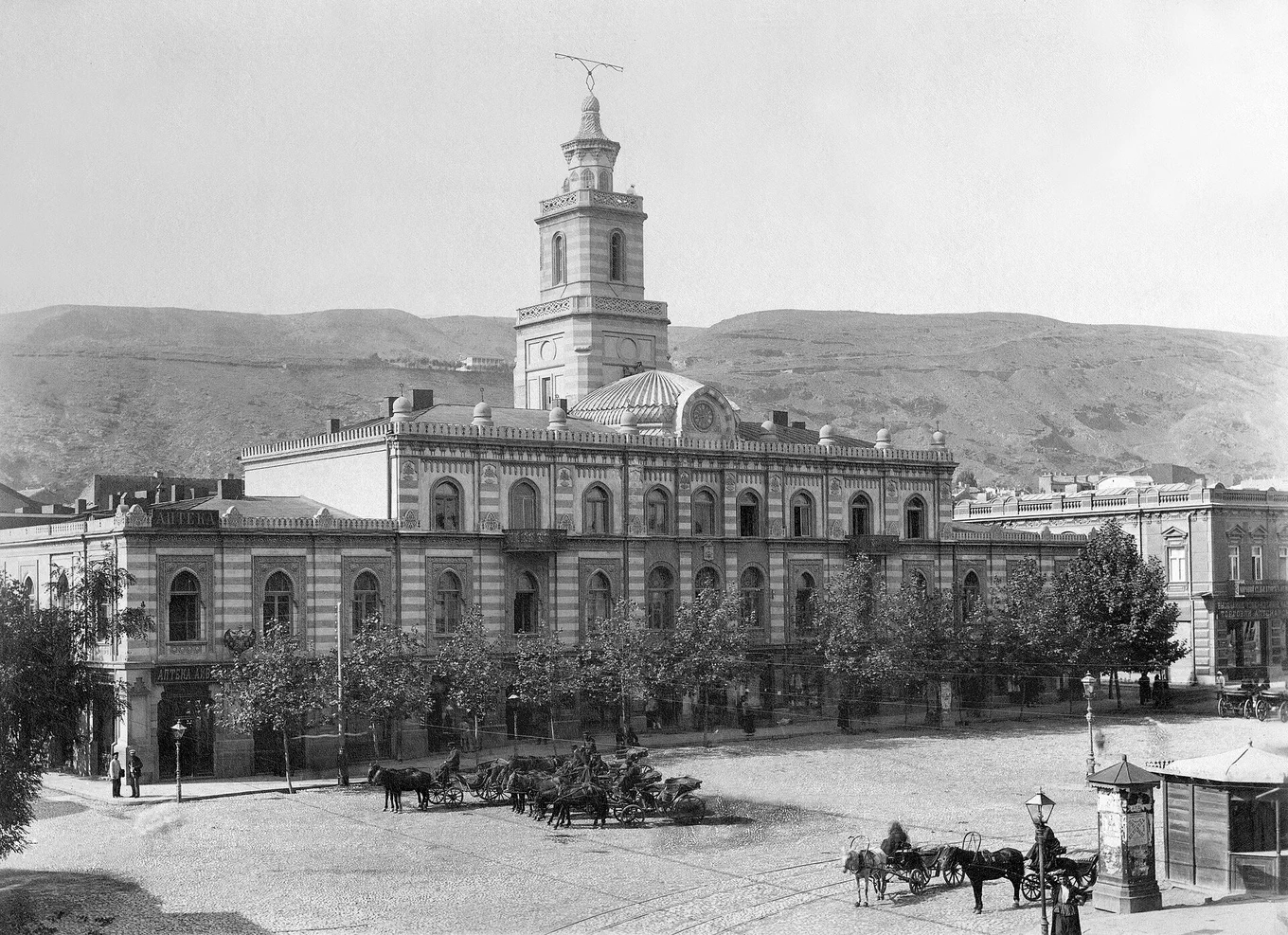
Stand here. Freedom Square, which under the tsars was Erivansky Square. Today it has Zurab Tsereteli’s Liberty Monument, St George slaying the dragon.
Tbilisi’s Erivansky Square, later Freedom Square, and its city hall in a 19th-century photograph.Unknown / Public domain.
In 1907, the Bolsheviks wanted money, and a gang led by Kamo, an early companion of Joseph Stalin, robbed a bank coach crossing this square. Kamo came dressed as a cavalry captain, in a horse-drawn carriage. Bombs were thrown from every side, and archive records count forty dead. The gang escaped with 241,000 roubles. But the authorities knew the serial numbers of the 500-rouble notes, and men trying to change them were arrested. Most of the big notes could not be spent.
5 Sergei Parajanov, the Tbilisi film-maker sent to a labour camp
Stand here. Parajanov’s bronze statue, near the corner of Erekle II and Bambis Rigi streets in Old Tbilisi.
Born in Tbilisi to Armenian parents, Sergei Parajanov broke with socialist realism to make poetic films, and The Color of Pomegranates won him acclaim in 1969. Then he was arrested in Kyiv, accused of homosexuality and pornography, and sentenced to five years’ hard labour. In the camp he kept working, making tiny doll-like sculptures and some 800 drawings and collages. He was released in December 1977. In Tbilisi, the street where he grew up has carried his name since 2021.
Pack nothing. Leave Friday.
Every Friday, I write a free letter, Journey, that takes us on a trip through places, stories, and ideas.
Hard by a Great Forest(Leo Vardiashvili, 2024). A debut novel of homecoming, guilt, and loss, set in Tbilisi. Saba arrives to find the city recently flooded.
Films to watch before you visit Tbilisi
My Happy Family(Nana Ekvtimishvili and Simon Gross, 2017). A film set in Tbilisi, about a woman who leaves a small downtown apartment shared with husband, parents, adult children, and son-in-law for one she has rented.
Street Days(Levan Koguashvili, 2010). A film set in Tbilisi, following a heroin addict struggling to protect a friend’s son from corrupt cops, shot in the city’s narrow streets.
Once Upon a Time There Was a Singing Blackbird(Otar Iosseliani, 1970). A Soviet musical comedy-drama film about Gia, who is a percussionist with an orchestra in Tbilisi.
Questions
What does the name Tbilisi mean?
It means “the place of warmth”. The name comes from the area’s many sulphur hot springs, and its root is the Georgian word for warm, which was once ṭpili and is now tbili. By legend, the springs were found when King Vakhtang’s falcon fell into one.
Can you still bathe in the Tbilisi sulphur baths?
Yes. More than ten bathhouses are still in use in Abanotubani, the old bath district. Among them is the Orbeliani Bath, known as Chreli Abano, the Colourful Bath. By the end of the 13th century, Tbilisi had 65 baths.
When does the angel come out of the Gabriadze clock tower?
Every hour. An angel comes out of painted doors to ring a bell in the tilting clock tower beside the marionette theatre of Rezo Gabriadze, co-writer of the film Mimino, at 13 Shavteli Street. Some locals say you should make a wish when the bell sounds. A puppet show plays in the tower twice a day, at 12:00 and 19:00.