Neil Druckmann, who created The Last of Us, was born in Tel Aviv. So was Daniel Kahneman, whose Thinking, Fast and Slow I’ve read three times. Between them, they explain most of my bad decisions and some of my best evenings.
— Nick
Tel Aviv sits on Israel’s Mediterranean coast and is the country’s economic and technological centre. It was founded in 1909 on sand dunes outside the ancient port of Jaffa, and the two became one city, Tel Aviv-Yafo, in 1950. Its stories here are a princess chained to a rock, a lottery drawn with seashells, an unfinished scroll, a burning ship, and a song sheet in a prime minister’s pocket.
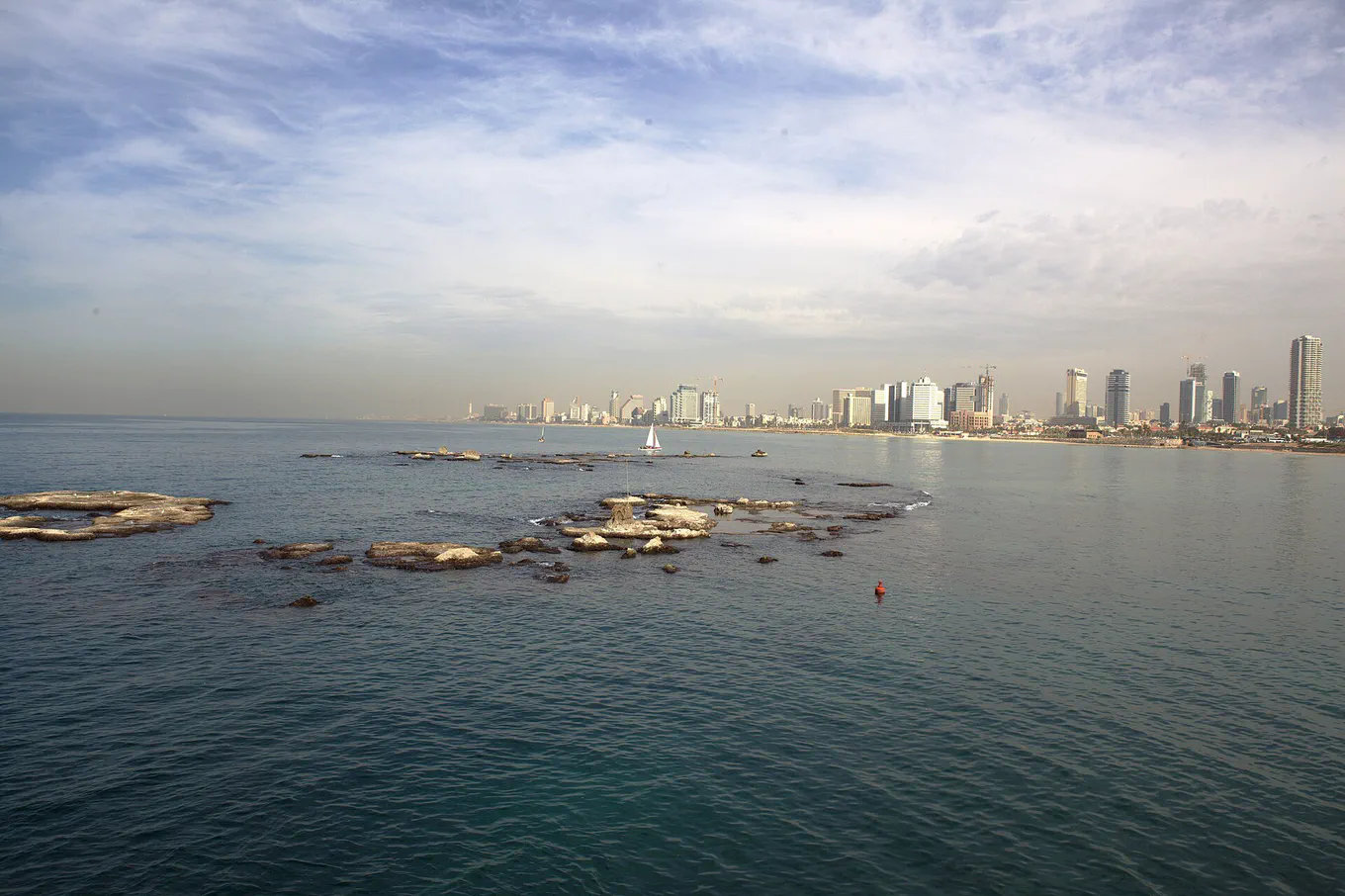
In the Greek myth, Perseus kills a sea monster with Medusa’s head and frees Andromeda, a king’s daughter chained naked to a rock by the sea. Her father’s kingdom was Aethiopia. But by the 1st century BC, the port of Joppa, today’s Jaffa, had claimed the rock for itself, and the story was serving its tourist trade. The historian Josephus wrote that on Joppa’s rocks the chains that bound Andromeda “have left their footsteps”. The borrowed myth had its evidence.
2 Akiva Weiss and the seashell lottery that founded Tel Aviv
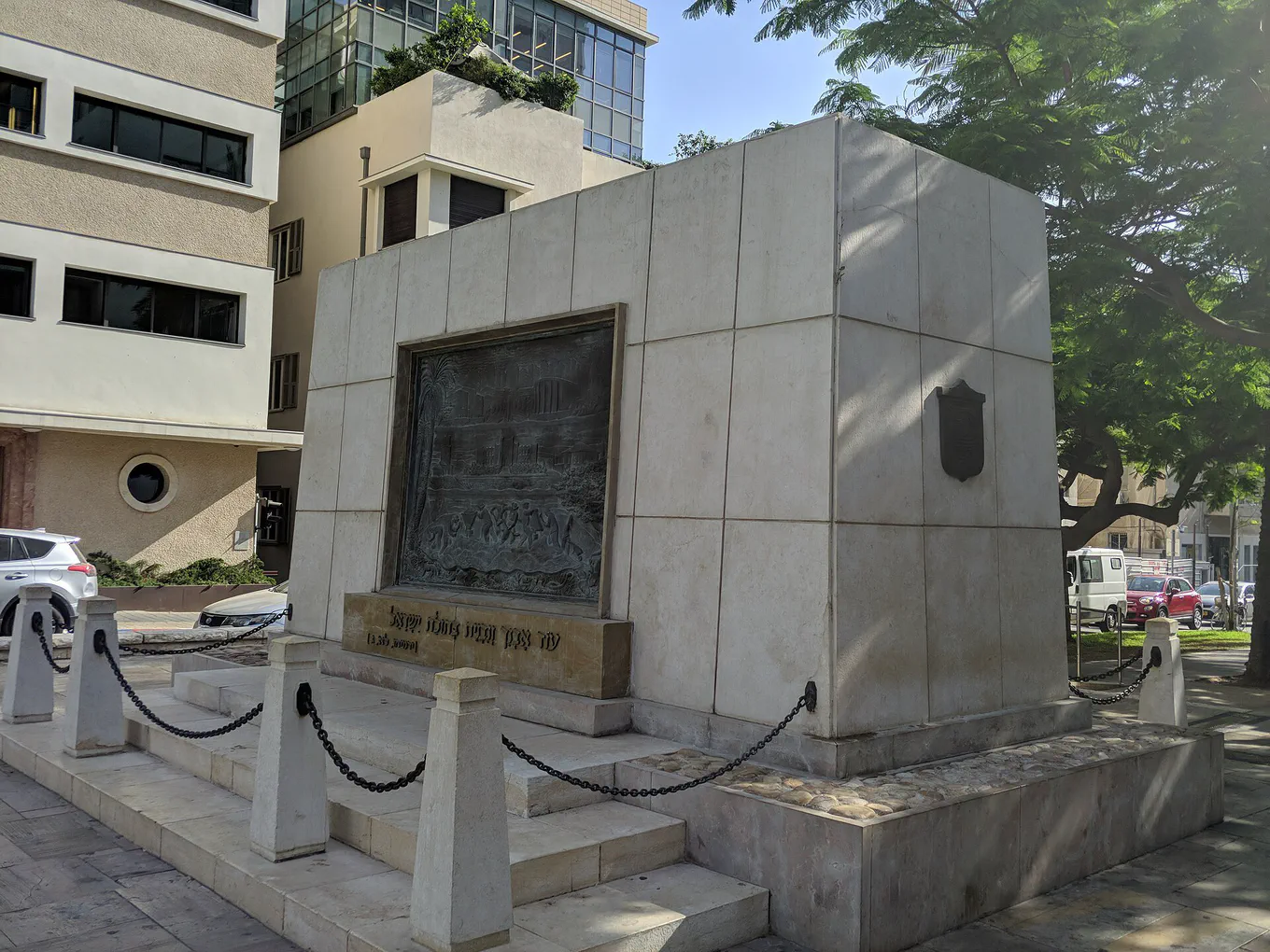
Stand here. The monument to Tel Aviv’s founders on Rothschild Boulevard, across from Independence Hall. It has stood on the lottery site since 1949.
One of the most famous photographs in Tel Aviv’s history shows the founding families on bare dunes on 11 April 1909, drawing lots for their plots. Its leading figure is Akiva Weiss, a watchmaker who had proposed a “first Hebrew city”. He collected 120 shells on the beach, white for names and grey for plot numbers, and they were drawn from two boxes, though accounts of the draw differ in the details. That day is counted as Tel Aviv’s founding. Yet in 1956, one writer noted that the “first founder” was forgotten, with no streets named after him.
3 David Ben-Gurion and the unfinished scroll on Rothschild Boulevard
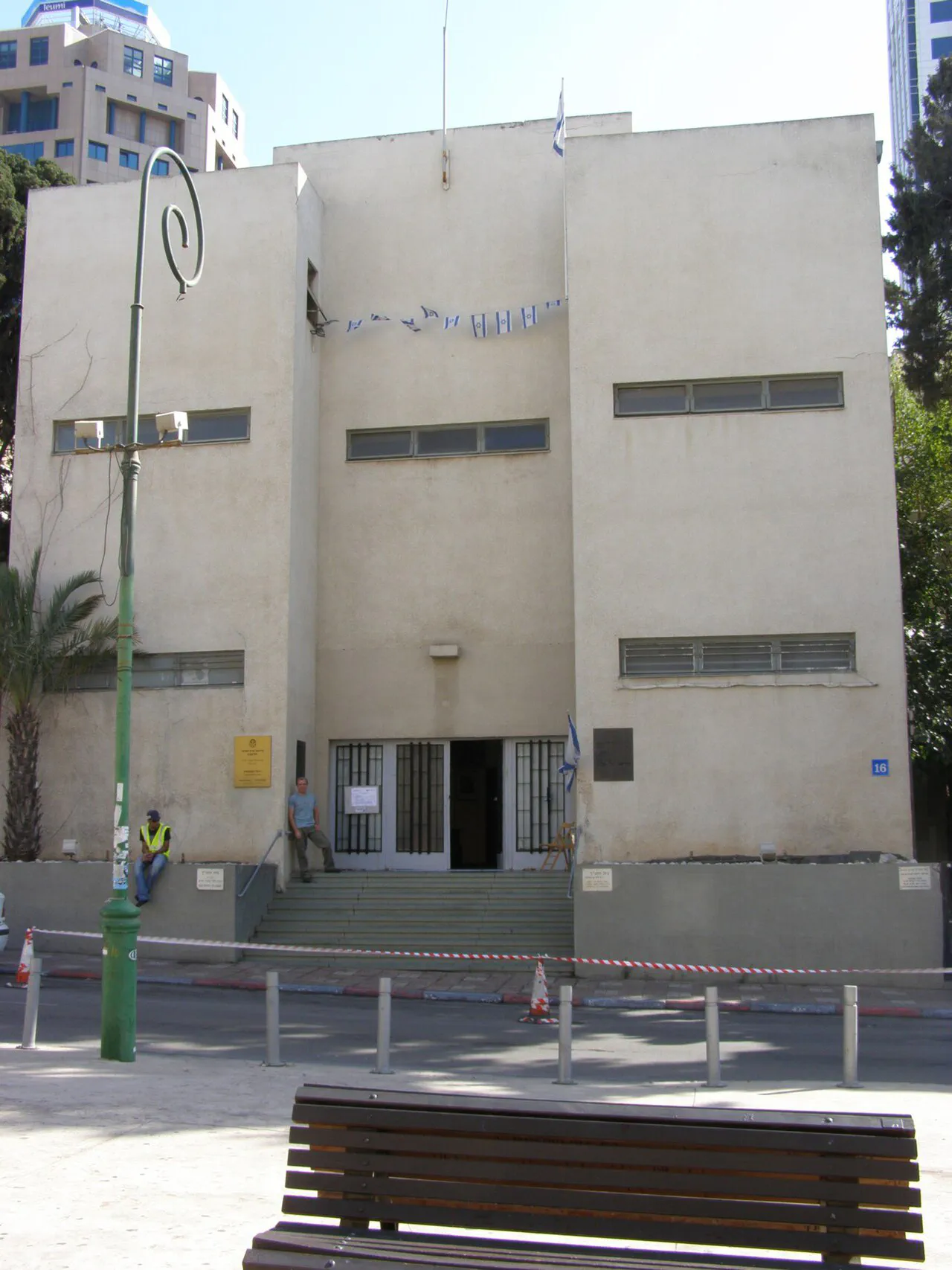
Stand here. Independence Hall, 16 Rothschild Boulevard, once the home of Tel Aviv’s first mayor.
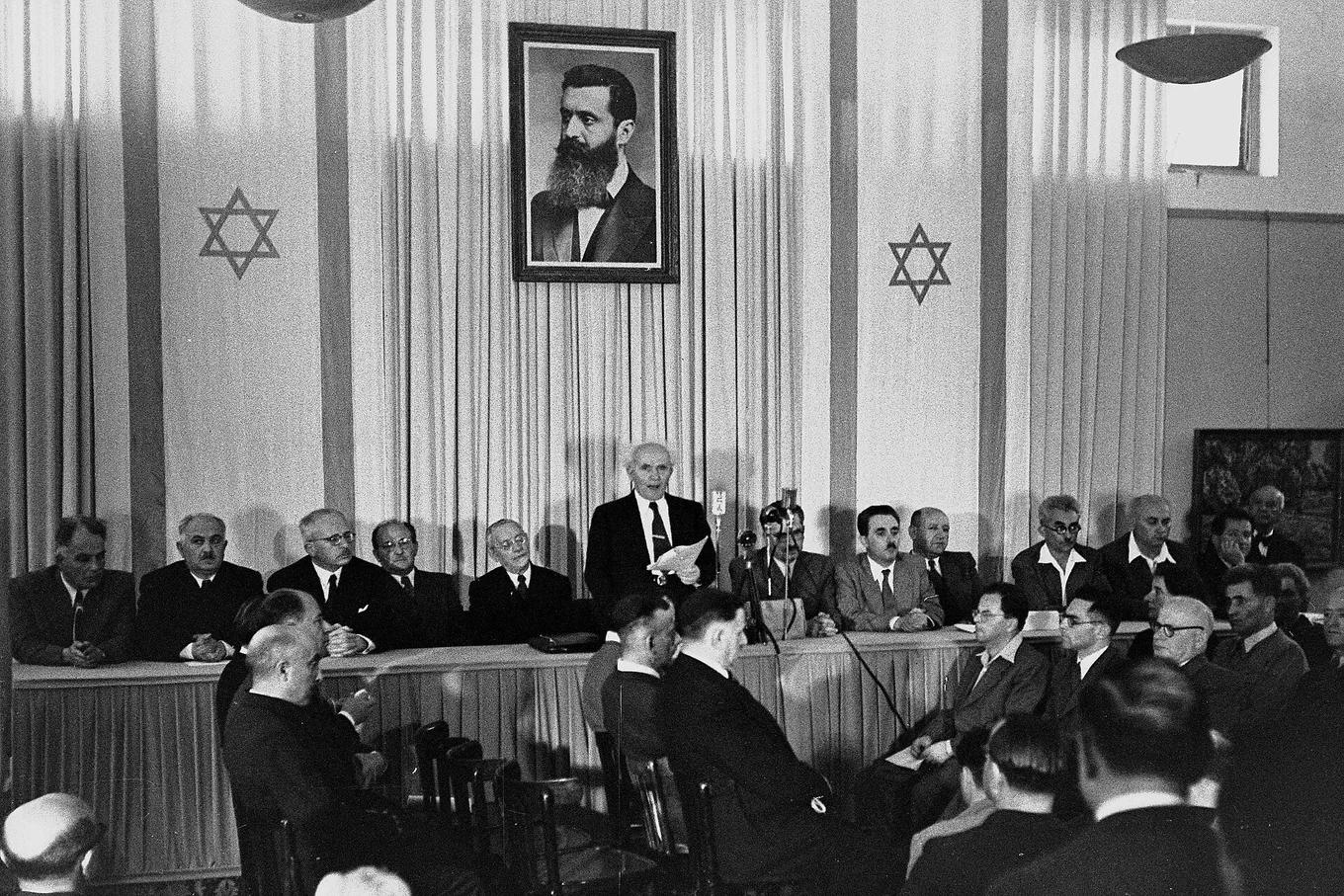
David Ben-Gurion reads out the declaration of the State of Israel beneath Herzl’s portrait in the old Tel Aviv Museum hall.Rudi Weissenstein / Public domain.
David Ben-Gurion proclaimed the State of Israel at 4 pm on 14 May 1948, in the main hall of Tel Aviv’s art museum. The guests had been sworn to secrecy, for fear the British, who ruled until midnight, might stop it. Ben-Gurion told all 250 of them he was reading from the scroll of independence. In fact only its bottom part was finished, so he read from handwritten notes. The calligrapher completed the scroll in June, when the state it declared was already weeks old.
4 Menachem Begin and the burning Altalena off Frishman Street
Stand here. Frishman Beach, at the foot of Frishman Street, where the ship ran aground. A statue of Ben-Gurion doing a headstand is on the beach today.
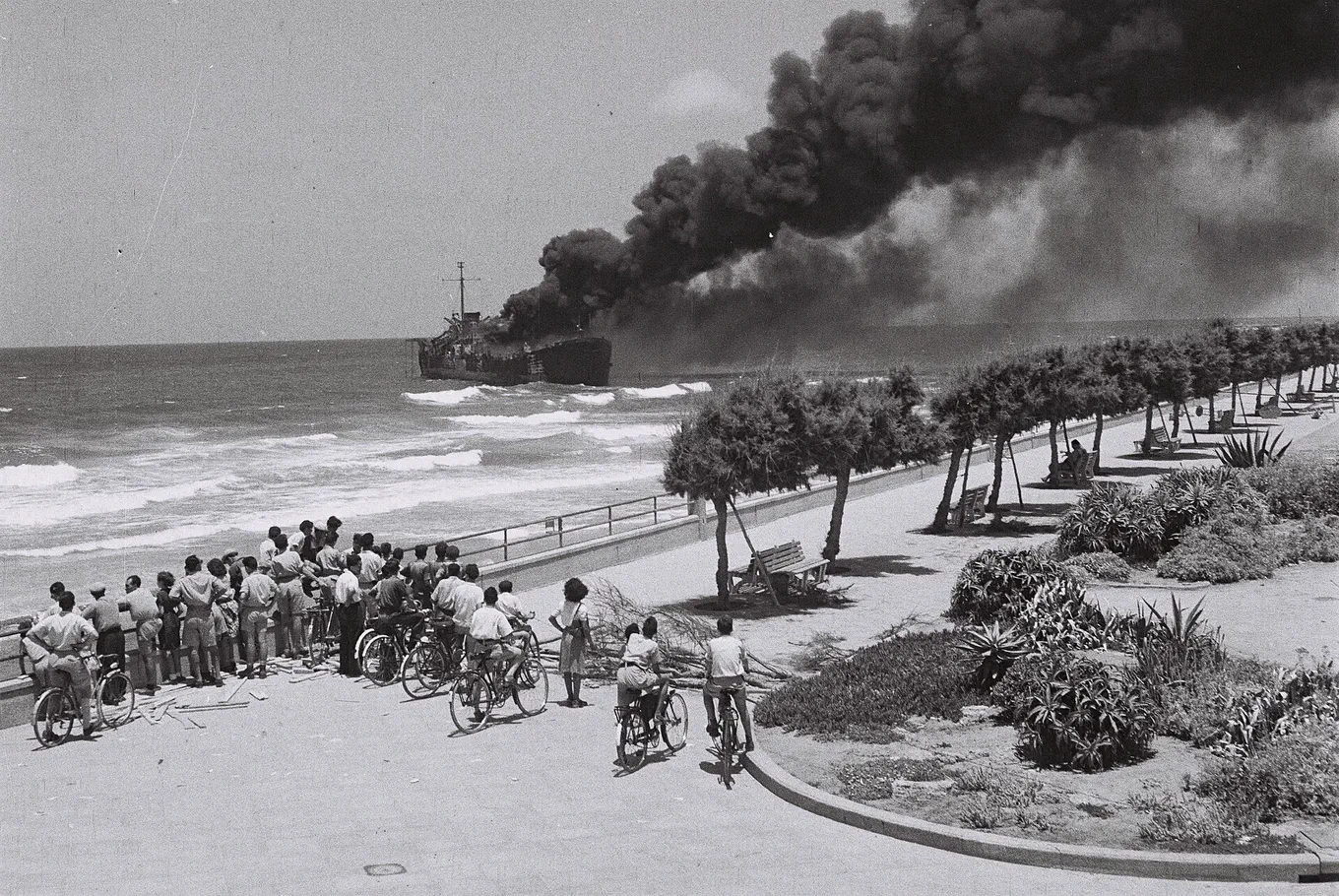
The Altalena burning after it was shelled, off the beach at Tel Aviv in June 1948.Hans Pinn / Public domain.
Years before he shared the Nobel Peace Prize, Menachem Begin led the Irgun, a militant group. In June 1948, its ship, the Altalena, ran aground here loaded with weapons and fighters. David Ben-Gurion ordered the new army to seize it, then shell it. Begin reached the ship by rowboat under fire and told his men not to shoot back. A shell set it burning, and he stayed aboard until the last of the wounded were off. “My greatest accomplishment,” he said later, “was not retaliating and causing civil war.”
5 Yitzhak Rabin and the Song for Peace below City Hall
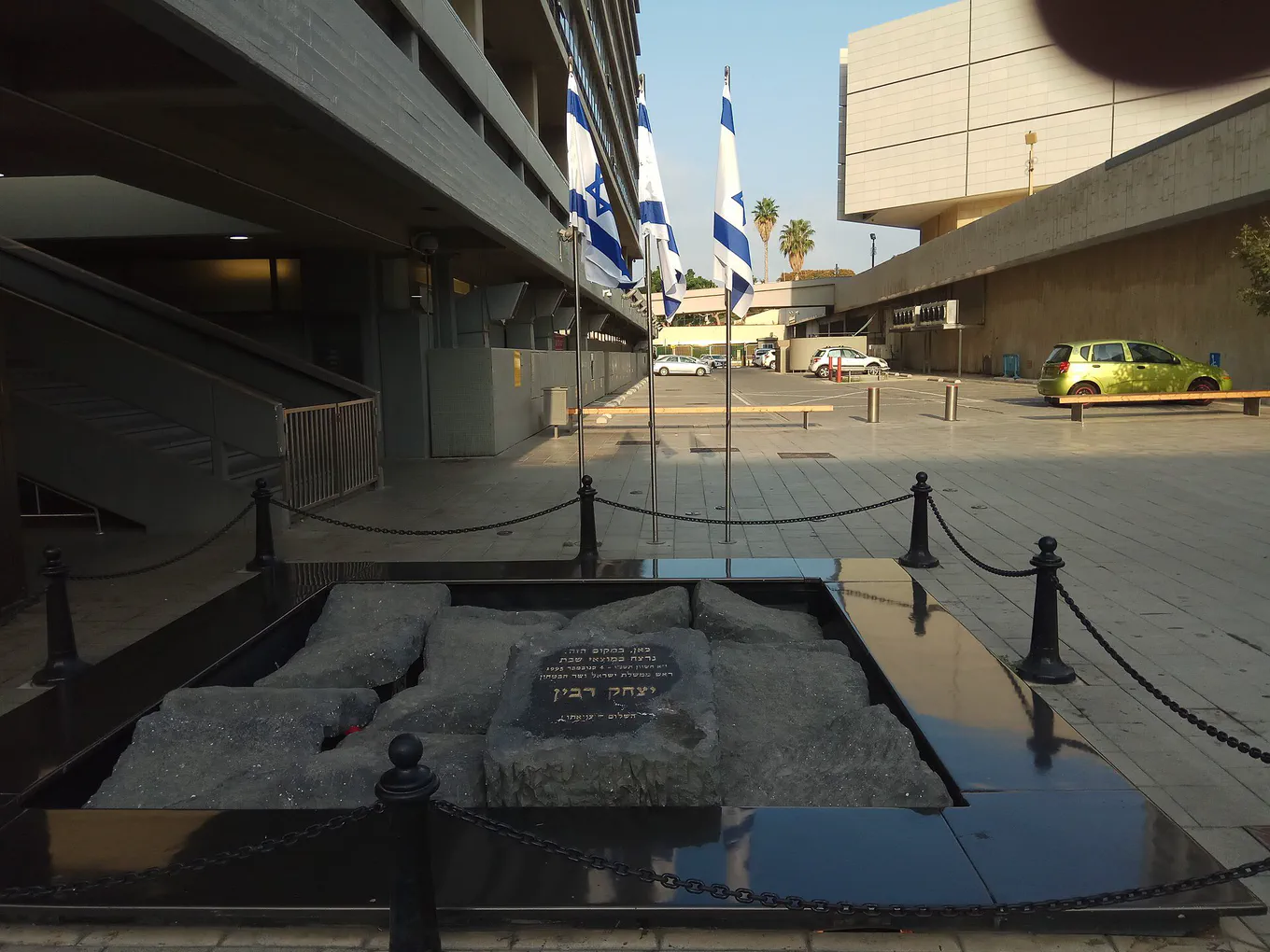
Stand here. The northeast corner of Rabin Square, below City Hall. A memorial marks the spot, and a stretch of the mourners’ graffiti has been preserved.
On 4 November 1995, more than 100,000 people rallied here in support of the Oslo Accords, and Prime Minister Yitzhak Rabin spoke. He told them he had always believed most people want peace and will take a risk for it. The rally ended with Shir LaShalom, the Song for Peace, and Rabin joined in. He walked down the City Hall steps, and as he got into his car, a far-right law student shot him twice. He died in hospital. In his pocket was the lyric sheet, stained with his blood.
Pack nothing. Leave Friday.
Every Friday, I write a free letter, Journey, that takes us on a trip through places, stories, and ideas.
Tel Aviv Noir(edited by Etgar Keret and Assaf Gavron, 2014). Short stories, each set in a different part of the city, from Rabin Square and Rothschild Boulevard to Florentin.
Café Nevo(Barbara Rogan, 1987). A novel. Its café on Dizengoff Street was modelled on the real Café Kassit, which stood on the same street.
The Book of Disappearance(Ibtisam Azem, 2014). A novel. Ariel Levy, the Israeli neighbour of Alaa Assaf, a Palestinian man living in Jaffa in Tel Aviv, reads Alaa’s diary after all Palestinian Arabs vanish from Israel.
Films to watch before you visit Tel Aviv
Kazablan(Menachem Golan, 1973). A film. New and old immigrants live together in a run-down housing complex in Jaffa.
Dizengoff 99(1979). A film, now an Israeli cult classic, about life around Dizengoff Street and how it changed over the years.
Lemon Popsicle(Boaz Davidson, 1978). A teen comedy-drama film. Three teenage boys in Tel Aviv study at the Shalva Gymnasium high school and pass the time at the Montana Ice Cream Shop.
Questions
Can you visit Independence Hall in Tel Aviv?
Independence Hall, at 16 Rothschild Boulevard, is a museum of the Declaration of Independence and of Tel Aviv’s history. The monument to the city’s founders stands across from it.
Why is it called Tel Aviv?
The name means roughly “tell of spring”. A tell is a mound built up over centuries, layer upon layer, by people living on the same spot, and aviv means spring. Nahum Sokolow used the name for his Hebrew translation of Theodor Herzl’s novel Altneuland, and the new town chose it in 1910.
What is Tel Aviv’s White City?
It is more than 4,000 buildings from the 1930s in the International Style, commonly known as Bauhaus. They were built by German Jewish architects who fled to British-ruled Palestine after the Nazis came to power. In 2003, UNESCO named Tel Aviv a World Heritage Site for its modern architecture.