We visited the Vatican on a day that the Sistine Chapel was closed for cleaning. I hated that at the time, but there’s a LOT to see in the Vatican… and I saw more of it because I didn’t fight through the crowds to get a photo of the thing that everyone takes a photo of. (There’s a lesson there.)
— Nick
Vatican City is the world’s smallest country by area, an enclave inside Rome with the pope as its head of state. The Lateran Treaty made it a state in 1929. Its stories here are a papal official painted into Hell, the Swiss Guard’s last stand, a hammer taken to the Pietà, a Hollywood film shut out of the Vatican, and a pope shot in his own square.
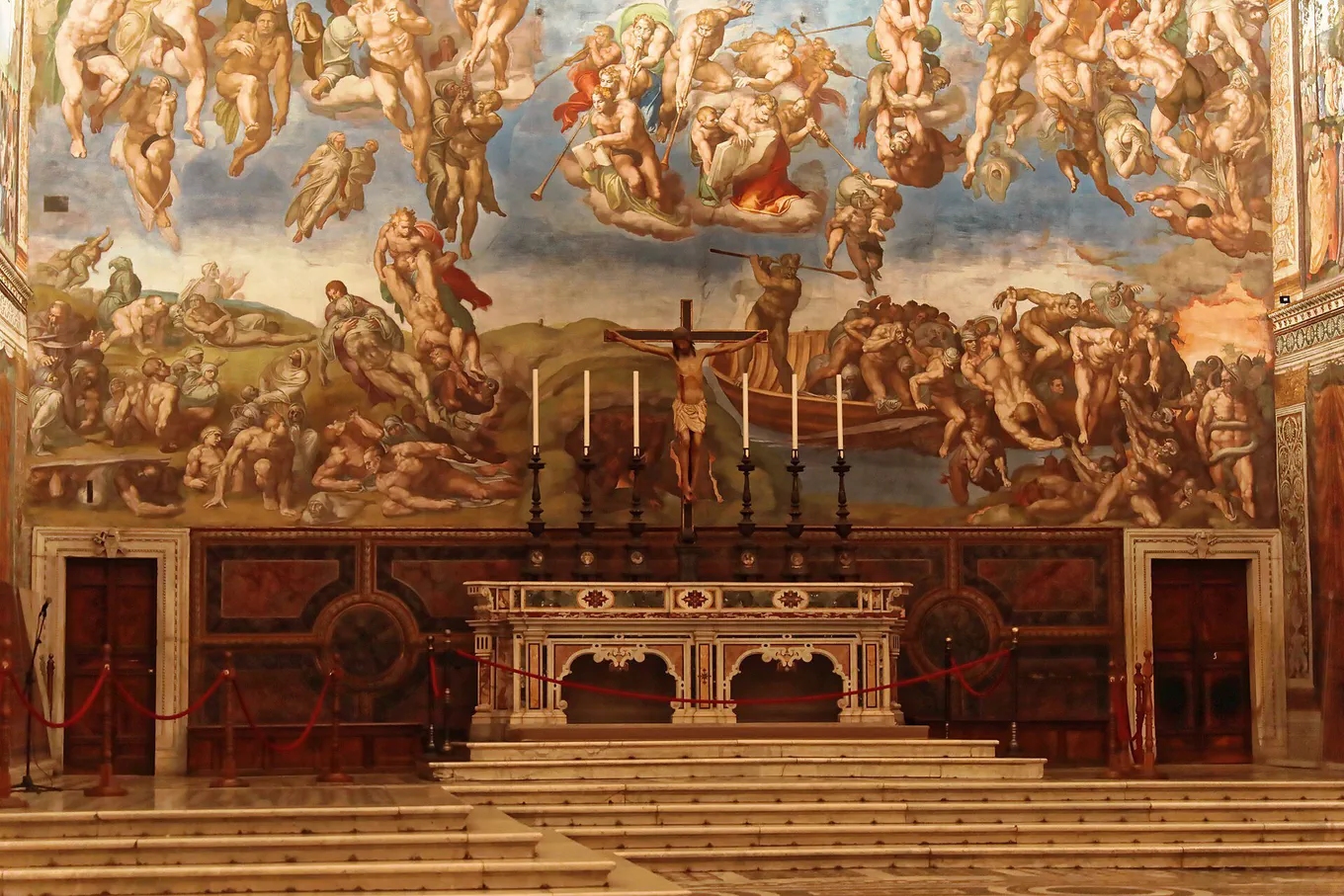
Before Michelangelo finished the Last Judgment in 1541, Paul III’s Master of Ceremonies, Biagio da Cesena, saw it on a preview visit with the pope. Biagio, as Vasari reports, called all those nudes disgraceful in so sacred a place, fit for baths and taverns. Michelangelo gave Minos, judge of the underworld, Biagio’s face, donkey’s ears, and a snake coiled over his nakedness. Biagio complained to the pope, who, the story goes, said his jurisdiction did not reach Hell. So Biagio is in Hell to this day.
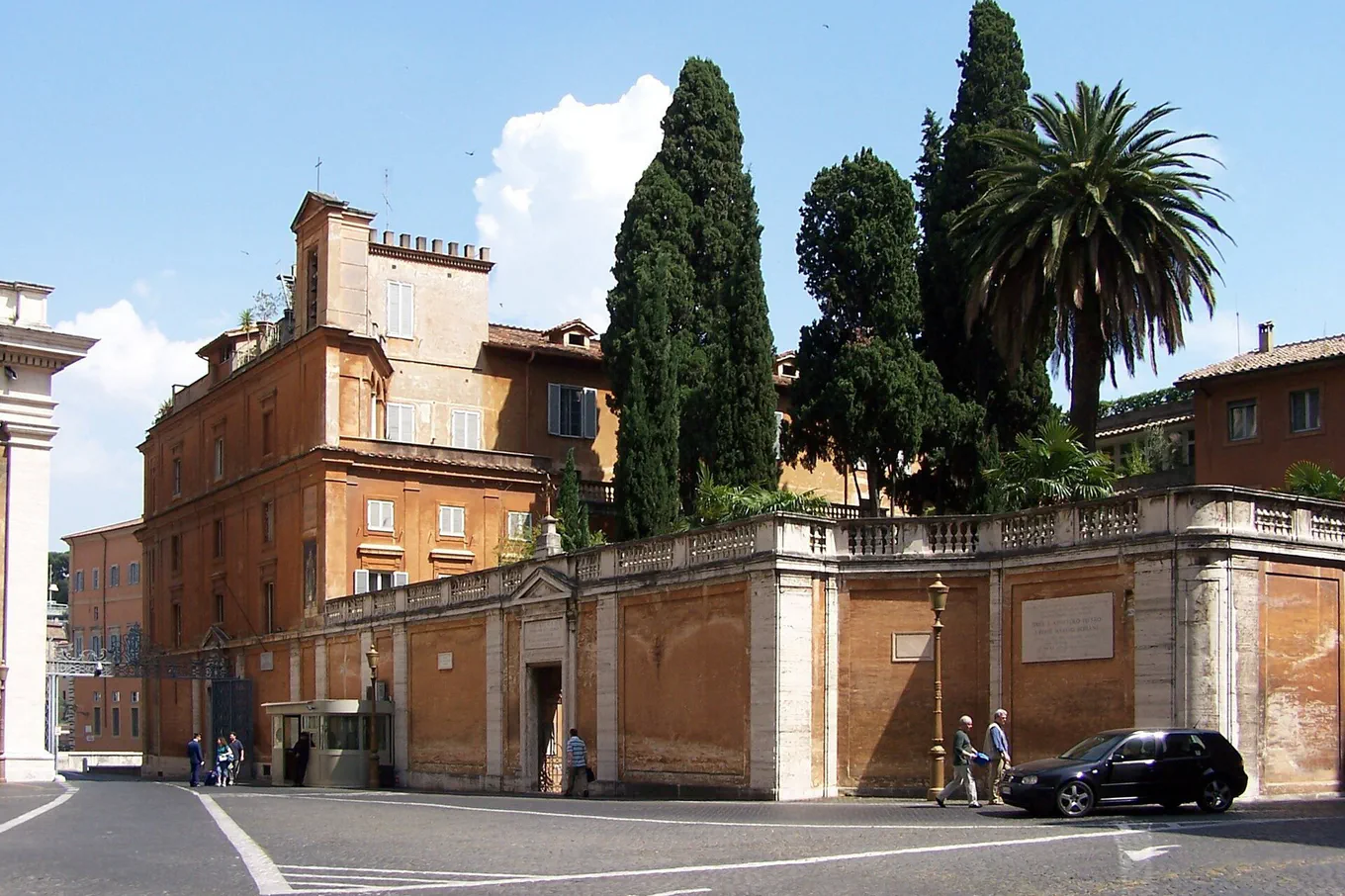
2 The Swiss Guard’s last stand beside St Peter’s, 1527
Stand here. The south side of St Peter’s Basilica, where the Guard made its last stand. The Guard, founded in 1506, is still in service, among the oldest military units in continuous operation.
The Piazza dei Protomartiri Romani and the Campo Santo Teutonico, on the south side of St Peter’s Basilica.Berthold Werner / Public domain.
When the mutinous troops of the Holy Roman Emperor Charles V captured Rome on 6 May 1527, the pope’s Swiss Guard had 189 men. Of those, 147 died fighting on the south side of St Peter’s so that Pope Clement VII could escape. The other 42 escorted him along the Passetto di Borgo, a raised passage to Castel Sant’Angelo, where he took refuge. Every new Guard is still sworn in on 6 May, the anniversary of the Sack of Rome.
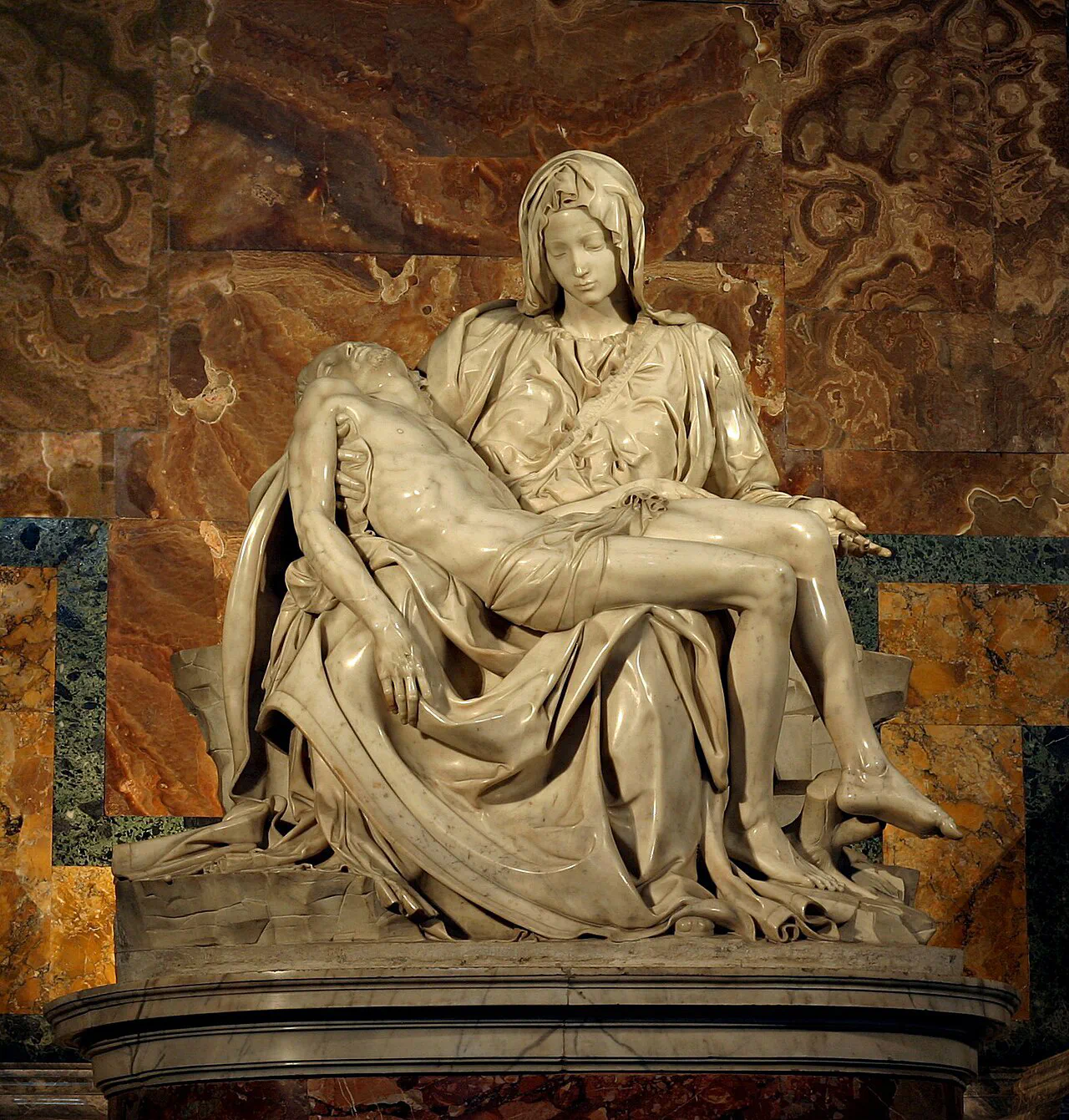
3 The hammer attack on Michelangelo’s Pietà in St Peter’s
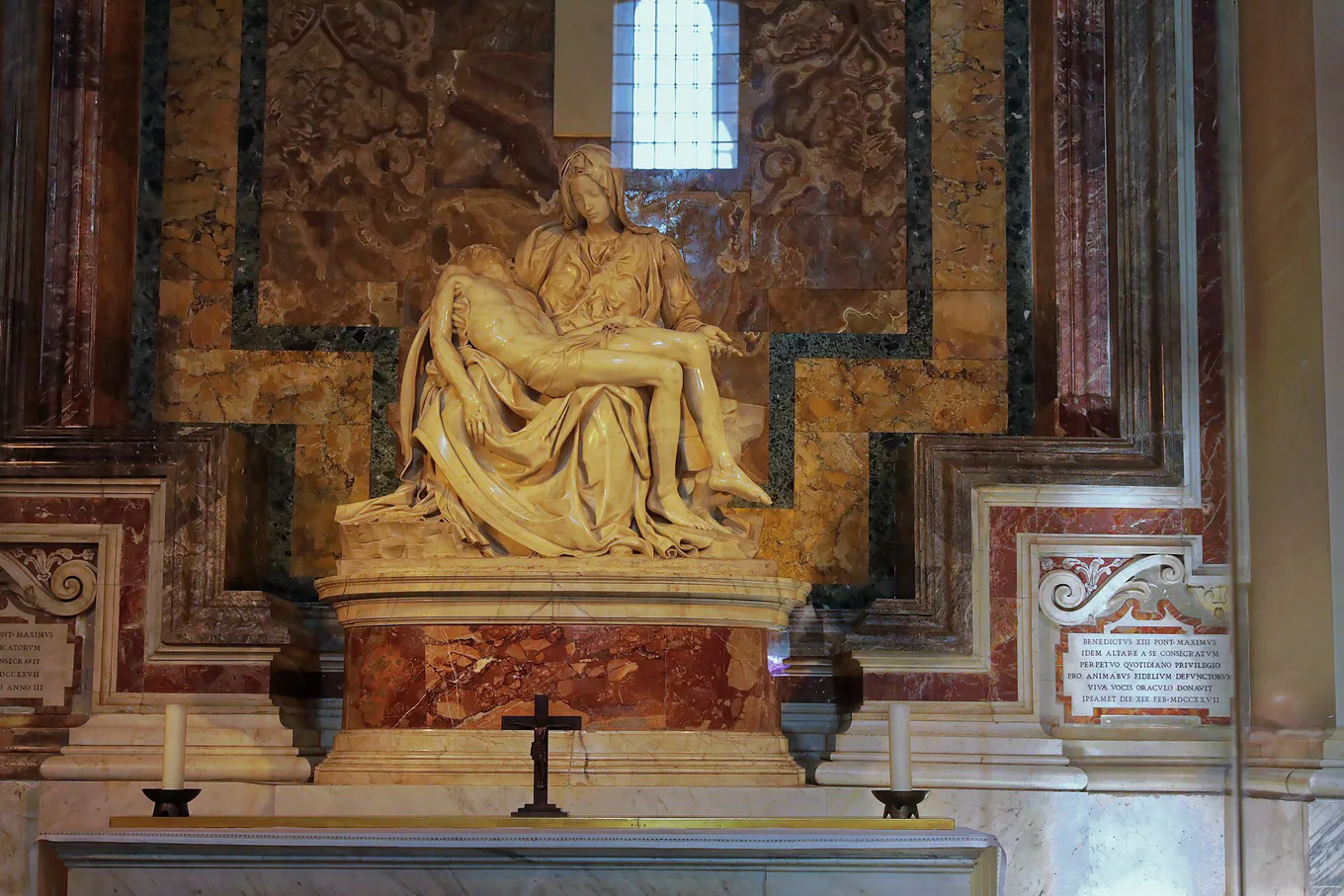
Stand here. Inside St Peter’s Basilica, just to the right of the entrance. The Pietà stands behind bulletproof glass, renewed in November 2024.
On Pentecost Sunday 1972, a geologist walked up to Michelangelo’s Pietà, the only work the sculptor ever signed, shouting that he was Jesus Christ. With fifteen hammer blows, he took off Mary’s arm at the elbow, knocked away part of her nose, and chipped an eyelid. The attacker was confined to a mental hospital. Restorers spent five months identifying over 100 fragments, and ten months after the attack the Pietà was back on show, behind glass. Mary’s nose was rebuilt from a block cut out of her own back.
4 How Angels & Demons rebuilt St Peter’s Square on a backlot
Stand here. St Peter’s Square. The film’s version was a set, built on a studio backlot.
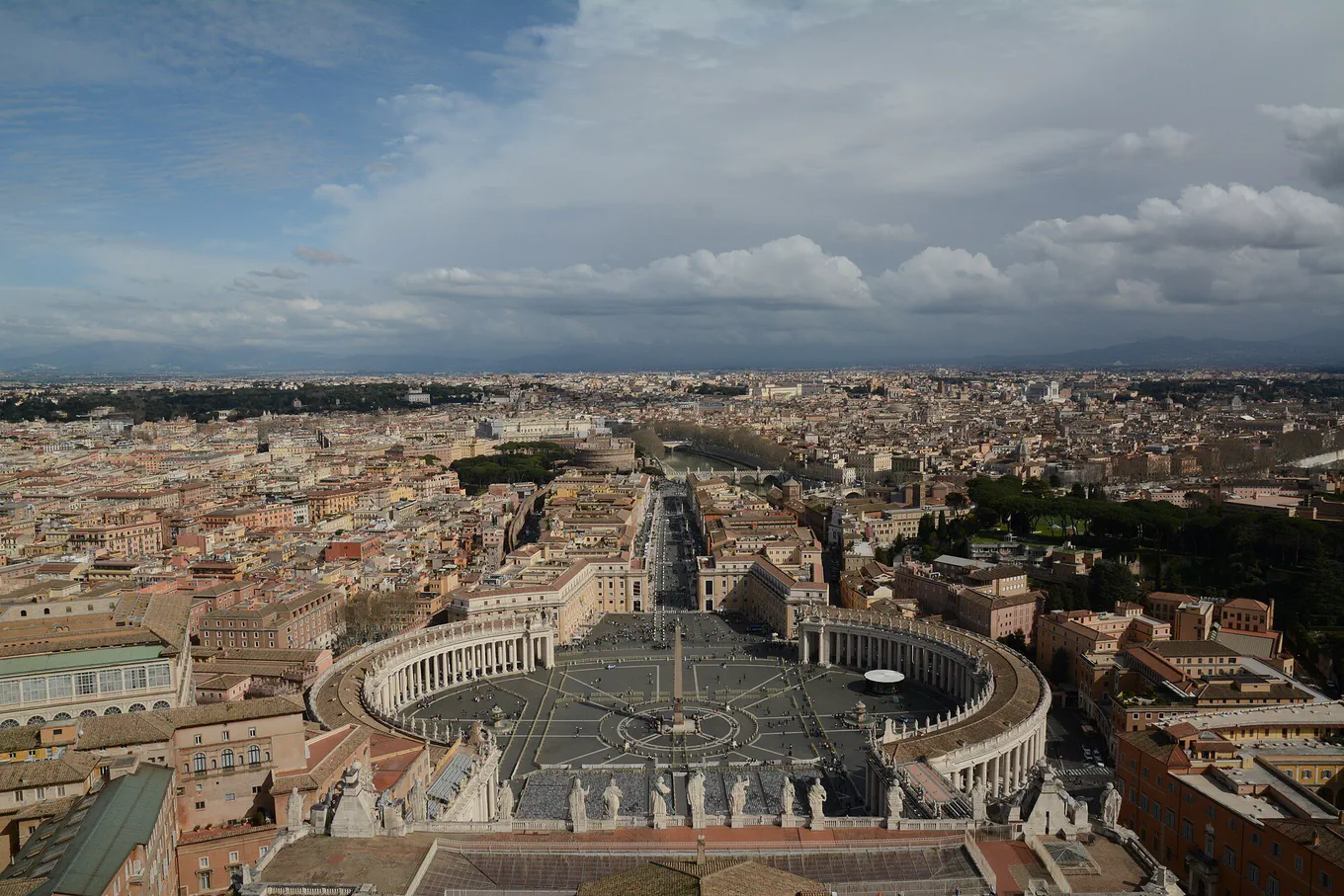
St Peter’s Square seen from the dome of St Peter’s Basilica, with Bernini’s colonnades and the obelisk.C1815 / CC0.
Ron Howard began shooting Dan Brown’s Angels & Demons, with Tom Hanks as Robert Langdon, in Rome in June 2008. Vatican officials and Rome’s parish priests banned filming in the Vatican and any church in Rome. A spokesman for the diocese said they normally read the script, but this time “the name Dan Brown was enough.” The film’s St Peter’s Square was built as a set on a backlot. Twenty crew members, posing as members of the public, photographed what they could of the Sistine Chapel, which was rebuilt full size.
5 John Paul II, shot in St Peter’s Square, and Fátima’s crown
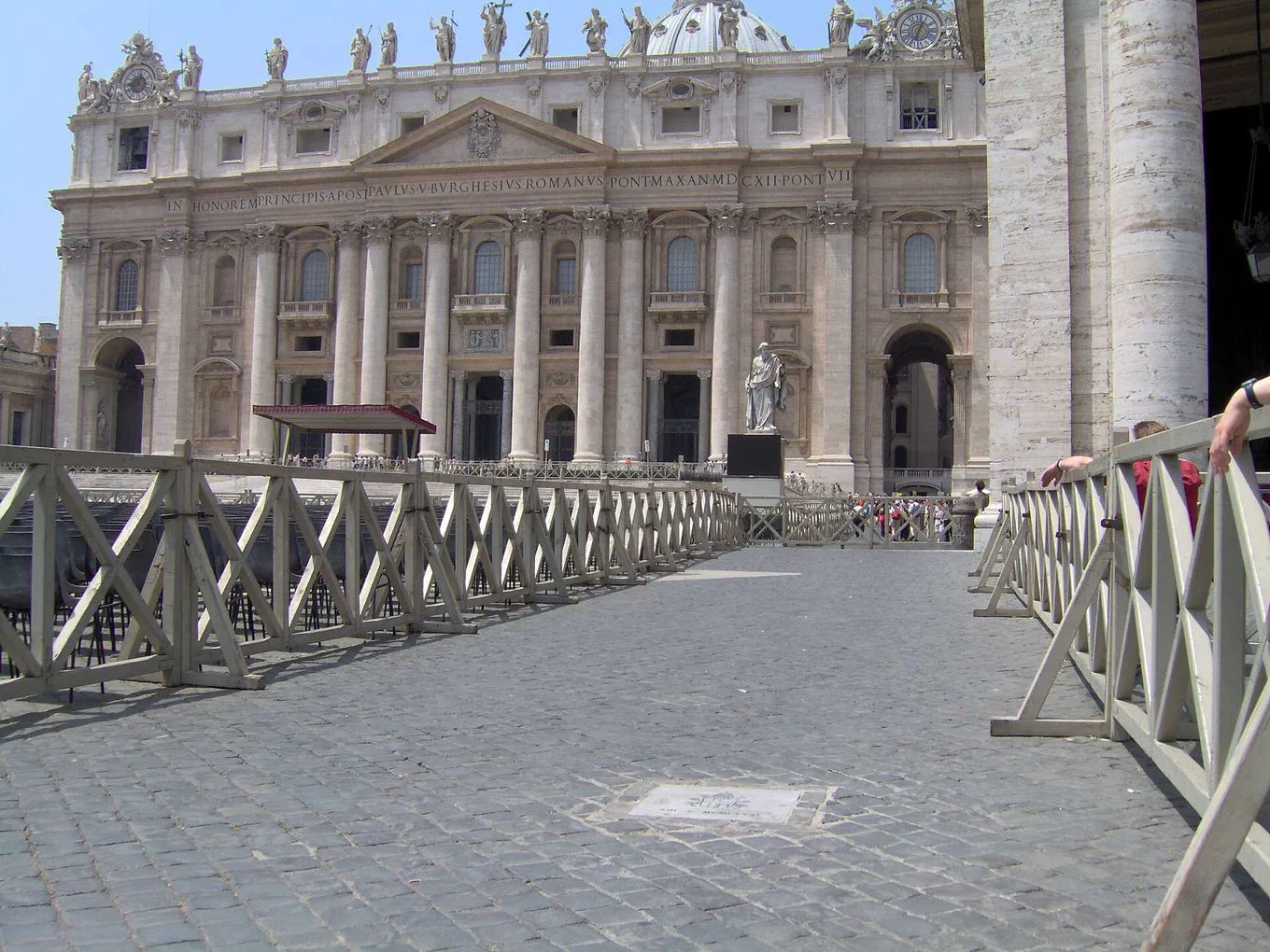
Stand here. St Peter’s Square. A small marble tablet bearing John Paul II’s coat of arms and the date in Roman numerals marks the approximate spot.
The spot in St Peter’s Square where John Paul II was shot in 1981, in front of the basilica’s façade.ProhibitOnions / Public domain.
Pope John Paul II was entering St Peter’s Square on 13 May 1981 when Mehmet Ali Ağca fired four shots at him. Two hit him, one narrowly missing his vital organs. The pope later visited Ağca in Rome’s Rebibbia Prison and forgave him, and Ağca was eventually pardoned at the pope’s request. John Paul always said the “maternal hand” of Our Lady had turned the bullet aside. He gave that bullet to the shrine at Fátima, and it was set into the crown of her statue.
Angels & Demons(Dan Brown, 2000). A novel. Robert Langdon comes to Vatican City as four cardinals tipped to be pope are kidnapped, and a canister is found on Saint Peter’s tomb.
Conclave(Robert Harris, 2016). A novel. The pope dies in his sleep at the Casa Santa Marta, and the cardinals vote for his successor in the Sistine Chapel.
Michelangelo and the Pope’s Ceiling(Ross King, 2002). A history of how Pope Julius II commissioned Michelangelo to paint the ceiling of the newly restored Sistine Chapel.
Films to watch before you visit Vatican City
The Two Popes(Fernando Meirelles, 2019). A film. Pope Benedict meets Cardinal Bergoglio in the Room of Tears in the Sistine Chapel, rebuilt full size at the Cinecittà studios in Rome.
Conclave(Edward Berger, 2024). A film. Its set designers took great care to replicate the Sistine Chapel, but took some artistic licence with the Casa Santa Marta.
The Agony and the Ecstasy(Carol Reed, 1965). A film. Michelangelo clashes with Pope Julius II while painting the Sistine Chapel ceiling, recreated on a sound stage at Cinecittà.
The Shoes of the Fisherman(Michael Anderson, 1968). A film. A new pope is chosen by acclamation in the Sistine Chapel, recreated after the Vatican gave no permission to film there.
Questions
Where is Michelangelo’s Pietà, and can you see it?
Yes. The Pietà is in St Peter’s Basilica, just to the right of the entrance, between the Holy Door and the altar of Saint Sebastian. Since the 1972 hammer attack, it has stood behind bulletproof glass, and the screen was renewed in November 2024.
Can you take photos in the Sistine Chapel?
No. Photographs and filming of any kind are forbidden in the Sistine Chapel, and so are mobile phones. Visitors are asked to keep absolute silence. Elsewhere in the Vatican Museums you can take photographs, but never with a flash.
How small is Vatican City?
Vatican City covers 44 hectares, about 0.49 square kilometres, and has about 882 residents. That makes it the smallest country in the world by area and the least populous. It is an enclave inside Rome, made a state by the Lateran Treaty in 1929.